Freelance Growth Marketers in IslamabadFreelance Growth Marketers in Islamabad
Web Developer | UI/UX| 3D Product Animation |
14
Followers
Web Developer | UI/UX| 3D Product Animation |

Cover image for 🖤 Velaro — Technical Architecture
🔗
🖤 Velaro — Technical Architecture 🔗 Live Website https://saif-velaro-clothing-brand.netlify.app 📌 Overview Velaro is a single-page application (SPA) for a fashion/clothing brand, built with React + TypeScript, bundled by Vite, and styled with Tailwind CSS. The entire UI renders on one HTML page and updates dynamically as the user scrolls, searches, or interacts with the cart — no full page reloads. The architecture follows a standard modern frontend pattern: a single entry point boots the app, a root App component composes independent section components, and a global context manages shared state (the shopping cart) across all of them. ⚙️ Build & Tooling Layer These files configure how the project compiles, lints, and runs — they aren't part of the visible website, but control everything behind it. vite.config.ts — Configures Vite, the build tool/dev server. Defines how .tsx/.ts files are compiled, how the dev server runs (npm run dev), and how the production bundle is generated (npm run build). tsconfig.json — Root TypeScript config — points to the two more specific configs below via project references. tsconfig.app (http://tsconfig.app).json — TypeScript rules specifically for the application code in src/ (JSX handling, module resolution, strictness, the @/ path alias). tsconfig.node.json — TypeScript rules for Node-context files (like vite.config.ts itself), since those run outside the browser. tailwind.config.js — Configures Tailwind CSS — defines the design system (colors, spacing, fonts) and which files Tailwind scans to generate only the CSS classes actually used. postcss.config.js — Configures PostCSS, the tool that processes Tailwind's output and applies vendor prefixing/optimization during build. eslint.config.js — Defines linting rules — catches code-quality issues, unused variables, and React/TypeScript best-practice violations during development. package.json — Lists all dependencies (React, Vite, Tailwind, etc.) and defines the npm scripts (dev, build, preview). package-lock.json — Locks exact dependency versions so the build is reproducible across machines. .gitignore — Tells Git which files/folders to exclude from version control (e.g. node_modules, dist). index.html — The single real HTML file. Contains a root <div> that React mounts into — everything else is injected by JavaScript. dist/ — Auto-generated production build output (plain HTML/CSS/JS) created by npm run build. This is the folder actually deployed to Netlify. node_modules/ — Auto-generated folder holding all installed dependencies (created by npm install, never edited manually). 🚪 Application Entry & Root src/main.tsx — The true entry point of the app. Imports React, imports App.tsx, and mounts it into the <div> inside index.html. This is the first application code that runs. src/App.tsx — The root component. Doesn't contain page content itself — instead it imports and arranges every section component (Navbar, Hero, About, etc.) in order, and wraps everything in the CartProvider so cart state is available app-wide. src/index.css — Global stylesheet — imports Tailwind's base/utility layers, applied once at the root so every component can use Tailwind classes. src/vite-env.d.ts — TypeScript type declarations for Vite-specific features (like importing images/CSS as modules) — lets TypeScript understand syntax that isn't standard JavaScript. 🛒 State Management src/cart.tsx — Implements the CartProvider, a React Context that holds global cart state (items, quantities, totals) and exposes functions to add/remove items. Any component wrapped inside it (via App.tsx) can read or update the cart without prop-drilling. src/data.ts — Static data module — likely product listings, collection info, or other content consumed by components like FeaturedCollection and Showcase, kept separate from UI logic. 🧱 Component Layer (src/components/) Each file is a self-contained, single-responsibility UI section. App.tsx stacks them vertically to form the full page. Navbar.tsx — Persistent top navigation — branding, menu links, and likely triggers for search/cart. Hero.tsx — The primary landing banner — headline, tagline, and call-to-action (e.g. "Shop Collection"). HeroCanvas.tsx — A visual/animated layer paired with Hero.tsx — likely a canvas-based or decorative background effect behind the hero text. FeaturedCollection.tsx — Renders a curated set of products, pulling structured data from data.ts. About.tsx — Brand-story section — static content describing the label's identity. Lookbook.tsx — A style/editorial gallery — visually presents outfits or campaign imagery. Showcase.tsx — An additional highlight section, likely for a specific collection, drop, or promotional content. Testimonials.tsx — Displays customer reviews/social proof. Newsletter.tsx — Email capture form/section for marketing signups. SearchOverlay.tsx — A modal/overlay component for in-site product search, toggled from the Navbar. CartDrawer.tsx — A slide-out panel UI that reads from the CartProvider (cart.tsx) to display current cart items and totals. Footer.tsx — Bottom-of-page section — links, contact details, social icons. 🔄 How It All Connects (Data Flow) The browser loads index.html, which pulls in the compiled JS bundle. main.tsx runs first and mounts App.tsx into the page. App.tsx wraps all sections in CartProvider, so cart state is shared without passing props down manually through every component. Each section component renders independently — some are purely static/presentational (About, Footer), while others are interactive and tied into shared state (CartDrawer, SearchOverlay). Tailwind classes used throughout every component are compiled once into index.css based on what's scanned via tailwind.config.js. On npm run build, Vite compiles and bundles all of this into optimized static files inside dist/ — which is what gets deployed to Netlify and served to visitors. 🧠 Why This Structure Works Separation of concerns — each component owns one visual section; layout composition happens only in App.tsx. Centralized state — cart logic lives in one file (cart.tsx) instead of being duplicated across components. Data/UI separation — data.ts keeps content separate from rendering logic, making it easy to update products without touching component code. Type safety — TypeScript configs enforce consistent typing across the whole src/ folder, catching errors before runtime. Optimized output — the dev-only tooling (Vite, Tailwind, ESLint, TS configs) never ships to production; only the final compiled dist/ bundle is deployed.
0
78
Cover image for StreamPro — Brand Website for
StreamPro — Brand Website for a Live Event Broadcasting Studio Live Website: saif-stream-pro-website.netlify.app (http://saif-stream-pro-website.netlify.app) What I built😍 A fully responsive, mobile and web based single-page marketing website for StreamPro, a Brisbane-based live-streaming production studio that broadcasts memorial services, weddings, sports events, and community occasions. The site was designed and developed from scratch to establish a premium, trustworthy brand presence and convert visitors into booking inquiries — working seamlessly whether accessed from a phone, tablet, or desktop. What it does🙌 The website guides visitors through a structured narrative — introducing the brand, building credibility, showcasing services, explaining the booking process, displaying social proof, and closing with a direct contact/quote form. It's built to load fast, adapt fluidly across mobile and web based environments, and feel as polished and reliable as the broadcast service it's selling. Core concepts & techniques applied💯 Semantic document structure — content organized into meaningful, accessible sections rather than generic divs, improving both SEO and screen-reader usability. Design system / design tokens — a centralized set of reusable variables (colors, gradients, typography, spacing) so the entire visual identity stays consistent and can be updated globally from one place. Responsive, mobile-first layout design — fluid grids and breakpoints so the layout adapts smoothly across mobile and web based screens without needing separate versions. Scroll-based interactivity — dynamic navbar states, scrollspy navigation (highlighting the active section as the user scrolls), and progressive scroll-reveal animations for content. DOM manipulation & event handling — mobile menu toggling, animated statistic counters, and form interaction logic, all built with vanilla JavaScript (no frameworks). Accessibility considerations — visible focus states, reduced-motion support for users sensitive to animation, and descriptive alt text on all imagery. Brand identity integration — a custom 3D gradient logo mark and supporting visual graphics applied consistently across the navigation, hero section, and footer to reinforce brand recognition. Conversion-focused UX — strategic placement of trust signals (stats, testimonials, direct phone contact) and a structured lead-capture form to turn visitors into inquiries. Outcome🚀 A performant, framework-free static website that's lightweight, cheap to host, easy to maintain, fully mobile and web based responsive, and built entirely around fundamental web development principles — structure, styling systems, interactivity, accessibility, and conversion design.
0
163
WordPress and Web designer with AI automation expert and SEO
New to Contra
WordPress and Web designer with AI automation expert and SEO
Growth Marketer with Analytics Expertise
SEO Specialist | SEO Writer | Ranking Brands Higher
New to Contra
SEO Specialist | SEO Writer | Ranking Brands Higher
Cover image for Off-Page SEO
Broken Link Building, Toxic
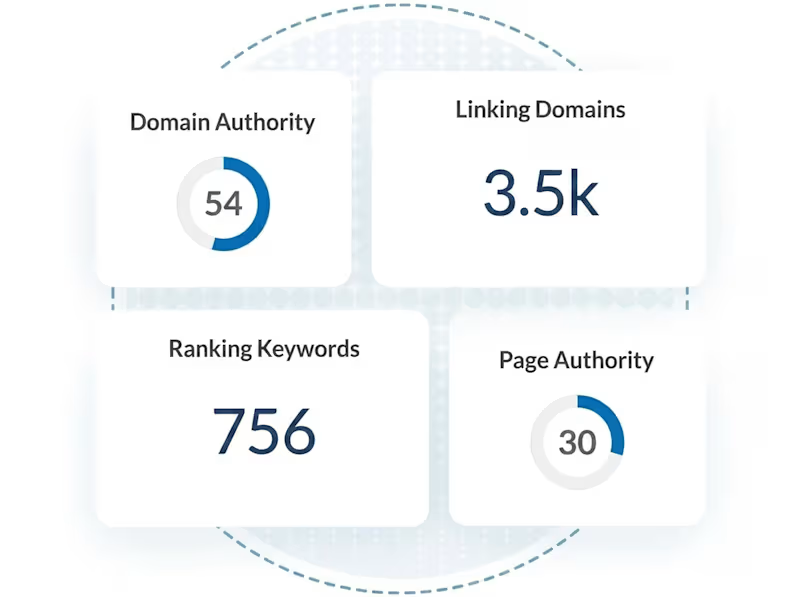
Off-Page SEO Broken Link Building, Toxic Backlink Cleanup & White-Hat Authority Campaign 🔴 The Problem An established eCommerce brand in the home décor industry had been operating for over 4 years and had accumulated 4,800+ backlinks from previous SEO and marketing efforts. While the backlink profile looked strong on paper, a significant portion consisted of low-quality, irrelevant, and spammy links that were weakening the site's authority. At the same time, a brand mention audit uncovered 63 unlinked mentions across blogs, news articles, and resource pages that were providing no SEO value. The website also lacked a consistent white-hat link acquisition strategy, allowing competitors with cleaner backlink profiles to outrank it for valuable commercial keywords. ⚠️ The Impact The high volume of toxic backlinks was suppressing the website's authority and limiting ranking potential. Valuable brand mentions were going unclaimed, and the absence of ongoing authority building meant organic growth had plateaued despite a well-optimized website and quality products. ✅ What I Did Conducted a complete backlink audit using Ahrefs and SEMrush to evaluate over 4,800 backlinks. Identified and removed or disavowed 1,900+ toxic and spammy backlinks, significantly reducing the website's spam score. Created and submitted a Google Disavow file for harmful links that couldn't be removed manually. Performed a web-wide brand mention audit and identified 63 unlinked mentions. Successfully converted 22 unlinked brand mentions into followed backlinks through targeted outreach. Executed a diversified white-hat link building campaign, including: Guest Post Backlinks Broken Link Building Forum Backlinks Profile Backlinks Niche Directory & Citation Backlinks Contextual Editorial Backlinks Resource Page Link Building Earned 200+ high-quality backlinks from relevant and authoritative websites. Maintained a natural backlink profile through diversified anchor text and steady link acquisition. 📈 The Results 1,900+ toxic backlinks removed or disavowed, significantly reducing the website's spam score. 22 unlinked brand mentions converted into followed backlinks. 200+ new white-hat backlinks acquired from authoritative websites. Domain Authority increased to 54 during the campaign. Multiple high-value commercial keywords reached Google's first page. Organic visibility and keyword rankings improved substantially across key product categories. Organic traffic increased steadily as backlink quality, authority, and trust signals strengthened.
0
22
Cover image for Niche Guest Posting Campaign —
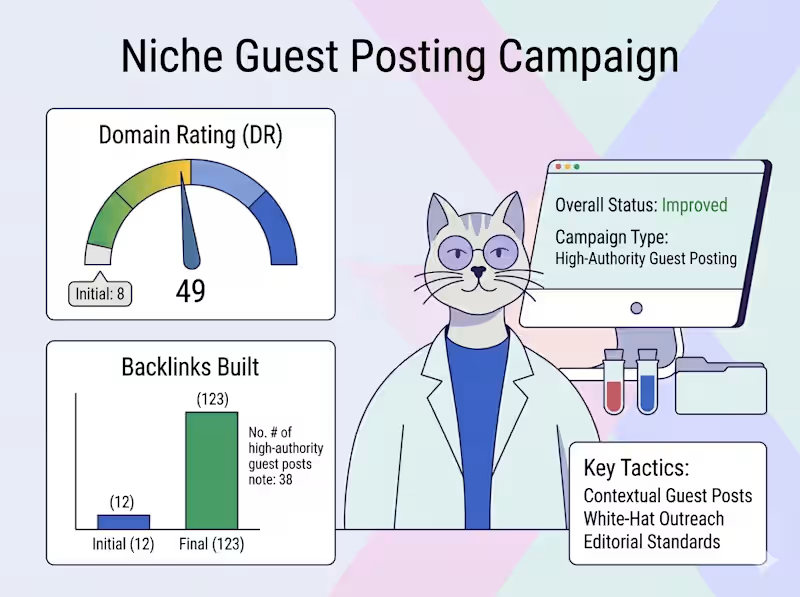
Niche Guest Posting Campaign — 108 High-Authority Backlinks Built in 60 Days 🔴 The Problem A digital marketing agency had strong on-page SEO and quality service pages but a critically weak backlink profile, only 12 referring domains, all low authority, several spammy. Their Domain Rating was sitting at 8 while every competitor ranking above them had Domain Ratings between 28 and 45. They had never run a structured link building campaign and had no existing relationships with any publications or blogs in their niche. ⚠️ The Impact Despite excellent on-page optimization and a clean technical foundation, the agency could not break past page 2 for any of their primary target keywords. Every competitor outranking them had significantly stronger domain authority, not better content, not better optimization, just more and stronger backlinks. The authority gap was the single factor preventing rankings from improving regardless of what else was optimized on the site. ✅ What I Did Conducted a full competitor backlink analysis across the top 5 ranking competitors, identified 440 high-value domains linking to competitors but not to the client Built a targeted outreach list of 110 relevant blogs, marketing publications, and industry resource pages meeting strict quality thresholds,  minimum DR 30, real organic traffic, genuine editorial standards Pitched and placed 38 guest posts on marketing, SEO, and business publications over 60 days Each guest post was 900–1400 words of genuine, original content written specifically for each publication's audience — not spun or templated content Anchor text distribution kept natural — branded, partial match, and naked URL anchors balanced to avoid over-optimization signals Executed a diversified white-hat link building campaign, including: Guest Post Backlinks Broken Link Building Forum Backlinks Profile Backlinks Niche Directory & Citation Backlinks Contextual Editorial Backlinks Resource Page Link Building 📈 The Results Domain Rating increased from 8 to 49 within 90 days of campaign launch Referring domains grew from 12 to 123 — all editorially placed, all relevant, zero toxic Primary target keywords moved from position 24 to position 3 within 25 days of first links indexing 11 secondary keywords entered page 1 rankings for the first time Organic traffic grew by 270% quarter over quarter as the authority increase lifted rankings across multiple pages simultaneously
0
22
Cover image for On-Page Recovery — Fixing Broken
On-Page Recovery — Fixing Broken Meta Tags, Image Bloat & Schema Errors Killing Rankings 🔴 The Problem A well-written content-heavy blog had strong articles but critical on-page technical failures dragging everything down: Meta titles truncated or missing on 60% of pages Featured images uploaded at 3–5MB each with no compression, wrong format, zero alt text Schema markup existed but was incorrectly implemented — triggering rich snippet errors in Google Search Console No canonical tags on paginated content creating duplicate page issues Image file names were all default camera codes (IMG_4521.jpg etc.) ⚠️ The Impact Despite publishing 3+ articles per week for 8 months, organic traffic had flatlined completely. Google Search Console was showing 23 schema errors and 14 warnings across the site. Page speed score on mobile was 31 out of 100 — firmly in the red zone. Images were the single biggest performance bottleneck. Articles that deserved featured snippets were not triggering them because of broken structured data. The writer was producing excellent content that search engines simply could not properly read or reward. ✅ What I Did Audited and rewrote all meta titles and descriptions — prioritizing pages with highest traffic potential first Compressed entire image library — converted all images to WebP, reduced file sizes by an average of 68% without quality loss Renamed all image files with descriptive keyword-relevant names Wrote descriptive alt text for every image across the entire blog Fixed all 23 schema errors and 14 warnings — corrected Article, FAQPage, and BreadcrumbList markup to pass Google's Rich Results Test cleanly Added canonical tags to all paginated content and category pages to resolve duplicate signals 📈 The Results Mobile PageSpeed score improved from 31 to 87 within 1 week of image optimization All 23 schema errors and 14 warnings cleared in Google Search Console within 30 days 6 articles triggered featured rich snippets within 6 days of schema fixes Average session duration increased by 78% as faster page loads reduced early exits Organic impressions grew by 215% within 40 days as previously suppressed pages gained proper indexing signals
0
24
Cover image for Full On-Page SEO Overhaul —
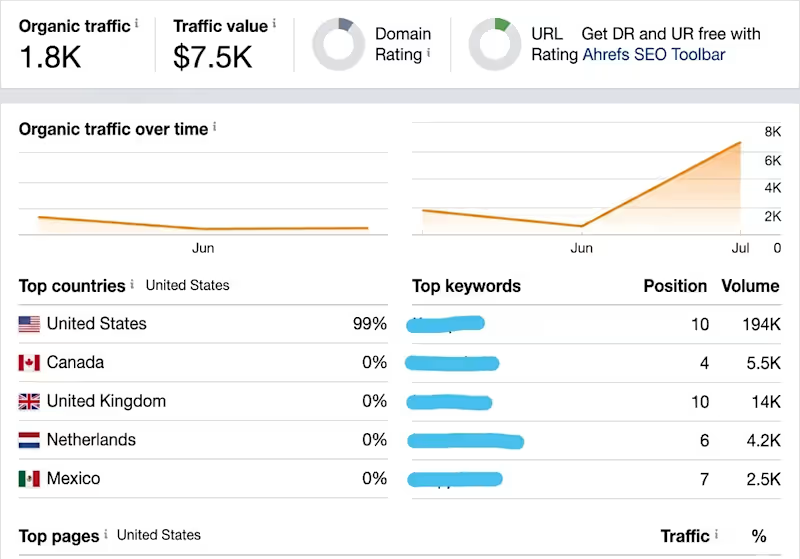
Full On-Page SEO Overhaul — Meta, Content, Schema & Site Structure Optimized 🔴 The Problem A 12-page service business website had been live for over a year with zero on-page optimization implemented. Specifically: Meta titles duplicated across pages, meta descriptions completely missing Multiple H1 tags per page with no heading hierarchy or keyword structure Raw uncompressed images with generic file names and no alt text No internal linking strategy — pages were effectively isolated from each other Messy keyword-stuffed URLs with no structure Zero canonical tags — pages competing against each other No schema markup of any kind implemented ⚠️ The Impact Despite having reasonable content, the site was invisible in search. Most target pages ranked between position 35 and 60. Organic traffic was averaging under 80 visits per month. Page load time was 7.8 seconds on mobile due to uncompressed images alone. No rich results of any kind were appearing in Google. The business was relying entirely on paid ads because organic simply was not working. ✅ What I Did Wrote unique keyword-optimized meta titles and descriptions for all 12 pages within character limits Rebuilt heading structure across every page — one clean H1 per page with supporting H2/H3 keyword hierarchy Compressed and converted all images to WebP, reduced average image size by 74%, renamed files descriptively, wrote alt text for every image Built a full internal linking map with optimized anchor text connecting all key pages Cleaned all URLs — removed stop words, added primary keywords, standardized structure Implemented canonical tags across all pages to consolidate ranking signals Added FAQ, Article, BreadcrumbList, and LocalBusiness schema markup to eligible pages 📈 The Results Page load time dropped from 7.8s to 2.1s on mobile 9 of 12 target pages moved from positions 35–60 to positions 6–18 within 75 days Rich snippets triggered in Google within 40 days of schema implementation Organic CTR improved by 94% from stronger meta titles and descriptions Monthly organic traffic grew from 80 to 1.8k visits within 90 days
0
30
Storytelling Video Editor & Animator

Packaging & Label Designer | Branding & Product Visuals

New to Contra
Packaging & Label Designer | Branding & Product Visuals
Senior Media Buyer Managed $1M+ Ad Spend

New to Contra
Senior Media Buyer Managed $1M+ Ad Spend