
Senior AI Full-Stack Engineer
- $1k+
- Earned
- 3x
- Hired
- 5.0
- Rating
- 6
- Followers
Senior AI Full-Stack Engineer


Aragon AI turns a few selfies into professional headshots in about 30 minutes, and sells team and LinkedIn headshots to businesses alongside an AI editor of 50+ tools. It has generated over 40 million headshots and holds SOC 2 Type II certification. I joined as senior engineering consultant in January 2025, working in Next.js, TypeScript, Node, and GraphQL, and have since shipped 15+ in-product changelog entries and 20+ photo-editor tool configurations. I own checkout reliability across Stripe and Paddle, including a fix for a live idempotency race that was double-charging users. I led the site-wide SEO and GEO overhaul, and built a Notion-based publishing pipeline that cut content release time from 7 days to 2.
2
374

Loveletta is a personalized jewelry brand I built and run for customers across the US. On the technical side, I customized the Shopify theme in Liquid, built the personalization fields so customers can add names and messages that carry through to each order, and set up the product structure, collections and SEO so the store is easy to manage and easy to find. I also run the brand's Instagram, using AI tools to produce the posts, carousels and reels that bring customers to the store.
0
34

Quant Systems Architect
Quant Systems Architect
Why am I building a quantitative trading system?
Because I don't want trading to depend on spending hours staring at charts, making repetitive decisions manually, missing opportunities, or letting emotions and inconsistency affect execution.
For retail and independent traders, the difficult part isn't just finding a strategy.
It's knowing whether the strategy actually works, why it works, and why it fails.
That's what I'm trying to solve with my Quantitative Systems Platform.
Recently, I found a major bottleneck in my research.
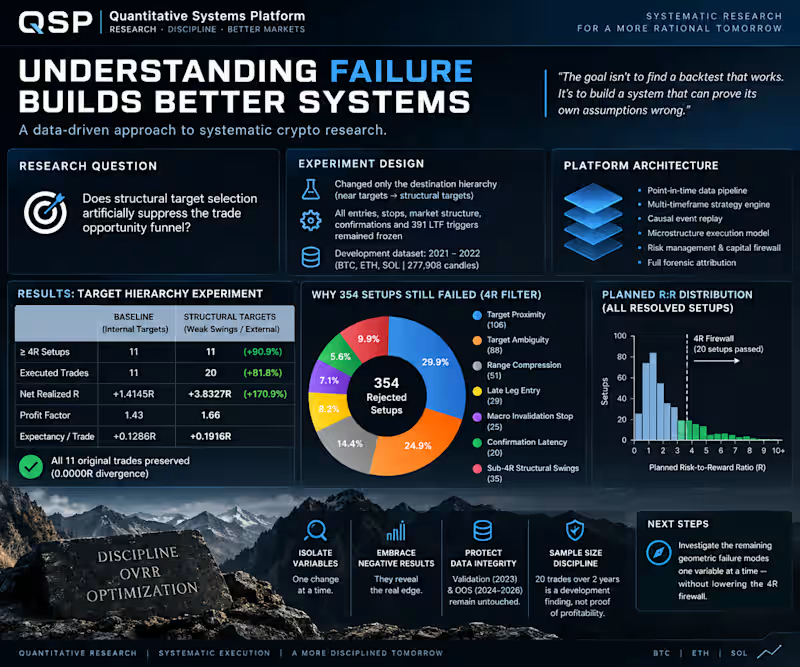
Out of 387 target-resolved setups, only 11 met my ≥4R requirement.
Instead of lowering the requirement to create more trades, I asked:
Was the system choosing the wrong structural target?
I ran a controlled experiment where I changed only the target-selection hierarchy. Entries, stops, market structure, confirmations and the 391 LTF-confirmed triggers stayed frozen.
On the 2021–2022 development dataset:
≥4R setups: 11 → 21
Executed trades: 11 → 20
Net realized: +1.4145R → +3.8327R
Profit Factor: 1.43 → 1.66
All 11 original trades were preserved with 0.0000R divergence.
But the most important part wasn't the improvement.
I investigated the 354 setups that still failed the 4R firewall.
They revealed multiple failure modes:
target proximity, compressed ranges, late entries, wide structural stops, confirmation latency, target ambiguity — and 35 structurally healthy-looking setups that still fell between 1.5R and 3.9R.
So the answer isn't simply:
“Lower 4R.”
The real research problem is understanding the interaction between entry geometry, available expansion, structural risk, confirmation timing and destination selection.
That's why I'm building this platform.
Not to create another black-box trading bot.
I want a system that can tell me:
Why did this trade qualify?
Why did another fail?
Which assumption caused it?
Can I isolate that assumption?
Can I reproduce the result?
Does it survive unseen data?
The long-term objective is straightforward:
Less manual trading. Less inconsistency. More systematic research. More reproducible execution. And eventually, if the evidence earns it, automation.
This experiment is still a development finding, not proof of profitability or production readiness. Validation and out-of-sample data remain protected.
The next step is to investigate the remaining failure modes one variable at a time.
I'm not trying to build a system that only proves itself right.
I'm building one capable of proving itself wrong.
🔗 Project: Quantitative Systems Platform — GitHub (https://github.com/Quantitative-Systems/crypto-platform?utm_source=chatgpt.com)
#QuantitativeFinance #QuantitativeResearch #SystematicTrading #AlgorithmicTrading #TradingSystems #Python #FinTech #RiskManagement #Crypto
1
246
⚡ IFM-CostIntel — Deterministic FinOps & Cloud Cost Intelligence Engine
I’ve built and released IFM-CostIntel v1.0.0, a production-grade C11 financial intelligence engine designed to process normalized cloud billing data and transform it into deterministic, reconciled cost intelligence.
What it does
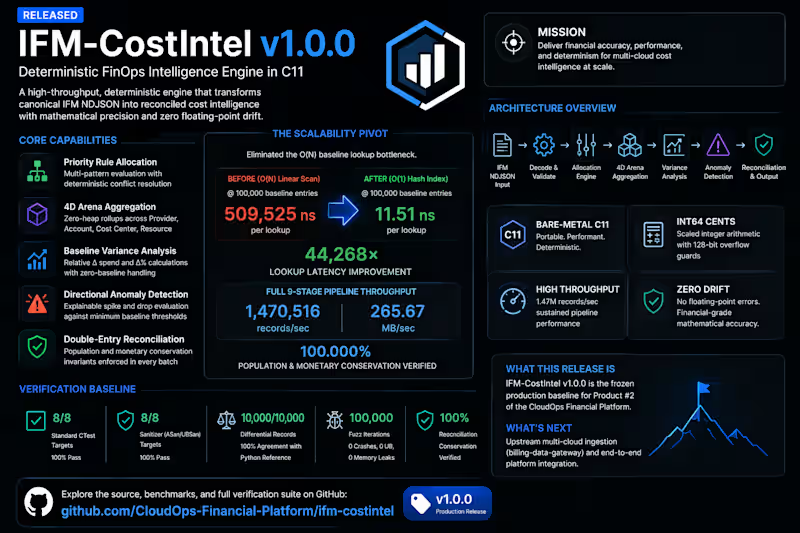
IFM-CostIntel provides:
Cost allocation with deterministic rule resolution
4D cost aggregation across provider, account, cost center, and resource
Baseline variance analysis
Directional anomaly detection
Financial reconciliation and conservation checks
Structured NDJSON output and audit telemetry
High-throughput processing designed for large billing workloads
Why it matters
Financial pipelines cannot afford silent rounding errors, inconsistent allocation, or unexplained reconciliation differences.
The engine therefore uses fixed-point integer financial arithmetic rather than floating-point calculations and enforces mathematical conservation throughout processing.
During scalability engineering, I also replaced an O(N) baseline lookup with an O(1) FNV-1a open-addressing hash index.
The measured improvement at 100,000 baseline entries:
509,525 ns → 11.51 ns per lookup
≈ 44,268× lower lookup latency
The complete pipeline benchmark reached:
1.47M records/sec
265.67 MB/sec
Verification
The v1.0.0 release has been validated through:
✅ 8/8 standard tests passing
✅ 8/8 ASan/UBSan tests passing
✅ 10,000/10,000 differential records matching the reference oracle
✅ 100,000 adversarial fuzz iterations
✅ 100% financial reconciliation conservation
What I can build with this capability
I can apply this systems-engineering stack to projects involving:
Cloud FinOps • Billing Infrastructure • Financial Data Pipelines • C/C++ Performance Engineering • Data Normalization • Cost Allocation • Reconciliation Systems • High-throughput Processing
The engine is available as an open-source reference implementation, and I’m interested in applying the same engineering principles to custom financial-data and cloud-cost infrastructure projects.
🔗 GitHub:
IFM-CostIntel Repository (https://github.com/CloudOps-Financial-Platform/ifm-costintel?utm_source=chatgpt.com)
🔖 v1.0.0 Release:
IFM-CostIntel v1.0.0 (https://github.com/CloudOps-Financial-Platform/ifm-costintel/releases/tag/v1.0.0?utm_source=chatgpt.com)
Need a high-performance financial or cloud-cost data pipeline? Let's talk.
1
2
273


SaaS Builder | MERN + Real-time Apps & IoT
SaaS Builder | MERN + Real-time Apps & IoT
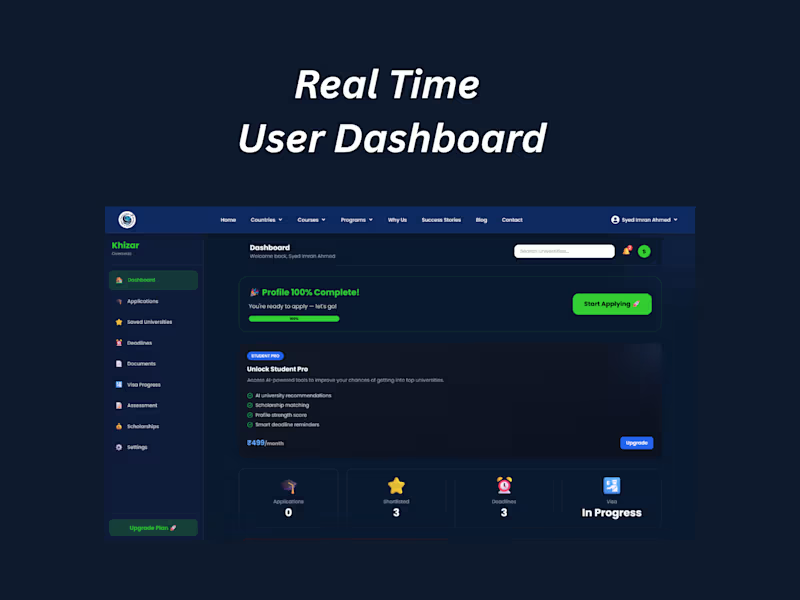
Built a full-stack overseas study abroad platform from scratch using the MERN stack. This wasn't just a CRUD app — it's a real SaaS system with four separate role-based dashboards (Student, Counselor, Admin, Super Admin), each with their own permissions and workflows.
The student side lets users track their entire application journey — from shortlisting universities to monitoring visa progress in real time. Counselors get a dedicated space to manage their assigned students, handle documents, and track leads. Admins oversee the counselors and overall operations, while the Super Admin has full system control.
Some things I'm genuinely proud of here: I integrated Socket.IO (http://Socket.IO) for real-time updates so students actually see status changes live without refreshing. Authentication runs on both Google OAuth and session-based login with Express Sessions. Security was taken seriously — Helmet.js for HTTP headers, XSS protection, and need-based API design so the server never over-fetches. Cloudinary handles all media uploads for university images and application documents.
The backend is built with pagination from day one, so it scales cleanly even with thousands of universities and users in the database. The whole thing is modular — adding new roles or features doesn't break existing flows.
This is one of those projects where I had to think like a product engineer, not just a developer. Managing multi-role access, real-time communication, and secure document handling all in one system was a solid challenge and I'm happy with how it came together.
0
122
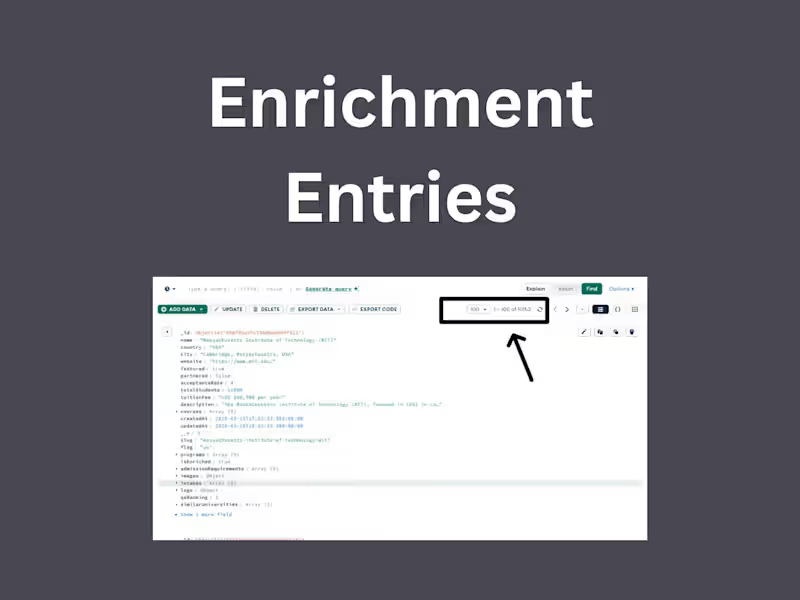
I built an AI-powered data enrichment system that efficiently processes and improves large university datasets. It automates the entire enrichment workflow, handles structured data cleanly, and gives real-time logs so you can easily monitor what's happening in the pipelines.
The main goal was to make the whole process scalable, automated, and easy to manage. I created a clean dashboard where users can track everything, which really helps improve data quality and gives full visibility into the operations.
Key Highlights:
AI-driven data enrichment workflows
Real-time processing logs and activity monitoring
Structured university data management
Automated backend pipelines
Clean dashboard for monitoring and control
Scalable and efficient architecture
Tech Stack: Node.js, Express.js, MongoDB, JavaScript, REST APIs, AI Automation Tools
1
79
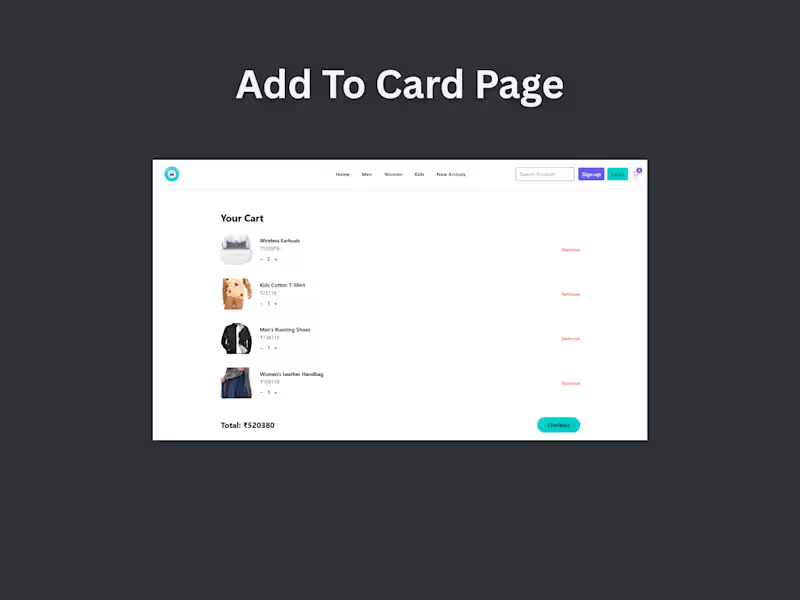
I built a clean and modern e-commerce website focused on great user experience. The whole thing feels smooth, looks good, and works perfectly on both mobile and desktop.
It includes a nice dynamic landing page, easy product browsing, add-to-cart functionality, a fully working shopping cart where you can change quantities or remove items, and a clean checkout page.
I developed it using React and followed modern frontend practices. Everything is built with reusable components and responsive design so it feels fast and seamless no matter what device you're on.
Key Highlights:
Responsive homepage with a modern look
Smooth add-to-cart experience
Smart cart management (add, remove, update quantity)
Clean and minimal UI/UX
Fully mobile-friendly
Tech Stack: React.js, Tailwind CSS, JavaScript, HTML & CSS
1
63
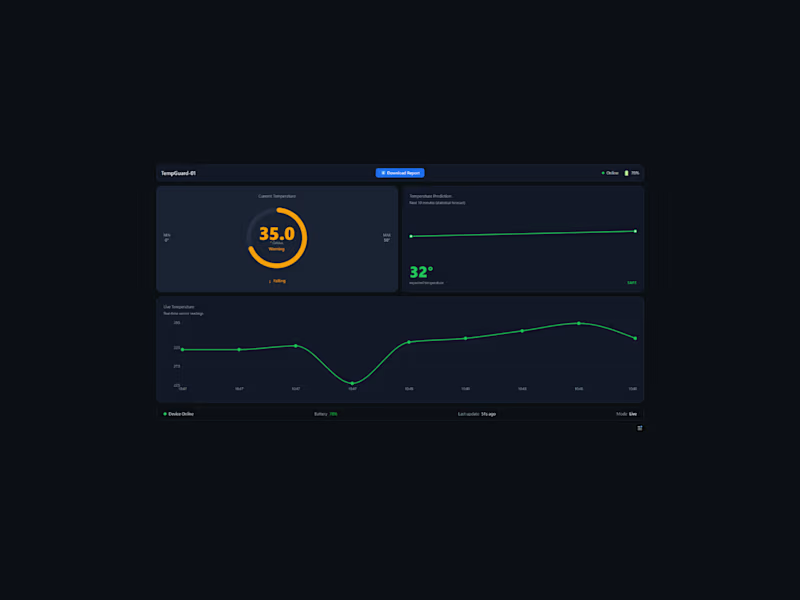
🚨 Preventing equipment failure with real-time IoT monitoring
I built a live temperature monitoring system that detects critical changes instantly and alerts before damage happens.
🔴 Live Demo: https://live-temperature-sensor.vercel.app
This system streams real-time sensor data using Socket.IO (http://Socket.IO) — no refresh, no delay.
⚡ What it does:
• Real-time temperature tracking with live graphs
• Instant alerts when thresholds are exceeded
• Predictive insights to detect risks early
• Device health monitoring (battery, uptime, status)
🧠 Tech Stack:
React + Node.js + Socket.IO (http://Socket.IO) + IoT sensors (MQTT)
💡 Use cases:
• Server rooms & data centers
• Industrial environments
• Medical storage systems
• Smart IoT setups
👉 Built as a scalable real-time system, not just a dashboard.
If you're working on IoT or real-time applications, let’s connect.
0
138