
From
Expertise to Asset: How to Package Knowledge That Sells
Most professionals think their
problem is income.
In reality, many have an asset
problem.
They possess:
✅ Years of experience
✅ Valuable insights
✅ Proven frameworks
✅ Specialized knowledge
Yet they continue to exchange time
for money.
• Consultants sell hours.
• Coaches sell sessions.
• Trainers sell workshops.
• Freelancers sell deliverables.
The challenge isn't a lack of
expertise.
The challenge is that their expertise
exists only in their heads.
Here's the truth:
Expertise alone is not an
asset.
Packaged expertise is.
The most successful consultants,
coaches, educators, and authors understand that knowledge becomes more valuable
when it can be:
✔ Transferred
✔ Replicated
✔ Scaled
✔ Monetized
Without requiring their constant
presence.
That's where expertise becomes
intellectual property.
And intellectual property becomes a
business asset.
The New Reality
Information is everywhere.
AI can generate content.
Search engines provide answers.
Videos teach skills.
People no longer pay for information.
They pay for:
🎯 Clarity
🎯 Structure
🎯 Proven systems
🎯 Real-world experience
🎯 Transformation
How to Turn Expertise into an Asset
1️⃣ Identify the Transformation
People don't buy information.
They buy outcomes.
Ask yourself:
"What transformation do
I help people achieve?"
The clearer the transformation, the
stronger the asset.
2️⃣ Extract Your Framework
Every expert has a process.
Ask yourself:
• How do I consistently achieve
results?
• What steps do I follow?
• What mistakes do I help people
avoid?
Document it.
Name it.
Refine it.
Your framework may become your most
valuable intellectual property.
3️⃣ Create a Foundational Asset
Instead of creating random content,
build one core asset first:
📖 A nonfiction book
🎓 A flagship course
📑 A training manual
🧠 A proprietary methodology
One strong asset can become many
others.
For example:
📖 Book → 🎓
Course → 🎤 Workshop → 💼 Consulting → 👥
Membership
One idea can become an entire
ecosystem.
4️⃣ Focus on Implementation
Information rarely changes lives.
Implementation does.
Help people take action through:
📋 Worksheets
📑 Templates
🎯 Exercises
📚 Case Studies
✅ Checklists
The easier you make implementation,
the more valuable your expertise becomes.
A Question for You
If you were unavailable for the next
six months, what asset could continue delivering your knowledge, helping your
audience, and strengthening your authority?
👇 Share your thoughts in
the comments.
0
67

Google Workspace and Microsoft 365 Business Email Setup
Set up professional business email accounts using Google Workspace and Microsoft 365.
The work included domain verification, mailbox creation, DNS configuration, MX records, SPF, DKIM, DMARC, admin settings, and final sending/receiving tests.
This helped the business use reliable email accounts for daily communication, team operations, and outreach.
My role:
I handled the business email setup, DNS configuration, mailbox setup, and final testing.
Tools used:
Google Workspace, Microsoft 365, Google Admin Console, Microsoft Admin Center, Cloudflare, and DNS tools.
0
95
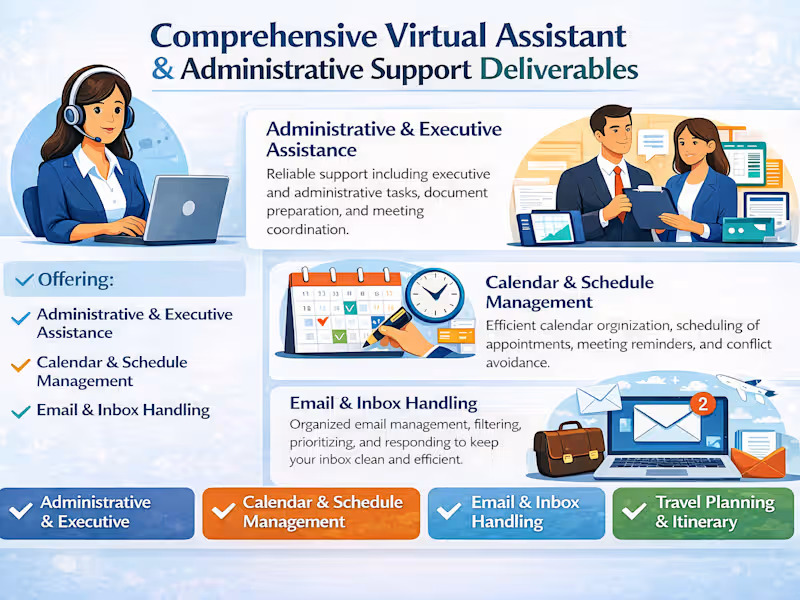
I deliver comprehensive virtual assistance and administrative support tailored to busy professionals and growing teams. My services include executive and administrative support, proactive calendar and schedule management, organized email and inbox handling, and end-to-end travel planning with detailed itineraries. I work with precision, discretion, and strong time-management skills to streamline daily operations, improve workflow efficiency, and ensure nothing falls through the cracks—allowing you to focus on strategic priorities and business growth.
#VirtualAssistant #AdministrativeSupport #ExecutiveSupport
#RemoteAssistant #CalendarManagement #EmailManagement
#InboxZero #TravelPlanning #BusinessSupport #OperationsSupport #Productivity #WorkflowEfficiency #ProfessionalSupport #TimeManagement #BusinessGrowth
0
325






Why Most Experts Struggle to Turn Their Knowledge into a Profitable Course
"I'm an expert in my field. Why isn't my course selling?"
This is one of the most common questions I hear from coaches, consultants, trainers, and authors.
The answer is surprisingly simple:
Expertise does not automatically create a successful course.
Many experts assume that if they know enough, learners will buy.
But learners don't pay for information.
They pay for transformation.
That's why instructional designers often use the ADDIE Model (Analysis, Design, Development, Implementation, Evaluation). It also explains why many expert-led courses struggle.
1️⃣ They teach everything they know.
Experts try to include years of knowledge in one course.
Learners don't want everything.
They want a clear path to a specific outcome.
2️⃣ They design from an expert's perspective.
What seems obvious to an expert may be confusing to a beginner.
Skipping fundamentals and using jargon creates frustration, not learning.
3️⃣ They create content instead of experiences.
Videos and slides alone rarely create transformation.
Activities, exercises, case studies, and feedback help learners apply knowledge and achieve results.
4️⃣ They build before validating demand.
Many spend months creating a course before confirming that people actually want it.
The Analysis phase should always come before development.
5️⃣ They sell lessons instead of outcomes.
Learners don't buy:
❌ 10 modules
❌ 50 videos
❌ 100-page workbooks
They buy:
✅ New skills
✅ Career growth
✅ Business results
✅ Confidence
✅ Solutions to real problems
The most successful courses aren't created by the most knowledgeable experts.
They're created by experts who understand how people learn, stay engaged, and achieve measurable outcomes.
Knowledge is the raw material.
Transformation is the product.
What's the biggest challenge you've seen when creating or taking an online course?
1
0
240
Email Deliverability Audit and Fix Plan
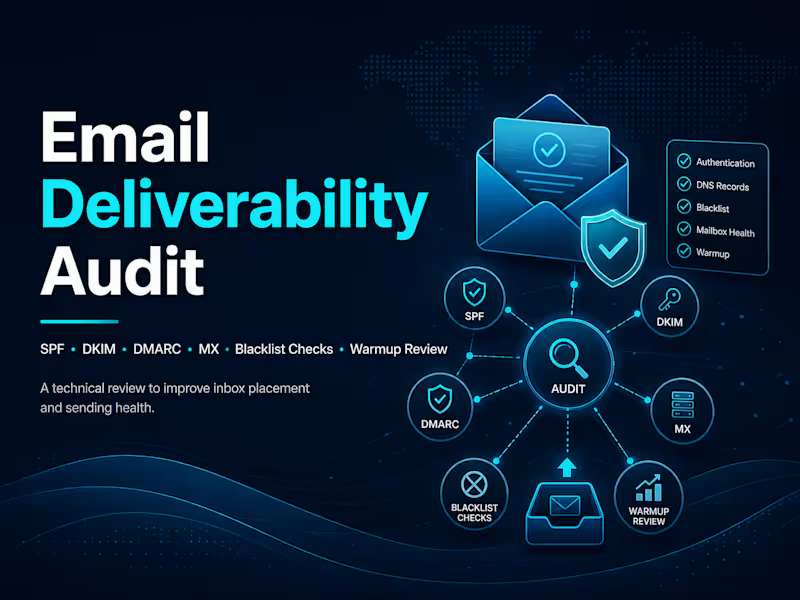
Reviewed a cold email setup to find technical issues affecting deliverability.
The audit covered DNS records, SPF, DKIM, DMARC, MX records, mailbox setup, tracking domains, blacklist status, warmup setup, and sending tool configuration.
After the review, I shared a clear list of issues and a fix plan to improve sending health before scaling.
My role:
I handled the deliverability review, identified technical problems, and prepared the fix plan.
Tools used:
Google Workspace, Microsoft 365, Cloudflare, DNS tools, Smartlead, Instantly, and blacklist checkers.
0
83