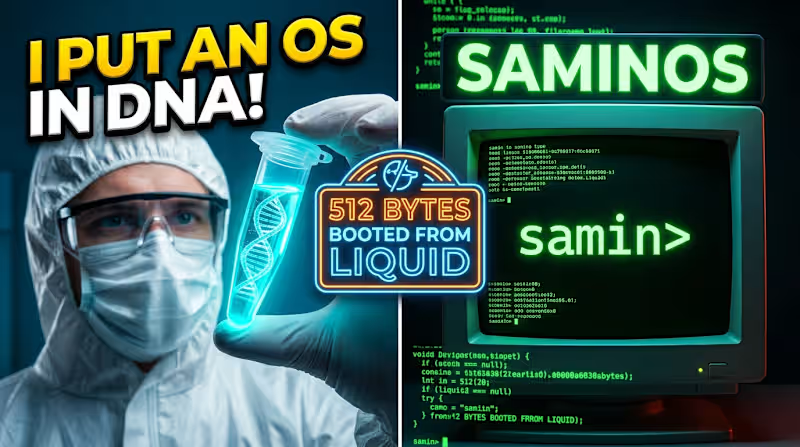
SaminOS: A Full Operating System Stored in a Single Molecule of DNA (https://github.com/Saminsami73/SaminOS_DNA)
Creator: Samin Sami (Samin Yasar Al Sami)
The Story Behind the Project:
Hey there, first off sorry for being this delay in posting projects on Contra. Well in my Contra profile I had uploaded and shown numerous love towards browser based Operating systems. We had seen a famous Vanilla based Win 95 (https://win95bysamin.netlify.app). A perfect retro functioning operating system running in your browser. Then I thought it would be more crazier to have AetherOS (https://aetherosbysamin.netlify.app), an AI agent based operating system running in a single HTML based file system! This year I decided I would build something different, something unique. Most operating systems today are massive. Windows and macOS take up tens of gigabytes of disk space and require gigabytes of memory just to show an empty desktop. Even a simple program usually carries megabytes of hidden background code.
I wanted to find out how small a real, interactive operating system could be.
I set a hard rule for myself: everything had to fit inside 512 bytes. That is the exact size of a single Master Boot Record sector on a computer hard drive. There is no room for bloat, third-party libraries, or sloppy instructions. Every single byte has to fight for its place.
I wrote SaminOS in raw 16-bit x86 assembly language. When a computer turns on, its motherboard BIOS looks for the first sector of a disk, checks for a two-byte signature at the end, and loads the code directly into memory address 0x7C00. SaminOS takes full control of the machine from that exact moment.
It does not just print a single line and freeze. SaminOS boots an interactive command line with a live blinking prompt. It draws a four-line bold ASCII art logo. It includes a keyboard driver that handles keystrokes, buffers characters in memory, and erases letters cleanly when you hit backspace. It reads the motherboard real-time clock chip, converts raw decimal numbers, and displays the local time in Dhaka. It gives you six working commands: help, info, time, say, cls, and reboot.
The entire system takes up 508 bytes of machine instructions and text, leaving two empty padding bytes and the two-byte boot signature. Exactly 512 bytes.
Then I realized something much bigger: that 512-byte operating system could live inside biology.
How Code Turns into DNA:
Computers think in binary numbers: 0 and 1. Living cells think in genetic letters: Adenine (A), Cytosine (C), Guanine (G), and Thymine (T).
Because there are four genetic bases, each letter can store exactly two binary bits:
- 00 becomes A
- 01 becomes C
- 10 becomes G
- 11 becomes T
Every byte of computer data contains eight bits. In my encoding system, each byte turns into a short four-letter genetic word. For example, the hex byte 0x55 (which is 01010101 in binary) turns into the letters CCCC. The hex byte 0xAA (which is 10101010) turns into GGGG.
Because SaminOS is exactly 512 bytes long, the entire operating system translates into an exact strand of 2,048 DNA base pairs.
This number changes everything.
When large tech companies store data in DNA, such as movies or research archives, the files are millions of bytes long. Chemists cannot easily synthesize a million-letter strand of DNA in one piece. They must chop the data into thousands of tiny, scrambled fragments, store them in a pool, and rely on complicated mathematical algorithms to piece them back together later. If one piece gets lost, the whole file can break.
SaminOS does not have to be chopped up. In nature, 2,048 letters is the normal size of a single bacterial gene. That means SaminOS exists as one single, unbroken, continuous strand of DNA.
The entire bootloader, the kernel, the command engine, the clock math, the prompt, and the author metadata all fit onto one molecular polymer.
From a Glass Tube to a Laptop Screen:
People often ask: how can clear liquid in a tube run on a computer screen?
The link between biology and hardware works in five clear steps:
1. Digital Compilation: A Python tool reads the 512-byte binary file of SaminOS two bits at a time. It maps each pair to A, C, G, or T, producing a 2,048-letter text sequence.
2. Chemical Synthesis: A DNA synthesizer prints the sequence. Instead of paper and ink, it links real molecules together, base by base, building physical double-helix strands floating in purified water.
3. Biological Storage: The dry DNA forms an invisible salt crystal, or dissolves into clear water. A single molecule of SaminOS is only 696 nanometers long and weighs 1.26 attograms. That is so small that a single drop of water can hold billions of complete copies of the operating system.
4. Nanopore Reading: To boot the system, you pipette a tiny droplet of the liquid into a portable DNA sequencer, like an Oxford Nanopore MinION. This device is smaller than a smartphone and plugs directly into a laptop via USB. Inside the device, an electrical current pulls the DNA strand through a microscopic protein pore. As each letter passes through, it creates a distinct dip in the electric current.
5. Silicon Boot: Software on the laptop reads those electric signals and turns them back into the original 512 bytes of machine code. A script loads those bytes into Sector 0 of a virtual drive or USB flash stick. The computer BIOS checks the last two bytes, confirms the 0x55AA boot signature, loads the code into RAM at 0x7C00, and boots SaminOS live on screen.
Molecular Surgery: Using Enzymes as Hardware Switches:
Because the computer instructions map directly to physical genetic letters, we can do something impossible with ordinary silicon: we can modify software using biology.
In molecular biology, scientists use restriction enzymes. These are natural biological proteins that act like microscopic scissors. Each enzyme looks for one specific pattern of genetic letters and cuts the DNA strand at that exact spot.
When we map SaminOS into DNA, our assembly instructions accidentally create real recognition sites for known enzymes:
-SmaI and XmaI (They are the Boot Switch): The x86 boot signature 0x55AA translates into CCCCGGGG at base pairs 2041 to 2048. Both SmaI and XmaI cut the sequence CCCGGG. If you add SmaI to the vial, it snips the strand right inside the boot signature. It does not touch any of the commands or code, but the computer BIOS will refuse to boot the disk. It acts like a biological write-blocker or kill switch.
- NsiI (The Keyboard Lock): At base pair 100, NsiI cuts right where the code calls the BIOS keyboard interrupt. Adding this enzyme physically unplugs the keyboard handler at the molecular level.
- AseI, PmlI, and MscI (The Clock Cutters): All three enzymes cut inside the mathematical routine that decodes the motherboard real-time clock.
- AgeI and SalI (The Dhaka Marker): Bases 1989 to 2008 spell out the word "Dhaka" in ASCII. The letters of the city name form the exact cutting site for AgeI and SalI. Dropping these enzymes into the tube cuts the geographic origin marker out of the code.
- StuI (The Banner Cutter): This enzyme cuts through the exact middle of the ASCII art startup logo.
You do not need a compiler or a hex editor to disable features. You can modify the binary using drops of liquid on a laboratory bench.
Why I did this:
This project is not just a technical puzzle. It points toward solutions for real problems in computing:
1. Storage That Lasts for Millennia: Modern hard drives fail within ten years. Magnetic tapes degrade. Flash memory loses charge. Synthetic DNA stored in tiny glass beads can last for tens of thousands of years at room temperature with zero electricity. SaminOS proves that executable software, not just static text or images, can be archived for deep time.
2. Extreme Data Density: DNA can store more information per cubic millimeter than any silicon chip known to science. All 512 bytes of SaminOS fit into an object smaller than a wavelength of visible light. You could pack copies for every person on Earth into a single drop of liquid.
3. Living Servers: Because 2,048 base pairs is the size of a normal gene, you can insert SaminOS into a harmless bacterium like E. coli. As the bacteria feed on basic nutrients, they duplicate the operating system billions of times without drawing power from an electrical wall outlet.
4. Absolute Physical Security: A vial of SaminOS has no radio antenna, no network card, and no electrical emissions. It cannot be scanned through an airport X-ray or intercepted across the internet. It exists outside the electromagnetic spectrum until it is sequenced.
What This Project Demonstrates:
SaminOS shows what happens when low-level assembly language meets synthetic biology. It demonstrates:
1. Deep mastery of bare-metal x86 architecture, memory layouts, and hardware interrupts.
2. Clean algorithm design under a strict 512-byte constraint.
3. Creative cross-disciplinary engineering linking computer science, information theory, and molecular genetics.
4. Clear communication that turns complex biocomputing concepts into accessible, human ideas.
Ref and Source Links:
1. SaminOS Research at Zenodo: https://doi.org/10.5281/zenodo.23554876
2. SaminOS Github Repo with all tools and resources : https://github.com/Saminsami73/SaminOS_DNA
3. A 61 Page Guidebook of SaminOS DNA : https://github.com/Saminsami73/SaminOS_DNA/blob/main/SaminOS_Complete_Guidebook.pdf
4. SaminOS Main Research paper : https://github.com/Saminsami73/SaminOS_DNA/blob/main/SaminOS_Research_Paper_v2.pdf
22
16
9.5K
Planning a milestone event shouldn’t feel like running an air traffic control tower from your inbox.
You know the drill: you want to celebrate a wedding, corporate events, milestone birthday, or anniversary. You find a venue you love, but their open Saturday doesn't work for the caterer. You scramble to find another date, but now the caterer is booked. Three weeks, nine different vendor quotes, and 30 back-and-forth emails later, you’re exhausted before the party even starts. The worst.
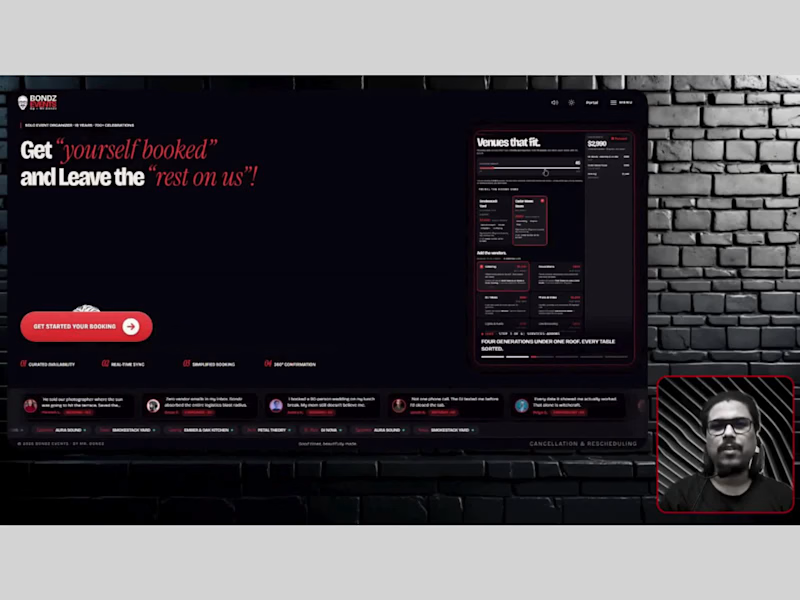
So I built Bondz Events. The problem I wanted to solve: eliminate multi-vendor booking chaos and turn high-touch event planning into a synchronized, single-sitting digital experience.
See it in action here: https://bondzevents.lovable.app
The booking canvas lets clients pick their vibe, select a venue or home setup, and assemble their curated vendor dream team, from live grill catering and craft lighting to DJs and cinematics. Behind the scenes, an intelligent 75-day multi-calendar availability engine checks everyone's schedules simultaneously. A date turns green only if the venue, Mr. Bondz, and every single selected partner are 100% available, zero double-booking, zero post-deposit cancellations. Everything wraps up with a high-contrast digital signature pad and with 360° confirmation feedback the moment you tap to lock in your deposit.
Behind the curtain, the dual-sided Owner's Portal keeps the entire ecosystem in sync. Mr. Bondz has a master command center to monitor live revenue, confirmed dispatches, and incoming requests. Meanwhile, partners have their own dedicated view to inspect work orders and toggle blackout dates that update front-end client availability in real time.
Built and deployed natively with Lovable and engineered with Web Audio synthesis and editorial visual.
Less phone tag for the client, zero scheduling conflicts for the vendors.
The celebration is bespoke. Locking it in shouldn’t be a headache. 🥂
See Social posts:
X: https://x.com/mdrafat007/status/2105906188852539804?s=20
LinkedIn: https://lnkd.in/p/gqiMf_he
See the demo walk through and the build process below.
2
2
671
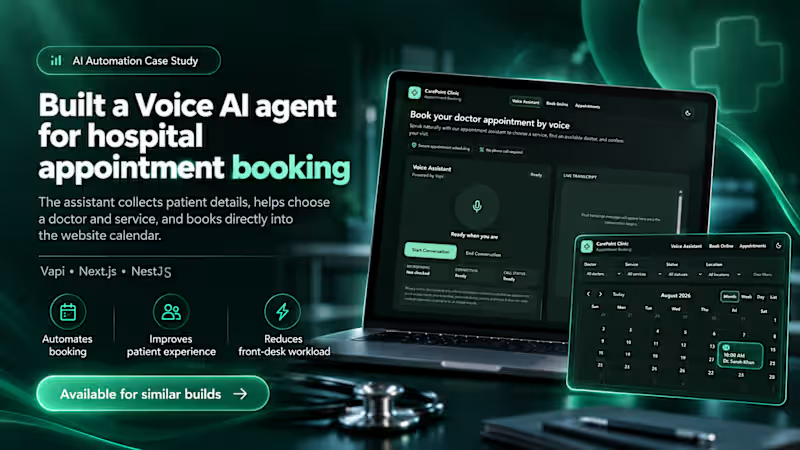
Built an AI Voice Agent for hospital appointment booking using Vapi, Next.js, and NestJS. It can collect patient information, help select the doctor/service/time, and automatically book the appointment directly into the website calendar.
A practical example of how voice AI can simplify scheduling and reduce front-desk workload.
#VoiceAI #Vapi #NextJS #NestJS #HealthcareTech #AIAutomation #WebDevelopment
2
1
323
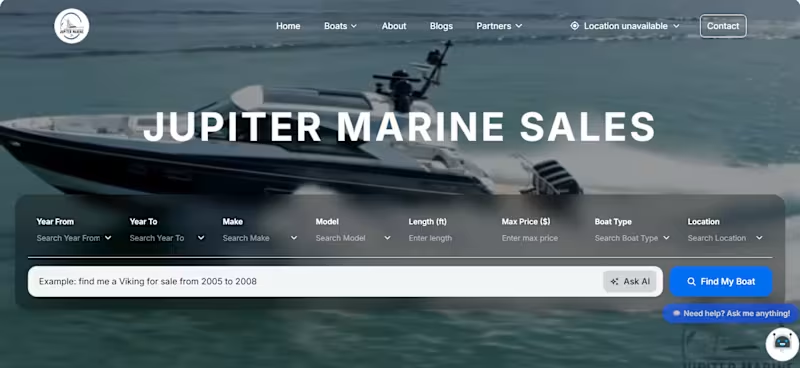
Transformed a traditional brokerage website into a scalable digital sales platform for a high-value marine sales business. Built structured yacht inventory search, detailed vessel listing pages, and an AI-assisted natural-language search layer — letting buyers describe what they want in plain language instead of manually filtering. Turned a static company site into a full digital sales channel, from discovery through inquiry.
0
86
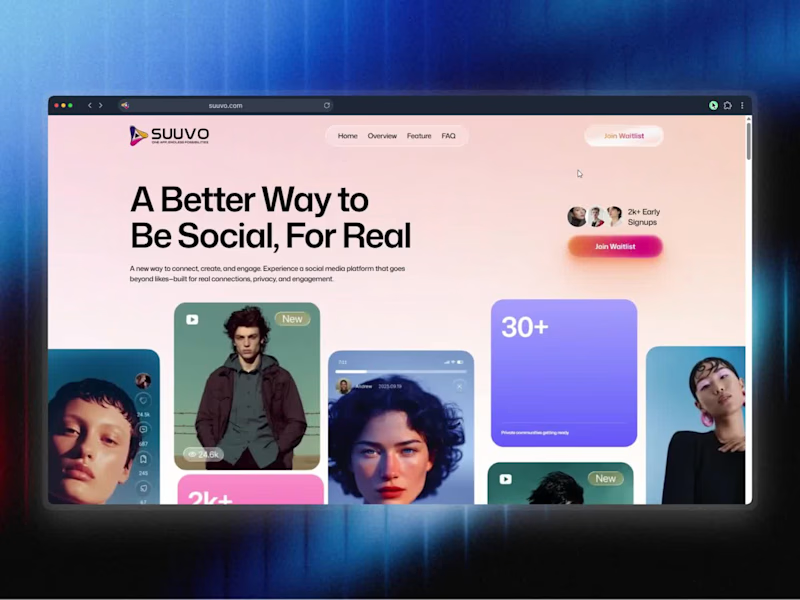
Social Media Platform · UX Design & Web Development
Designed and developed a high-converting landing page for a next-generation social media platform.
The goal: help founders and growth teams turn website visitors into users, faster.
Strong UX design reduces bounce rate, builds credibility, and directly impacts your bottom line. This project was a full end-to-end execution from wireframes to live deployment.
Looking to build a landing page that actually converts? Let's talk.
Check out the live site: suuvo.com (http://suuvo.com)
5
4
289

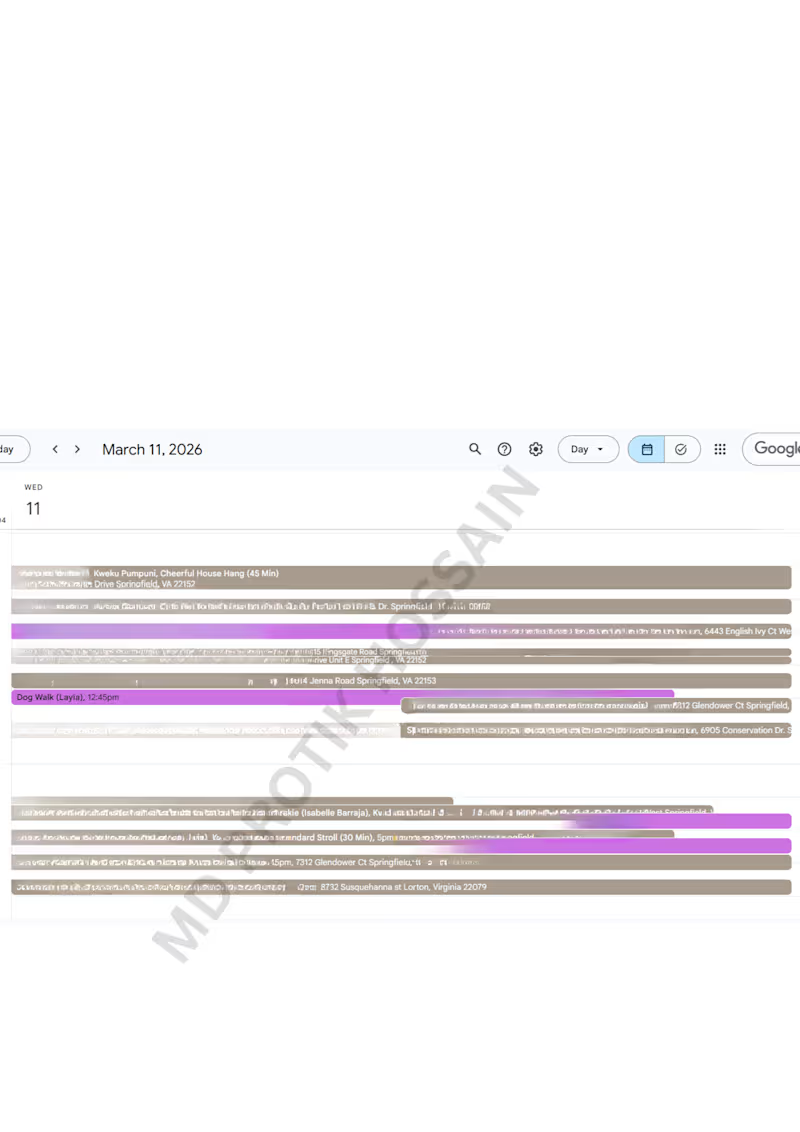
AI-Powered Organic Booking System (Service-Based Businesses)
I built and launched an AI-powered organic booking system designed specifically for service-based businesses to generate consistent appointment bookings through SEO and inbound traffic.
This system is not dependent on ads, cold calling, or manual outreach—it is built to attract ready-to-book customers automatically.
⚙️ What this system does:
✔ Attracts high-intent users searching for your service through SEO
✔ Uses AI-driven optimization to target the right audience at the right time
✔ Converts website visitors into booked appointments or consultation calls
✔ Automates the full journey from search → inquiry → booking
🧠 How it’s different
Most businesses rely on the following:
Paid ads that stop when budget ends
Manual outreach with low conversion
Random traffic with no booking intent
This system replaces that with a self-sustaining organic booking engine.
📈 Core Flow
Search Visibility → AI Targeting → Trust Building → Booking Conversion
So instead of chasing clients, the system brings ready-to-book customers directly to your calendar.
💡 Outcome Focus
This system is designed to:
Increase appointment bookings consistently
Reduce dependency on paid ads
Build predictable inbound client flow
Scale service-based revenue organically
If you want a similar AI-powered booking system for your business, send me your website or service details. I’ll analyze your current setup and show you how to increase your bookings through organic systems.
1
333
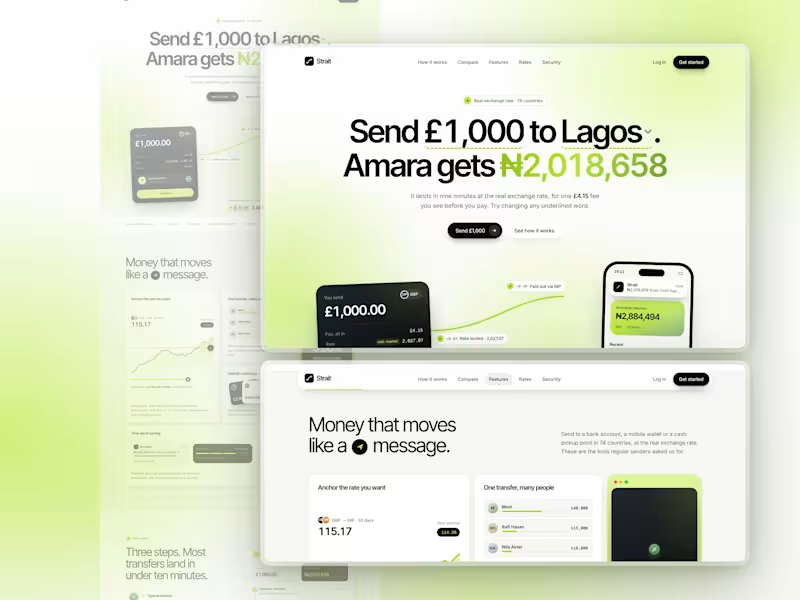
🔥 Strait is a Next.js landing page for a money transfer app, crafted entirely with Claude on high settings. The headline is a working calculator: change the amount, currency or city, and the payout updates. Below it, the money travels from a send card into the recipient's banking app.
It's lime, white and black, smooth on mobile, and built with Next.js 16, Tailwind CSS v4 and TypeScript. There are no image files.
https://strait-tau.vercel.app/
2
195
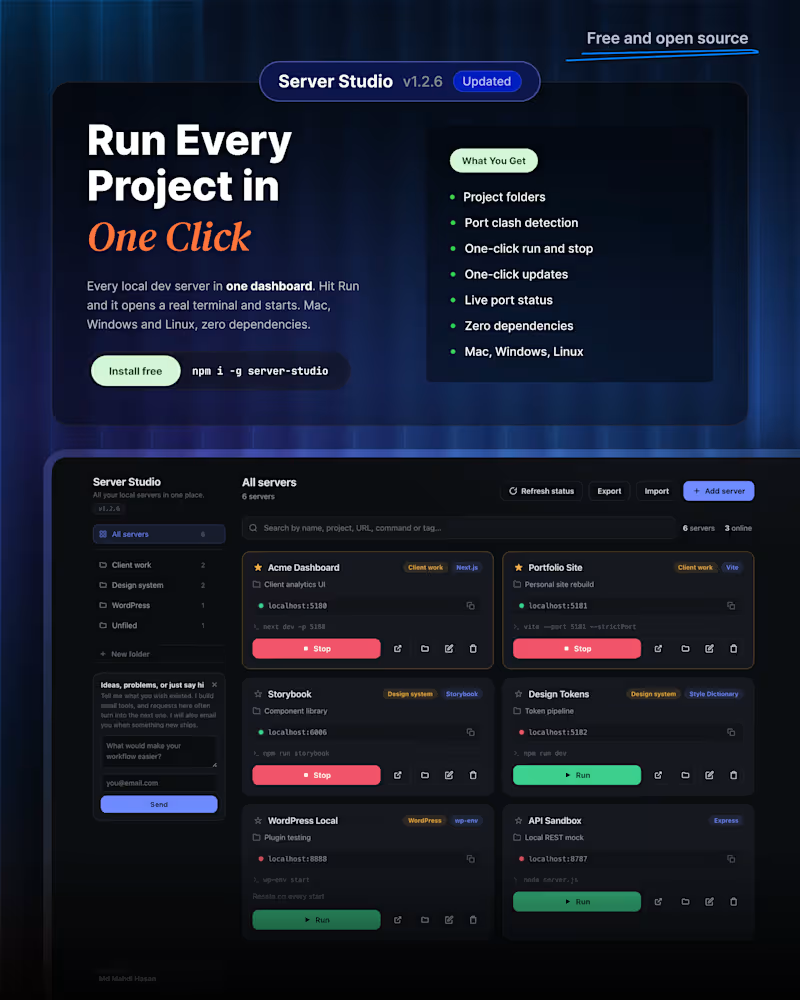
I just open sourced a tool I built for myself.
Basically, I work on a lot of projects at the same time. Marketing sites, plugin test setups, design system sandboxes. Every time I switched to one of them, it was the same few minutes gone. Which port does this one run on, what was the exact command to start it, and half the time the port was already taken by something I left running, so I had to go find that first.
So I built Server Studio. Every local dev server gets a card with its folder, its run command and its URL. One click runs it in a real terminal, one click opens it in the browser, and a live dot shows what is already running.
The part that makes it actually stick, every project keeps one permanent port that nothing else can take. A saved shortcut is worthless if the port keeps changing, so it assigns a unique one and you set it in the project config. Months later it still works.
I also added a message box in the app. It is not a mailing list. I am a designer and a problem solver, and I would rather hear what actually gets in your way than sit here guessing. Leave your email and I will write back.
It also comes with a Claude Code skill, so I can just say "save this server" while I am building something, and it registers the project and picks a free port on its own. If you use a different tool, there is a plain command that does the same job.
Free and open source, MIT licensed, zero dependencies. Works on Mac, Windows and Linux.
Link in the comment below ⬇️
1
1
261