Projects using Python in DelhiProjects using Python in DelhiThat makes total sense. A lot of portfolio platforms like Contra don't support LaTeX rendering, so those equations just end up looking like broken code.
Here is the revised version with the math translated into clean, readable plain text so it formats perfectly on the site.
AuraOps: The Autonomous Unified Release Authority 🚀🧠
Moving AI from "Assisting Developers" to "Making Production Decisions"
Modern CI/CD pipelines are reactive. They lint, test, and warn—but the final decision still depends on a human. As DevOps complexity grows with security risks, compliance requirements, and sustainability concerns, developers are overwhelmed.
We asked a simple question: What if the pipeline itself could decide whether code is safe to ship? That idea led to AuraOps—a multi-agent AI system integrated directly into GitLab Merge Requests that doesn’t just analyze code, but actively fixes it, verifies it, and makes the final release decision.
💡 How It Works: The Autonomous Pipeline
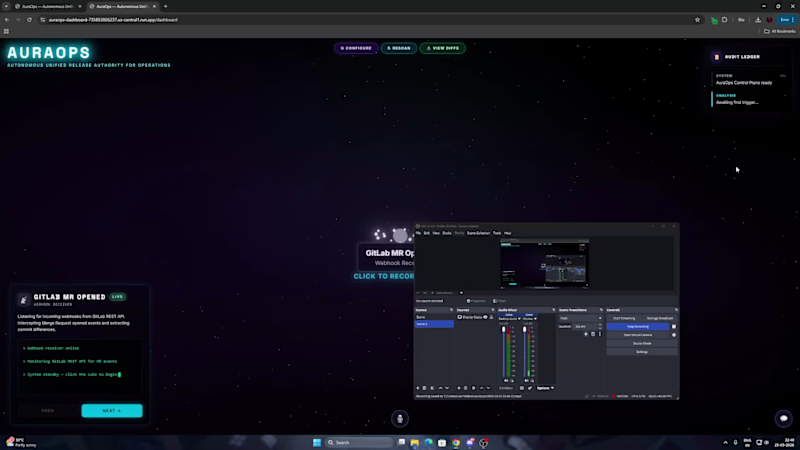
AuraOps intercepts GitLab webhooks when a Merge Request is opened, extracts the code diff, and triggers a 3-phase autonomous pipeline powered by specialized AI agents.
The Execution Flow:
Phase 1 (Parallel): Security & Sustainability Analysis
Phase 2 (Sequential): Validation & Risk Decision
Phase 3 (Parallel): Compliance Checks & Deployment
🤖 The Multi-Agent AI System
AuraOps orchestrates several distinct agents to handle the entire lifecycle:
SecurityAgent: Detects vulnerabilities (SQLi, XSS, secrets), auto-remediates them by writing and committing patches, and re-validates its own fixes.
GreenOpsAgent: Optimizes infrastructure using real-time carbon data and suggests lower-emission deployment regions.
ValidationAgent: Runs the GitLab CI/CD pipeline to ensure AI-generated fixes didn’t break functionality, with graceful fallbacks if CI is down.
ComplianceAgent: Audits code and deployment against SOC2, GDPR, and HIPAA requirements.
DeployAgent: Builds and deploys the application to Google Cloud Run, selecting the greenest, most optimal region.
RiskEngine (The Brain): The decision-making core that aggregates all signals into a single release scorecard and outputs a definitive APPROVE or BLOCK.
🧮 The RiskEngine Decision Model
To confidently block or approve a release without human input, we engineered a weighted decision model to generate a final confidence score.
The core confidence score combines three key weighted metrics:
Security Score * Eco (Sustainability) Score * Validation Result The final AI decision function evaluates this combined score against a strict threshold. For example, if the total confidence score is 75% or higher, the release is securely shipped and marked as APPROVE. If it falls below that mark, the system automatically outputs a BLOCK decision to prevent risky deployments.
🧗♂️ Engineering Challenges
Reliable Auto-Remediation: Detecting issues is easy; safely fixing them is not. We implemented multi-pass revalidation (up to 3 cycles) and auto-commits directly to GitLab.
Failure Resilience: Real-world systems fail. We built AuraOps with graceful degradation—handling CI failures by safely skipping them, retrying API rate limits with exponential backoff, and bypassing missing configs without crashing.
Sustainability as a Metric: Mapping cloud infrastructure to real-time carbon intensity APIs to quantify exact CO₂ savings.
🚀 The Final Output: The Release Scorecard
Instead of overwhelming the developer with logs, AuraOps outputs a clean, aggregated scorecard directly in the MR containing:
Security score & vulnerabilities auto-fixed
Sustainability index & CO₂ emissions avoided
Time saved via automation
Final AI Decision + Confidence Percentage
💻 Built With
AI Models: Gemini 2.5 Flash | Gemini 3.5 Pro | Claude 3.5 Sonnet
Backend & Orchestration: Python | FastAPI | Uvicorn | Node.js | TypeScript
Frontend & 3D Vis: React | Three.js (React Three Fiber) | CSS
DevOps & Cloud: Docker | GitLab API & Webhooks | GitLab CI | Google Cloud Build | Google Cloud Run
Try AuraOps : https://auraops-735853806237.europe-north1.run.app/dashboard
Competitor Price Monitor | n8n + Google Sheets
Keeping track of competitor prices becomes repetitive when a retailer manages several product categories and regularly adds new SKUs.
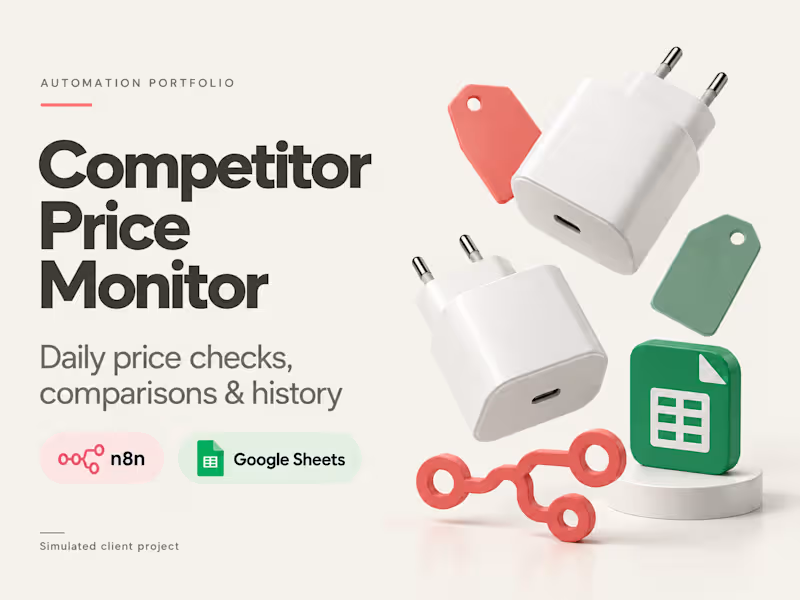
I built this automation around TechNest Accessories, a simulated electronics retailer, with a practical brief: monitor comparable competitor products while keeping the solution affordable and easy to manage.
The budget shaped the approach. Product discovery and matching stayed manual: the retailer enters its own SKU, selling price and chosen competitor URL in Google Sheets. This keeps control over which products are compared and reduces the complexity of the build.
Once a listing is selected, the repeated checking is automated.
The workflow reads active listings, retrieves competitor prices and availability, and compares each result with both the retailer’s price and the previously recorded competitor price. It then updates the Current Prices tab and appends a timestamped record to Price History.
The retailer can manage everything from the sheet—add listings, update selling prices, or pause monitoring with a Yes/No dropdown.
The workflow also handles failed page requests and price extraction. It records the error, preserves the last valid price and continues to the next listing. A successful later check clears the error.
I tested the build with two Portronics charger listings, confirming price comparisons, historical records and recovery after a deliberately failed check. The workflow supports scheduled daily checks and manual runs.
The result is a working prototype that brings selected competitor prices into one place, highlights meaningful differences and preserves a record for review—while leaving product selection and pricing decisions with the retailer.
Built with: n8n, JavaScript, HTTP requests and Google Sheets.
Independent portfolio project based on a simulated client brief. Images show recorded test data and simplified views of the working system.