Freelance Personal Assistants in Dallas
Freelance Personal Assistants in Dallas
Sign Up
Post a job
Sign Up
Log In
Filters
2
Projects
People
Shawnte' Williams
DeSoto, USA
A passionate Virtual Assistant based in the US
New to Contra
Follow
Message
A passionate Virtual Assistant based in the US
2
Running everything yourself was never meant to be permanent. Most founders and creators start out wearing every hat by necessity (such as answering emails late at night, rebuilding the same spreadsheet, chasing a follow-up between five other things.) It works, for a while. But at some point, the constraint on growth stops being the idea and starts being the hours in the day. The answer isn't to push harder. It's to understand the support options available because "assistant" isn't one job. It's a category, and that category has evolved. The support systems spectrum: three roles, three purposes Personal Assistant - Focused on your life outside of work: personal scheduling, errands, household logistics, travel for you and your family. A PA protects your personal time so you can show up fully when it's time to work. Executive/Administrative Assistant - Typically embedded within a company, supporting a specific leader or team: calendar and inbox management, meeting prep, internal coordination, travel booking, reporting. This model has long been the backbone of in-office business support, built around proximity and structure. Virtual Assistant - A flexible, remote evolution of both roles above. A VA can take on personal logistics, executive-level coordination, and business operations (often across time zones) on a schedule that flexes with your needs. It's not a smaller version of traditional support; it's a more adaptable structure for how businesses actually operate today. All three sit under the same umbrella (supporting people so they can focus on what matters most.) The difference is really about structure and flexibility, not value. VAs simply reflect where the workplace has moved: digital-first, remote-friendly, and built around outcomes rather than physical presence. Why Virtual Assistants matter more right now? Remote work reshaped how support gets structured, and a few things make VAs an especially strong fit today: Cost-efficiency: You pay for the hours and outcomes you need, without the overhead of a full-time in-house role. Scalability: Need more support during a launch and less the following month? A VA relationship can flex with you. Global talent access: You're not limited to your immediate area; you can find the right fit for the work. Speed: Many VA engagements can start within days rather than weeks. A quick note on misconceptions? There's sometimes an assumption that VAs only handle simple, low-stakes tasks. In practice, many VAs today manage meaningful, high-impact work, including: - Operations: process documentation, vendor coordination, project management across tools like Asana or Notion - Data: cleanup, reporting, dashboard maintenance - Customer support: client communication, onboarding, retention touchpoints - Content & admin support: scheduling, light copywriting, community management, launch coordination - Executive-level coordination: calendar and inbox management at the same level you'd expect from in-house support Who this is for? If you're a founder, creator, or professional who feels like there's more on your plate than hours in the day... you're far from alone, and it doesn't have to stay that way. Delegating isn't something you earn only after reaching a certain size. Often, it's part of how you get there. Looking ahead The future of work seems to be less about doing everything alone and more about building the right support around you. A Virtual Assistant isn't a replacement for what a PA or EA offers. It's simply a flexible option shaped for a remote, digital-first world. The real question worth sitting with: what would change if you had the right support in place?
4
2
457
1
The Founder's Table: The Denise Okafor Story (Original Pilot) It's about a girl who had a dream of running her business. Grows up to land her dream job and loses it shortly after experience months of low volume in the restaurant. She, then, learns a new skill in data and reach out to restaurants to help them operate while they focus on scaling. She becomes a Virtual Assistant and is empowered to take on task. Season one follows Denise building "The Founder's Table" one restaurant at a time — each episode centered on a different owner in crisis (a family diner about to close, a chef drowning in inventory chaos, a restaurant group facing a PR disaster), with Denise diagnosing the real problem and rebuilding it from the inside out. Inspired by the case-driven structure of Law & Order: SVU, each episode functions as its own contained "case" while an underlying arc builds across the season: Denise confronting her own history in the industry that once let her go, deciding whether to stay a solo operator or build an agency, and eventually facing a client whose business mirrors the very restaurant that fired her. The series is grounded in a true story, giving it the weight of something that actually happened rather than a fictional rags-to-riches arc.
1
40
5
The Founder’s Table: The Denise Okafor’s Story "The Founder's Table" follows Denise Okafor, a self-made CEO whose grind nobody ever sees. As a girl, she knew she wanted to lead — she just didn't know what yet. Years later, working as a waitress while chasing a dream of running her own kitchen, she's let go when her restaurant's customer volume drops. Instead of chasing another job, Denise turns the loss into her turning point: she teaches herself business operations and analytics from scratch, then builds a virtual assistant agency that helps struggling restaurant owners fix what's broken and scale. The pilot traces her arc from that notebook-scribbled dream to the moment she's running two screens of live client data — now the boss she always imagined, just not in the way she expected. Season one follows Denise building "The Founder's Table" one restaurant at a time — each episode centered on a different owner in crisis (a family diner about to close, a chef drowning in inventory chaos, a restaurant group facing a PR disaster), with Denise diagnosing the real problem and rebuilding it from the inside out. Inspired by the case-driven structure of Law & Order: SVU, each episode functions as its own contained "case" while an underlying arc builds across the season: Denise confronting her own history in the industry that once let her go, deciding whether to stay a solo operator or build an agency, and eventually facing a client whose business mirrors the very restaurant that fired her. The series is grounded in a true story, giving it the weight of something that actually happened rather than a fictional rags-to-riches arc.
2
5
879
6
Here's exactly what it looks like to work with me 👇 Hiring someone you've never worked with is a leap of faith... and honestly, most "hire me" posts don't help. They tell you what someone offers, not how it actually goes. So let me close that gap. Before we even start: a quick discovery conversation No commitment, no pressure. We talk through what's actually eating your time, what "support" would ideally look like for you, and whether I'm the right fit. If I'm not, I'll tell you and probably point you somewhere better. Week one: I get the lay of the land This isn't me disappearing into a task list. I ask questions about your tools, your workflow, your pet peeves, the thing you keep meaning to fix but haven't had time for. By the end of week one, I've usually already spotted at least one small inefficiency worth flagging. Ongoing: communication that doesn't require babysitting You'll get regular updates on what's moving, what's done, and what needs your input on a cadence we agree on upfront (daily check-in, weekly summary, whatever actually fits how you work). No mystery. No "what has she even been doing" moments. What "done" looks like Done means the task is complete and handed back in a way you can actually use labeled, organized, explained if needed. I don't consider something finished just because it's off my plate; it's finished when it's usable on yours. The honest part: I'm not going to pretend every project is flawless from day one. Systems get refined. But refinement happens through clear communication, not radio silence and that's the part I take seriously. If the biggest thing holding you back from hiring support is "but what am I actually getting into?" hopefully this answers it. 💬 Got a question about how this would work for your specific situation? Ask. I'd rather answer it now than have it be the reason you don't reach out.
6
617
Personal Assistant
(1)
Follow
Message
Breanna Jackson
Dallas, USA
Multifaceted Creator & Licensed Cosmetologist/MUA
Follow
Message
Multifaceted Creator & Licensed Cosmetologist/MUA
0
"Bird's Eye View" Official Visualizer and Promotional Material
0
12
0
"Might as Well" Music Video and Promotional Material
0
15
0
"Mood Swings" by Hollyn Visualizer Video & Promotional Material
0
11
0
"Opinions" by Hollyn, Single promotion and Music Video
0
14
Personal Assistant
(8)
Follow
Message
Trendon Peters
Dallas, USA
Multitasking VA for HR, Travel & Events
Follow
Message
Multitasking VA for HR, Travel & Events
0
Pinterest travel site Carousel
0
4
0
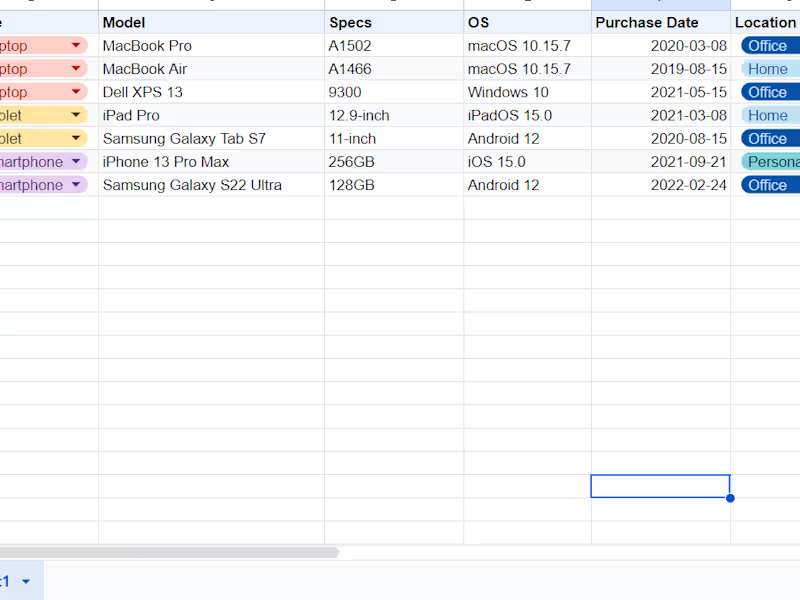
Device Inventory
0
15
0
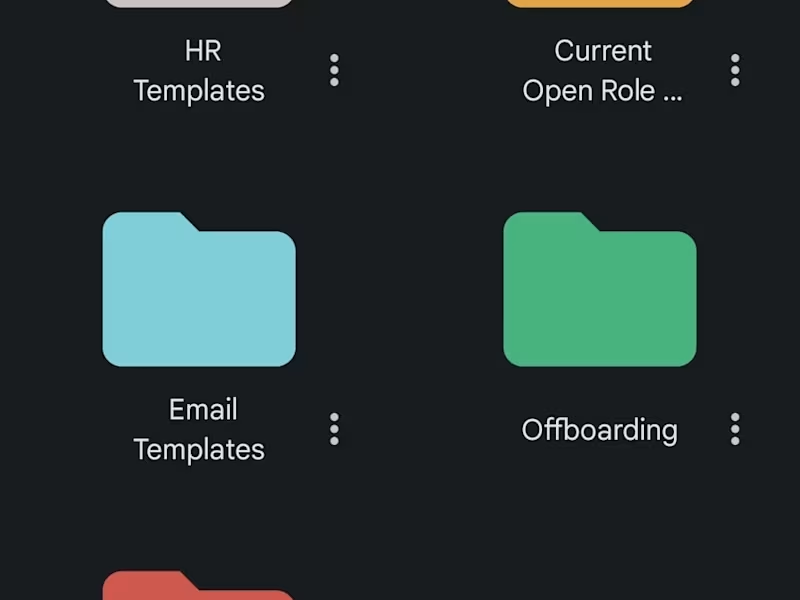
Drive Organization
0
6
0
Presentation for Austin Off-site
0
7
Personal Assistant
(1)
Follow
Message
Explore people