Freelancers using Tolstoy in Brazil
Freelancers using Tolstoy in Brazil
Sign Up
Post a job
Sign Up
Log In
Filters
2
Projects
People
Nessa Studio
Brazil
Connecting strategy and aesthetic for unique brands
$1k+
Earned
3x
Hired
66
Followers
Follow
Message
Connecting strategy and aesthetic for unique brands
1
Winner of Contra’s #HolidayChallenge2025
1
17
30
A Custom holiday Game Card! Can you find all of them? 🕵️♀️ There are more than 6 Grinches and 3 hidden Santas. Good luck! My second submission for the #HolidayChallenge2025! Using LoveArt for the heavy design lifting and Tolstoy to visualize the final mockups. But it’s not just a holiday card, it’s a searching game! I used AI to bake in specific intimate nicknames because nothing says "I love you" like a custom-prompted experience. It’s a unique gift that will definitely be on your memory and heart. 💖 Check the comments below for an extra!
13
30
968
3
For some patients, the hardest part of a dental visit isn't the appointment. It's getting there. The problem: booking care for them used to mean hours of WhatsApp back-and-forth for a solo, on-the-road dentist. Explaining accessibility needs, quoting prices, and chasing reminders, one message at a time, time that came straight out of the day with patients. So I replaced all o with a booking system built for a home-care dentist's real day: Sorriso Sem Barreiras, in Rio de Janeiro. The patients are elderly, bedridden, or living with special needs. Depending on the case, the patient books it themselves, or a caregiver does it on their behalf. Cleaning, cavity treatment, gum care, or a full evaluation: all in plain language, with upfront prices and no medical terms to figure out. A routine visit books in about two minutes. Urgent cases get their own same-day flow, with a fixed price and the earliest slot available. Now, confirmations, reminders, and 6-month recalls go out on their own. The dentist's day starts with one screen showing only what actually needs attention- nothing more to chase, more time for patients instead of messages. The booking works in English and Portuguese. The name means "smile without barriers." That's the goal: making sure a real barrier, like mobility or distance, doesn't stand between someone and the care they need. This was my first time using Lovable. I wrote and refined the full brief with Claude, then built it in Lovable: testing the flow myself, catching what didn't work, and rebuilding piece by piece until it worked end to end. @Lovable Project Link (https://sorrisocare.lovable.app)
1
3
243
2
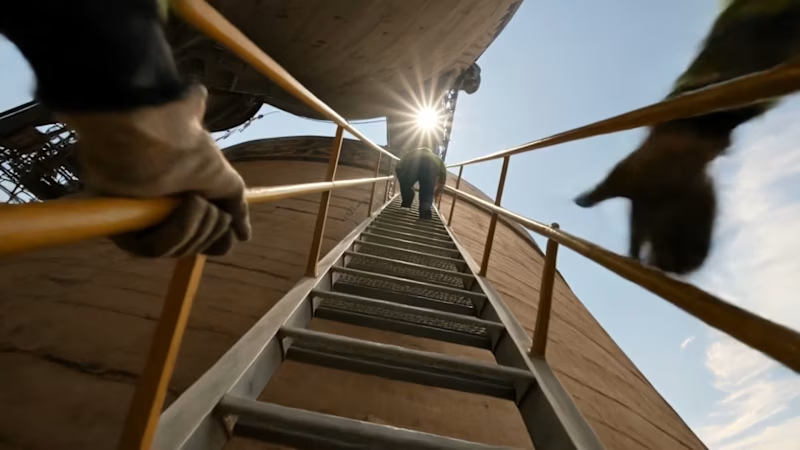
2,600 years ago, this small terracotta vessel held perfumed oil — carried on three legs, ringed with a frieze of a siren, a sphinx, a lion, and Aristaios, the mythical figure who gave humans agriculture. I scaled it up. What if it wasn't oil it was holding — what if it was grain? Turns out that's not even a stretch: farmers really did build silos out of fired clay tile in the early 1900s, before concrete and steel took over. So I rebuilt this piece as one — same tripod form, same painted frieze, wrapped around a real working structure: ladders, catwalks, conveyors, floodlights. Then I followed one worker through an ordinary day on it, dawn to night. The myth of the harvest, still holding up the harvest, 2,600 years later. Built entirely on floraai Original piece: Terracotta tripod kothon, The Met LINK (https://www.metmuseum.org/art/collection/search/255067)Instagram post (https://www.instagram.com/p/DdAZxCyGjHe/?img_index=1) Flora link (https://app.flora.ai/join-project/afb70048-3223-4bbf-bfd0-58666a5f7c22)Process, start to finish: 1-Sourced the original piece — Terracotta tripod kothon, The Met's open access archive 2-Researched the real history of terracotta silo construction (early 1900s hollow clay tile silos, and grain storage in fired clay going back millennia) to ground the concept in real material history, not just visual similarity 3-Designed the silo concept, merging the kothon's tripod form and painted frieze with a modern industrial grain silo structure 4-Iterated the silo image on FLORA until the frieze accurately matched the siren, sphinx, lion, dancers, spearmen, and Aristaios from the original 5-Built an 8-shot storyboard following one worker through a full day at the silo, from dawn to night 6-Generated and refined each storyboard frame, staying loyal to the locked silo design 7-Animated the storyboard into a continuous video on FLORA — motion, transitions, environmental sound, sparse dialogue, and a soft ambient score 8-Final cut and review. The walkthrough video is on the comments,i also did a second version.
2
269
Tolstoy
(2)
Follow
Message
Explore people