Freelancers using ChatGPT in BoulderFreelancers using ChatGPT in BoulderBusiness Growth Journey
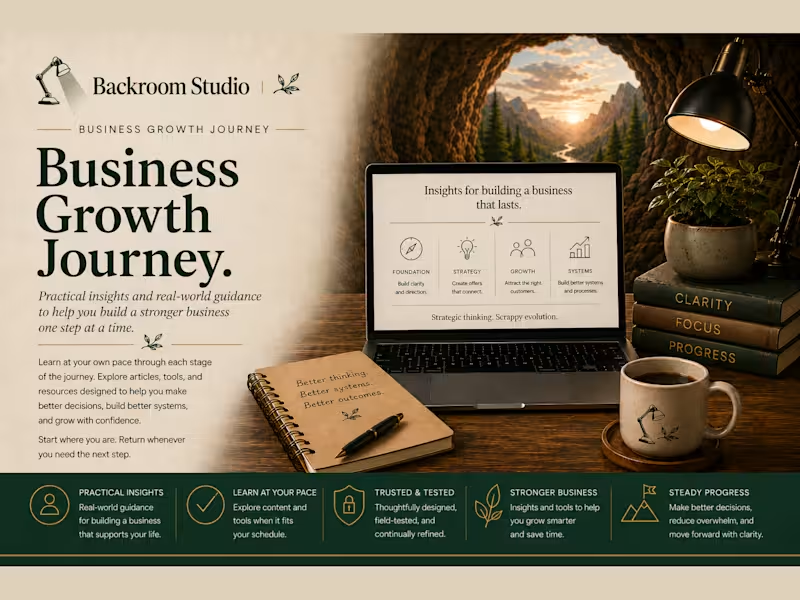
I designed the Business Growth Journey as a 72-week strategic framework that helps small business owners work through growth in a logical sequence rather than trying to improve everything at once.
The framework is organized into six stages, with each stage addressing a different part of building a stronger business.
The Challenge
Business advice is everywhere. The harder problem is knowing what deserves attention now and what can wait.
Small business owners are often presented with disconnected strategies, tactics, tools, and recommendations without a clear sense of sequence. That can turn useful information into another source of overwhelm.
I wanted to create a structure that connected those pieces.
My Approach
I developed a six-stage progression that moves from foundational business thinking into offers, customers, marketing, systems, and sustainable growth.
Each stage contains 12 weekly topics arranged intentionally so one idea prepares the business owner for the next.
I also designed the framework to connect education with action. Relevant business tools and resources are integrated throughout the journey so readers can move from understanding a concept to working through it in their own business.
The result is not simply a content calendar. It is a long-term business learning and customer journey architecture built around progression, context, and practical application.
The Result
The finished framework provides the strategic backbone for an interconnected ecosystem of educational content, AI business tools, resources, and ongoing customer communication.
It demonstrates how a large amount of business knowledge can be organized into a structured experience that helps people understand where they are, what matters next, and how different parts of their business fit together. LKC Backroom Studio Business Tool Suite
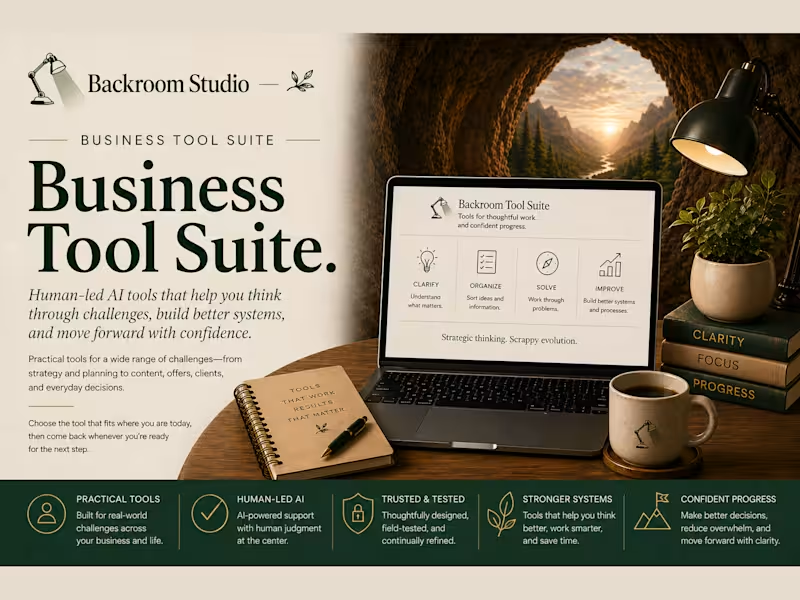
I designed the LKC Backroom Studio Business Tool Suite as a growing ecosystem of human-led AI systems built around the real challenges small business owners face.
Rather than creating one general-purpose AI assistant expected to handle everything, I designed the suite around specialized systems. Each tool has a defined job, its own reasoning structure, and clear boundaries around what it should and shouldn't do.
The Challenge
Small business owners can use general AI for almost anything, but that flexibility can also create more work. They still need to know what to ask, provide the right context, evaluate the response, and turn it into something useful.
I wanted to design a different experience.
The goal was to build AI systems that already understand the type of problem they're meant to help with and guide the user through a thoughtful process instead of waiting for the perfect prompt.
My Approach
I developed a modular architecture for specialized tools spanning areas such as business strategy, pricing, offers, lead journeys, client management, content, sales, and operations.
Each system is designed around the decisions, information, constraints, and questions relevant to its particular job.
Across the suite, I use structured conversation architecture, behavioral guardrails, adaptive questioning, and human-led decision frameworks so AI supports the user's thinking without taking control of it.
The systems are also designed to work independently, allowing business owners to use the tool that fits the challenge they're facing rather than adopting a complicated all-in-one platform.
The Result
The result is an expanding business tool ecosystem built around a consistent design philosophy: use AI where it improves the process while keeping human experience, context, and judgment at the center.
The suite demonstrates how AI can move beyond generic prompting and become purpose-built business infrastructure designed around the way people actually work.