The network for creativity
Join 1.25M professional creatives like you
Connect with clients, get discovered, and run your business 100% commission-free
Creatives on Contra have earned over $150M and we are just getting started
Back to feedPost

🚀 Helping Odoo Teams Fix Backend Bottlenecks, Automate Workflows, and Ship Faster
I work with Odoo partners, SaaS teams, and tech agencies that need senior backend support for complex ERP, automation, and integration projects.
Most Odoo projects don’t fail because of the UI.
They fail because of backend issues:
• Slow scheduled actions
• Broken API integrations
• PostgreSQL performance problems
• Manual finance or inventory workflows
• Duplicate records from automation flows
• AI outputs that are not safe for ERP usage
• Custom modules that break during upgrades
That’s where I help.
I specialize in:
✅ Custom Odoo module development
✅ Odoo v17/v18/v19 backend customization
✅ n8n workflow automation
✅ PostgreSQL query optimization
✅ Odoo API integrations
✅ Oracle / Fusion / enterprise system integrations
✅ Claude & OpenAI middleware for ERP workflows
✅ Pydantic-validated structured AI outputs
✅ Async white-label delivery for agencies
My core stack:
Python, Odoo ORM/API, PostgreSQL, FastAPI, Flask, Django, n8n, Docker, Redis, Claude API, OpenAI API, Oracle OCI, Oracle EPM FCCS, Oracle Fusion, AWS.
I can support projects as:
• Fixed-scope implementation
• Backend audit
• White-label subcontractor
• Automation specialist
• Long-term backend support partner
If your Odoo, Oracle, or automation project needs a reliable backend specialist, I’m open to remote contract work.
Let’s start with a small scoped task and let the work speak for itself.
The network for creativity
Join 1.25M professional creatives like you
Connect with clients, get discovered, and run your business 100% commission-free
Creatives on Contra have earned over $150M and we are just getting started







Related posts

I built The Quiet Chair, a booking experience for a fictional single-chair hair studio in Baner, Pune, run by a solo stylist named Mira.
Mira’s problem is simple: every booking message interrupts an appointment. Checking availability, confirming times, and handling changes take attention away from the customer in her chair.
The app lets customers choose a service, see available times, and receive an immediate booking confirmation. Availability accounts for opening hours, lunch breaks, existing appointments, and cleanup time. Customers can request a quiet appointment and use a secure link to reschedule or cancel, with online changes closing four hours before their appointment.
Mira has a protected owner workspace to view her daily agenda, check customer preferences, manage appointments, and block personal time.
I built it to turn “Can I book with you?” into “You’re booked” without needing a reply from the owner—and to make later changes just as straightforward. The result is fewer messages, fewer manual calendar checks, and more time for Mira to focus on her clients. @Lovable


Agent Evaluation Dashboard — Full-Stack LLM Observability Tool
Teams running AI agents in production need visibility into how those agents actually perform not just whether they respond, but how accurate, fast, and cost-efficient they are. I built a full-stack observability dashboard to solve exactly that: a single place to track accuracy, latency, API cost, and schema compliance across multiple LLM models and agent types.
What I built
A responsive Next.js (App Router) frontend styled with Tailwind CSS — deep purple sidebar, live accuracy/latency charts (Recharts), filterable eval-run tables, and per-model performance comparisons
A Python FastAPI backend serving the dashboard's data layer, with token-based authentication protecting every route
Full session handling: login, protected pages, automatic redirect for unauthenticated users
A fully responsive layout collapsible drawer sidebar on mobile, reflowing grid on tablet/desktop


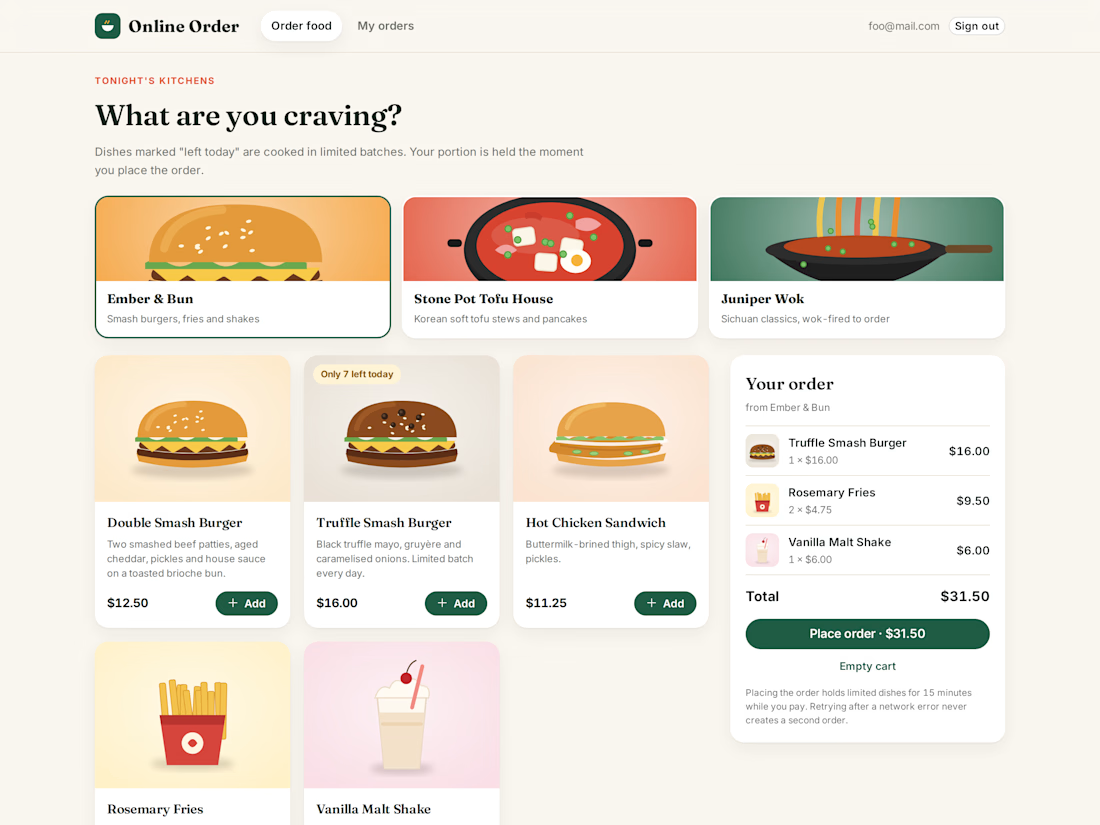
A food-ordering app for customers and kitchen staff: limited daily dishes, live order tracking, and a kitchen board that updates the moment a payment clears. The hard part is staying correct when many people act at once — limited stock is never oversold, a retried checkout never creates a second order, a duplicated payment webhook never charges twice, and every cent moves through a double-entry ledger. Each of those guarantees has an integration test against a real PostgreSQL database.
Spring Boot 3 (Java 21), React, PostgreSQL. The restaurants are fictional and payments go through a simulated card processor.
Code: github.com/Rolinmuuu/Online-Order