The network for creativity
Join 1.25M professional creatives like you
Connect with clients, get discovered, and run your business 100% commission-free
Creatives on Contra have earned over $150M and we are just getting started
Back to feedPost

StringTune-3D: Orchestrating WebGL through the DOM
Live demo: https://codesandbox.io/p/sandbox/stringtune-3d-filter-list-4v2z5q
Syncing HTML layouts with WebGL typically means verbose JS and 1-frame scroll lag. StringTune-3D solves this by enforcing the DOM as the strict single source of truth.
Instead of imperative Three.js glue code, 3D objects and materials are controlled exclusively via HTML attributes and CSS variables.
Mechanisms:
• Synchronous Mapping: Maps 3D meshes directly to CSS Grid/Flexbox bounding boxes, completely eliminating scroll jitter.
• CSS-to-Uniform: Parses properties like --filter into shader uniforms in real-time.
Zero manual matrix updates. Pure WebGL driven by CSS.
The network for creativity
Join 1.25M professional creatives like you
Connect with clients, get discovered, and run your business 100% commission-free
Creatives on Contra have earned over $150M and we are just getting started
Related posts

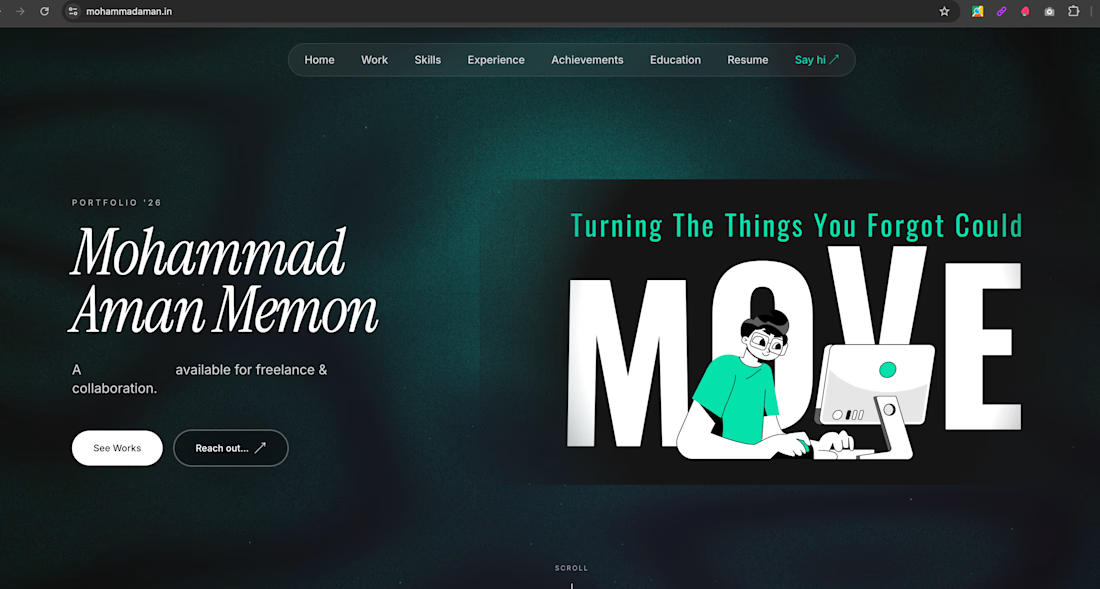
Built my personal portfolio from scratch using Next.js
& TypeScript. Features project showcase, skills, work
experience & contact — fully responsive & SEO optimized.
Live at mohammadaman.in



Project Title: Aura Spaces — Luxury Real Estate Conceptual Web Template
The Objective:
To design and build a high-fidelity, interactive concept landing page for upscale real estate developers and luxury architectural firms. The goal was to demonstrate how clean, ultra-minimalistic design can be paired with modern web interactions to build massive brand authority and engage high-ticket buyers.
The Solution:
Developed as a production-ready frontend sample using Next.js and Tailwind CSS, this project acts as a blueprint for luxury digital experiences. It avoids crowded layouts, leaning into heavy white space, sophisticated typography, and hardware-accelerated animations.
Key interactive design structures engineered into this template include:
Cinematic Fluidity: Seamlessly integrated video-driven elements in the hero layout, overlaid with a custom glassmorphic dynamic header.
Interactive Spatial Configurator: A functional floor plan selection module designed to showcase how architectural layouts can render dynamically to provide an intuitive user experience.
Visual Ergonomics: Custom card grids built with focused hover-states that subtly de-emphasize neighboring text to maximize focus on property metrics.
Luxury Component Ecosystem: A collection of highly reusable, minimal layout components engineered to be responsive across all devices while maintaining strict luxury brand guidelines.
Takeaway for Clients:
This live build highlights my approach to building interactive frameworks that feel high-end, smooth, and tailored specifically to luxury, architecture, and premium lifestyle markets.
check out The Template : https://aura-spaces-541844083157.asia-southeast1.run.app
intrested one can DM me to create their customised websites !

My latest web design exploration
Mount Fuji Web Design Concept built entirely in Framer
https://mt-fuji-web-concept.framer.website
Fully responsive with smooth scroll animation and the best part no single line of code applied.


Fantastic work! Every screen feels purposeful.













Trending

Claude
Claude has entered the design space. How are you using Claude Design?

Contra University
Learn from expert creatives how to earn more using next-gen AI tools.

MagicPath
The canvas is infinite, and exploration is becoming the workflow. How are you using MagicPath?
creativeaiflow
Creative AI workflows are evolving. What tools do you use, and what are their strengths and weaknesses?
freelancerlife
Freelancer life is wins, pivots, and everything in between. What’s yours right now?