The network for creativity
Join 1.25M professional creatives like you
Connect with clients, get discovered, and run your business 100% commission-free
Creatives on Contra have earned over $150M and we are just getting started
Back to feedPost

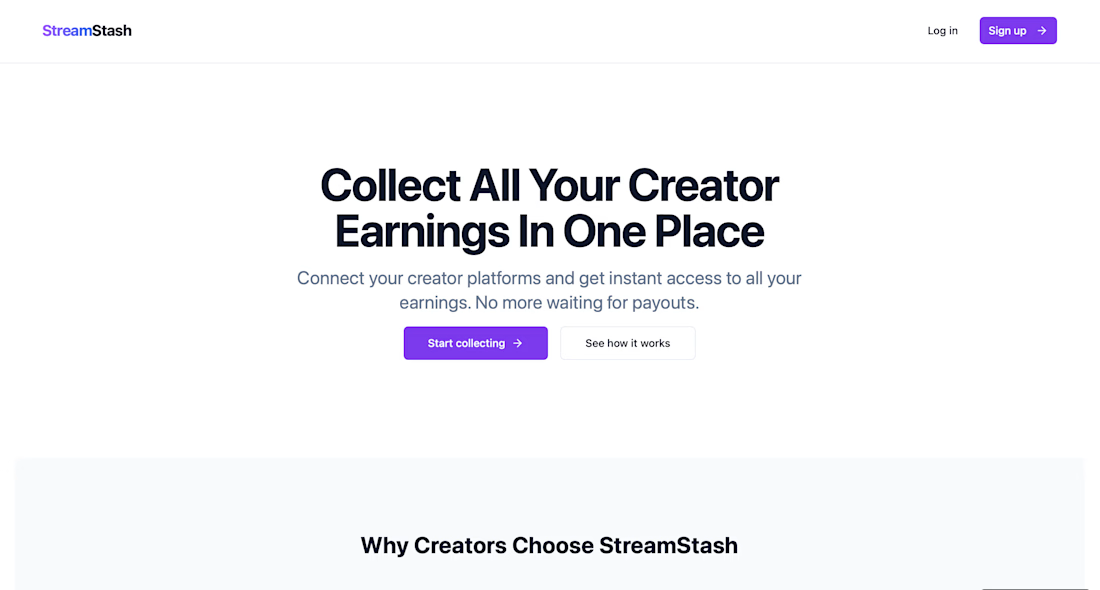
StreamStash is a fintech platform built for digital creators — musicians, streamers, vloggers, influencers, and online entrepreneurs — to organize, track, and access their earnings across multiple platforms in one place.
The idea behind StreamStash is simple:
Creators today make money from many different sources:
Streaming revenue
Brand deals
YouTube monetization
TikTok payouts
Affiliate income
Merchandise sales
Donations and subscriptions
Sponsorships
But all of those payments arrive at different times, on different platforms, with different payout rules.
StreamStash acts like a financial command center for creators.
What It Does
Unified Creator Dashboard
Creators can connect multiple income platforms and view:
Total earnings
Pending payouts
Monthly revenue trends
Platform performance
Estimated future income
Faster Access to Earnings
One of the platform’s goals is reducing the long wait creators face before getting paid.
StreamStash is designed to support:
Instant payouts
Early payout access
Revenue advances
Flexible withdrawal systems
Especially for independent creators who rely on consistent cash flow.
AI Financial Assistant
A future-facing part of StreamStash is AI-powered creator finance support.
The AI layer could:
Forecast upcoming income
Analyze spending patterns
Suggest budgeting strategies
Predict slow revenue periods
Recommend growth opportunities
Help creators understand taxes and business finances
Not replacing accountants — more like giving creators a smart financial operations assistant.
Why It Matters
Most creator tools focus on content creation.
StreamStash focuses on the business side of being a creator.
That matters because a lot of talented creators:
don’t understand cash flow,
get paid inconsistently,
struggle with taxes,
or can’t scale because their finances are fragmented.
StreamStash aims to make creators feel less like freelancers surviving month-to-month and more like actual digital businesses.
Positioning
The platform sits somewhere between:
creator economy tools,
digital banking,
creator analytics,
and fintech infrastructure.
Think:
“Plaid + Stripe + creator analytics + AI finance copilot for creators.”
And frankly, the creator economy still has a giant hole here. Everybody wants creators to make content. Very few companies are helping creators build financial stability.


The network for creativity
Join 1.25M professional creatives like you
Connect with clients, get discovered, and run your business 100% commission-free
Creatives on Contra have earned over $150M and we are just getting started



Related posts




We are testing two ways to browse a large template library.
Load More
Users initially see 9 cards. After clicking the button, 9 more are added while the previous results remain visible. Browsing feels continuous, but the page gradually becomes longer.
Pagination
The catalog is divided into numbered groups. When users select the next page, the current 9 cards are replaced with a new set. They can jump to a specific part of the catalog and easily return to where they were.
Load More creates a smoother browsing experience, while pagination offers greater control.
Which option would you choose for a template library?

17 voted
68%
8 voted
32%
25 votes
Closed

Load more

EchoMind is live on the Framer Marketplace.
It’s a calm, editorial shop template for brands that make physical things: hardware, objects, small product lines. I designed the brand, generated the product photography and built every page in Framer.
What’s inside:
20 pages, each designed for desktop, tablet and phone
CMS-driven shop with working price sort
Product pages with gallery, specs and FAQs
A build-your-own configurator with live pricing
A bag with quantities and discount codes
Journal with hover image previews
Launch, studio, support and gift card pages
The product itself is fictional: a modular mixing desk where one core listens to your mix and suggests one fix at a time. I wanted the template to feel like a real brand from day one, so it’s been built and photographed like one.
Get the template: https://www.framer.com/marketplace/templates/echomind/


Congrats on the launch, Jonathan. Designing the brand, the photography and every page yourself gives it a clear voice. What was the hardest part of building a shop template in Framer?