The network for creativity
Join 1.25M professional creatives like you
Connect with clients, get discovered, and run your business 100% commission-free
Creatives on Contra have earned over $150M and we are just getting started
Back to feedPost


My process always starts messy. There's no clean line from idea to finished piece, just a rough, half-formed feeling I have to sit with until it starts making sense.
For this project — a new visual concept for an Italian artisanal liqueur brand — that's exactly how it went.
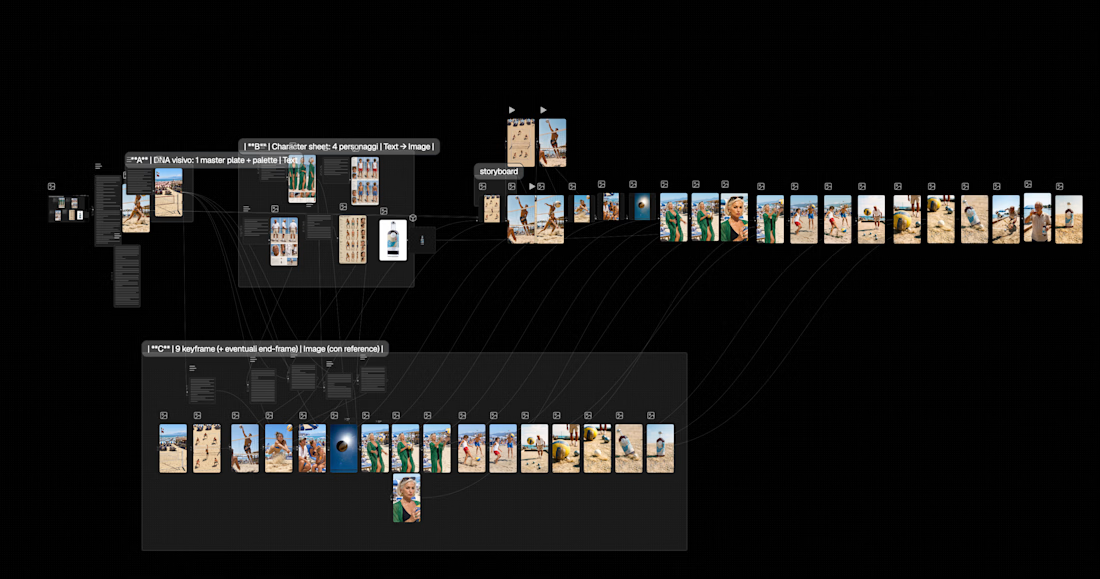
Step 1: ideation and rough ideas. I began with scattered notes, mood fragments. Nothing usable yet. Even Even my AI assistants got lost trying to make sense of my notes.
Step 2: character references. Once the tone started to settle, I moved on to building visual references for the characters, figuring out who would inhabit this world and how they should look and move.
Step 3: the full storyboard. From there, the whole sequence came together: frame by frame, the story finally had a shape.
Now I'm at the next stage. Turning that storyboard into an actual video. It's early days on this one (I only recently started working this way on @FLORA and I already used all the credits. I'll have to improve my workflow).
More soon ;)
The network for creativity
Join 1.25M professional creatives like you
Connect with clients, get discovered, and run your business 100% commission-free
Creatives on Contra have earned over $150M and we are just getting started



Related posts

I've been testing the new Kling Image 4.0 + Kling Video 4.0 workflow, and I'm really impressed with the results!
What makes this combination particularly interesting is the ability to create original visuals with Kling Image 4.0 and then bring them to life using Kling Video 4.0.
I put together a short breakdown of my workflow, showing how I go from image generation to a cinematic video sequence.
The results are great, and I can already see how useful this pipeline can be for my upcoming creative projects.
Definitely a workflow I'll be using more often!
Check out the video to see the process in action. 🎬
#KlingAI #KlingImage4 #AIWorkflow #AIFilmmaking #MotionDesign #CreativeProcess


Clean result. Image-first then animate is the workflow that keeps a character consistent, the jacket and helmet detail hold up through the motion. How many takes did the video step need before the fabric moved like that?



📌When you animate for an agency's client, you're designing for two audiences at once. In white-label work, fewer revision rounds are the real deliverable.
The script grew with every line, so the animation had to grow too.
Levo's story goes from one thought to a full team workspace. That led to three decisions:
→ Open on a single element with nothing else on screen
→ Add UI layers only when the voiceover earns them
→ Save the full-workspace reveal for the tagline
Matching scale to the script keeps the viewer oriented.
💎Note: This is a self-initiated study, not client work. We recreated Notion's product video under a placeholder brand, "Levo," to test whether we could match that level of craft.
→ Check for more work.
