How Supply Chain Technology Is Transforming Modern Logistics Modern supply chains are becoming in...How Supply Chain Technology Is Transforming Modern Logistics Modern supply chains are becoming in...
The network for creativity
Join 1.25M professional creatives like you
Connect with clients, get discovered, and run your business 100% commission-free
Creatives on Contra have earned over $150M and we are just getting started
How Supply Chain Technology Is Transforming Modern Logistics
Modern supply chains are becoming increasingly complex. Businesses now coordinate manufacturers, suppliers, warehouses, transportation providers, distributors, and customers across multiple locations. Managing all these moving parts efficiently requires more than spreadsheets and disconnected systems.
Technology is helping organizations create more connected, transparent, and data-driven supply chains. From real-time tracking and inventory management to automation and predictive analytics, digital solutions are changing how businesses plan and manage logistics operations.
Why Supply Chain Technology Matters
Traditional supply chain processes often rely on manual data entry, emails, spreadsheets, and separate software systems. These approaches can make it difficult to maintain accurate information across different departments and partners.
A modern digital supply chain can connect operational data across procurement, inventory, warehousing, transportation, and order management. This allows businesses to make decisions using more timely and consistent information.
Key benefits can include:
i. Better inventory visibility ii. Faster order processing iii. Improved shipment tracking iv. Reduced manual work v. Better demand planning vi. Greater operational transparency vii. Improved coordination between supply-chain partners
The Role of Supply Chain Software
Supply chain software acts as a central technology layer that helps businesses manage different parts of their logistics operations.
Depending on the organization's requirements, a platform may include inventory management, warehouse management, transportation management, procurement, order processing, supplier management, analytics, and reporting.
Rather than maintaining isolated systems for each process, businesses can connect these functions through integrated software.
For example, an order management system can communicate with inventory and warehouse systems to determine product availability before an order is processed. Transportation information can then be connected to shipment tracking, giving businesses better visibility from order placement through delivery.
Real-Time Visibility Across the Supply Chain
Visibility is one of the biggest priorities for modern supply-chain operations.
Businesses need to know where products are, how much inventory is available, whether shipments are delayed, and whether suppliers are meeting expected timelines.
Modern software can collect information from warehouses, vehicles, sensors, enterprise systems, and other data sources. This information can then be presented through dashboards and alerts.
Instead of discovering a supply problem after it has already affected customers, managers can identify potential disruptions earlier and take corrective action.
Automation and Artificial Intelligence
Automation is becoming increasingly important in supply-chain management.
Software can automate repetitive tasks such as inventory updates, purchase-order processing, shipment notifications, document management, and routine reporting.
Artificial intelligence can add another layer of intelligence by helping organizations analyze large datasets and identify patterns.
For example, predictive models can analyze historical sales, seasonal trends, supplier performance, and other variables to support demand forecasting.
AI should not replace human decision-making in every situation. Instead, it can provide data-driven recommendations that allow supply-chain teams to respond faster and focus on higher-value activities.
IoT and Connected Supply Chains
The Internet of Things is also contributing to supply-chain visibility.
Connected sensors and devices can provide information about location, temperature, humidity, movement, and other conditions.
This can be particularly valuable for industries transporting sensitive products. For example, temperature monitoring can help organizations identify potential problems during pharmaceutical or food shipments.
When IoT data is integrated with supply-chain software, organizations can move from simply tracking events to responding automatically when specific conditions occur.
Blockchain and Supply Chain Transparency
Blockchain can provide another layer of transparency for selected supply-chain applications.
Multiple organizations may need to share information about a product's movement or origin, while each participant maintains its own internal systems. A blockchain-based architecture can provide a verifiable record of selected transactions or events.
Smart contracts can also automate predefined processes when verified conditions are met.
However, blockchain should not be introduced simply because it is technologically interesting. Businesses should first determine whether shared verification, traceability, or programmable transactions solve an actual operational problem.
Choosing the Right Technology Partner
Building a modern supply-chain platform requires expertise across software architecture, APIs, databases, cloud infrastructure, analytics, security, and logistics workflows.
A supply chain software development company should understand both the technical and operational sides of the project. The development team needs to understand how procurement, inventory, warehousing, transportation, and order management processes interact.
Before selecting a technology partner, businesses should evaluate:
i. Experience with supply-chain workflows ii. Integration capabilities iii. Scalability iv. Data security v. Cloud and infrastructure expertise vi. Analytics and reporting capabilities vii. Mobile and web development viii. Long-term maintenance and support
The right partner should be able to translate operational requirements into a scalable digital architecture rather than simply delivering a collection of software features.
Building Scalable Supply Chain Platforms
A supply-chain platform needs to support changing business requirements.
As organizations expand into new markets, add suppliers, increase order volumes, or introduce new transportation networks, their software must be capable of scaling with them.
Modern supply chain software development therefore needs to consider scalability from the beginning. Modular architecture, APIs, cloud infrastructure, and well-designed data models can make it easier to add new capabilities without rebuilding the entire system.
Security is equally important. Supply-chain platforms may handle sensitive information about suppliers, customers, inventory, pricing, shipments, and business operations. Access controls, encryption, authentication, monitoring, and appropriate compliance measures should therefore be part of the architecture.
The Future of Digital Supply Chains
Supply chains are moving toward increasingly connected ecosystems where data flows between businesses, software platforms, logistics networks, and physical assets.
Technologies such as artificial intelligence, IoT, cloud computing, blockchain, automation, and advanced analytics can each contribute to this transformation.
The most successful implementations, however, will not necessarily be the ones using the largest number of technologies. They will be the ones that solve clearly defined operational problems and deliver measurable improvements.
Businesses should therefore begin with their supply-chain challenges, identify where technology can create the greatest value, and then build an architecture around those requirements.
Conclusion
Modern supply chains require visibility, flexibility, automation, and reliable data. Digital technology can help businesses move away from fragmented processes and toward connected operations.
By combining integrated software with technologies such as AI, IoT, cloud computing, analytics, and blockchain where appropriate, organizations can create supply chains that are more responsive and better prepared for changing market conditions.
The goal is not simply to digitize existing processes. It is to build a supply-chain ecosystem that enables better decisions, faster responses, and sustainable operational growth.

devtechnosys.com

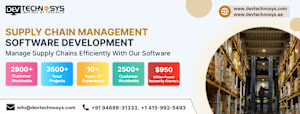
Supply Chain Software Development Services

Dev Technosys provides supply chain software development services that automate operations, boost visibility, and reduce costs. Get a free quote!

Back to feed
The network for creativity
Join 1.25M professional creatives like you
Connect with clients, get discovered, and run your business 100% commission-free
Creatives on Contra have earned over $150M and we are just getting started