The network for creativity
Join 1.25M professional creatives like you
Connect with clients, get discovered, and run your business 100% commission-free
Creatives on Contra have earned over $150M and we are just getting started
Back to feedPost

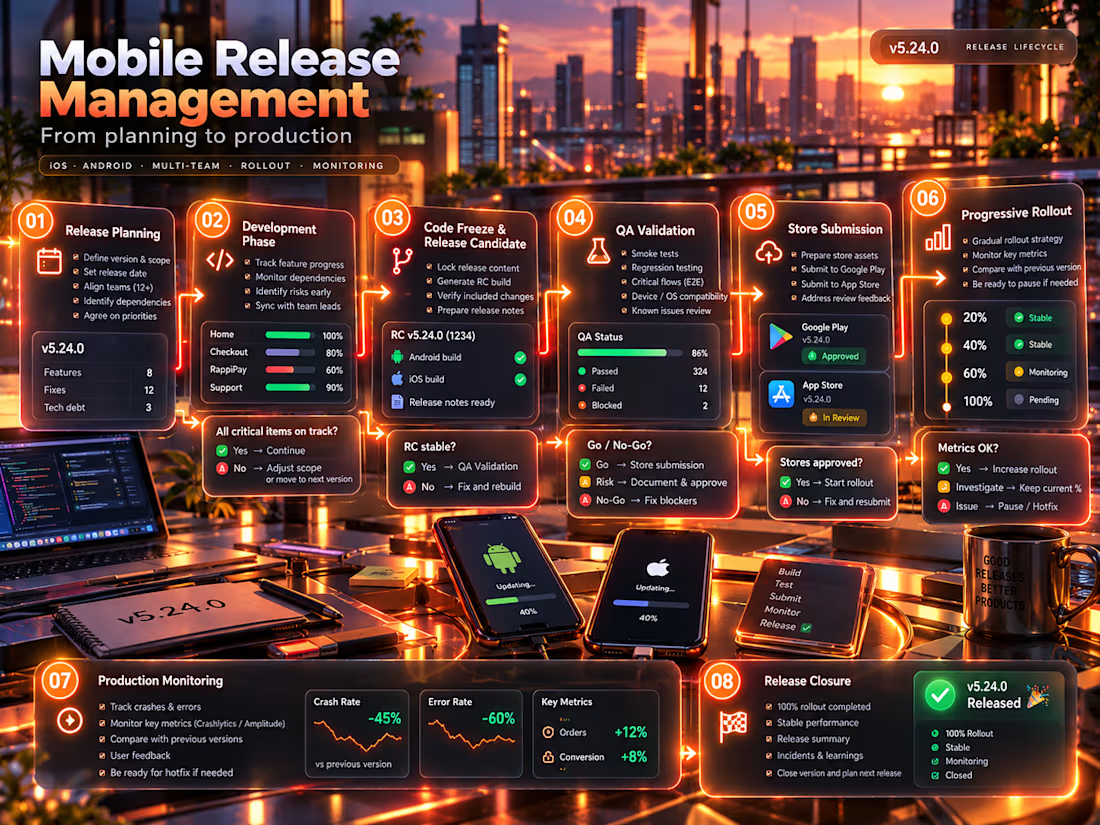
Mobile Release Management — From Planning to Production
A successful release is not just about getting a new version into production.
The goal is to move a version through development, validation and rollout with clear visibility of its status, dependencies and risks, making the right decisions at each stage before increasing its exposure to users.
This workflow represents the lifecycle of a mobile release from the initial planning stage to a stable production deployment.
01 — Release Planning
Every release starts by defining what is expected to be delivered.
The version scope, target dates, participating teams and major dependencies are identified before the release cycle moves forward. Critical features and fixes should have clear ownership and expected delivery dates.
Potential risks should also become visible early, while there is still time to react to them.
Expected result: a defined release scope with aligned teams, ownership, dependencies and timeline.
02 — Development Phase
As development progresses, the status of the release changes continuously.
Features and fixes move toward completion while dependencies, blockers and unexpected changes can affect the original plan. The release scope needs to remain visible so these changes can be evaluated before they become release-day problems.
If a critical item cannot be completed safely within the expected timeline, its impact on the release must be assessed.
This creates an important decision point:
Is the critical scope on track?
🔷 Yes → continue toward the Release Candidate
🔶 At risk → evaluate dependencies and available options
♦️ No → adjust the scope or move the affected change to a future version
Expected result: a realistic release scope containing changes that are actually ready to move forward.
03 — Code Freeze & Release Candidate
Once the planned content is ready, the release scope is closed and a Release Candidate can be generated.
The objective of this stage is to establish a stable build containing the changes expected for production.
Included features, fixes, versions and platform builds should match the agreed release scope before final validation begins.
Is the Release Candidate ready for validation?
🔷 Yes → move to QA validation
♦️ No → resolve the issue and generate a new candidate
Expected result: a controlled and identifiable Release Candidate ready for final testing.
04 — QA Validation & Go / No-Go
The Release Candidate is validated before production exposure begins.
Testing can include smoke tests, regression coverage, critical end-to-end flows, device and operating-system compatibility, and verification of known issues.
The objective is not necessarily to reach a version with zero known issues. It is to understand the actual quality status of the build and the risk associated with releasing it.
This leads to one of the key decisions of the release:
GO / NO-GO
🔷 GO → quality is acceptable for release
🔶 Risk identified → document and evaluate before proceeding
♦️ NO-GO → resolve critical blockers before release
Expected result: a release decision supported by known testing results, risks and blockers.
05 — Store Submission
Once approved for release, the Android and iOS builds move into their respective store processes.
Each platform can have a different status. One build may already be approved while another remains under review or requires additional action.
For that reason, Android and iOS should remain independently visible throughout the submission process.
Are the builds approved for distribution?
🔷 Yes → prepare production rollout
🔶 In review → monitor store status
♦️ Rejected → address the issue and resubmit
Expected result: approved production builds with a clear status for each platform.
06 — Progressive Rollout
Store approval does not necessarily mean immediate exposure to 100% of users.
A progressive rollout allows the new version to reach production gradually:
20% → 40% → 60% → 100%
Each increase becomes a checkpoint.
Production stability, crashes, errors, critical flows and other available signals can be evaluated before exposing the version to a larger audience.
Is the release behaving as expected?
🔷 Stable → increase rollout
🔶 Uncertain → maintain the current percentage and investigate
♦️ Critical issue → pause rollout and activate the appropriate response
Expected result: controlled production exposure where rollout decisions are based on observed stability rather than simply elapsed time.
07 — Production Monitoring
Once real users begin receiving the version, production becomes the final validation environment.
Crash information, errors, analytics, key user flows and feedback help determine whether the release is behaving as expected at scale.
The new version can also be compared with previous versions to identify unexpected changes associated with the release.
If an important anomaly appears, rollout progression can be reconsidered before additional users are affected.
Expected result: early visibility into the real production behavior of the new version.
08 — Release Closure
A release is complete when the intended rollout has been reached and the version demonstrates stable production behavior.
The final state should include the rollout result, relevant incidents, known issues, production observations and any lessons that should influence upcoming versions.
At this point, the release lifecycle can be formally closed and attention moves toward the next version.
Expected result: a stable production version with its lifecycle, decisions, risks and final status clearly documented.
Final Outcome
The ideal result is not simply “the new version was published.”
It is a release that moved from planning to production through controlled checkpoints, with clear visibility across teams, informed Go / No-Go decisions, gradual user exposure and production evidence supporting each step forward.
Plan → Develop → Validate → Decide → Release → Monitor → Stabilize → Close
Note: The versions, interfaces, metrics and scenarios shown in this project are illustrative and were created exclusively to represent a release management workflow. For confidentiality reasons, no internal data, documentation or proprietary materials from the companies and products I have worked with are displayed.


The network for creativity
Join 1.25M professional creatives like you
Connect with clients, get discovered, and run your business 100% commission-free
Creatives on Contra have earned over $150M and we are just getting started





Related posts

Switching a client site to automatic production deploys is rarely a decision anyone made. It was the platform default, left on, then defended later as philosophy.
What it saves is a click and the awkward message asking a client to open the preview URL again. Both land on the developer. What it costs is the publish decision, handed to whoever merges next, with whatever the branch holds.
On a product team that's fine. On client work the merger owns the code and the client owns the brand.
Every host ships the fix. Netlify locks the published deploy. Vercel stages the push once you turn off auto-assigned production domains. Actions uses environment protection rules when the approver shouldn't be the author.
If your live deploy turned out to be wrong right now, could you name the deploy ID you'd roll back to?
https://www.duskolicanin.com/blog/manual-production-deploy-client-websites



We’re building something new for creators who make serious digital products—playbooks, software, 3D assets, and high-value tools.
Introducing Strum ⚡️
Most marketplaces take huge cuts or flood buyers with low-quality clutter. We’re building a curated, performance-based launchpad designed to put real revenue back into creators' pockets.
• 80% creator revenue split
• Dedicated launch marketing & ad strategy
• Curated catalog of high-impact digital products
We’re currently hand-selecting our 10 Founding Creators for the official launch.
If you build high-converting digital assets or software tools, DM me or comment below.
Big things dropping soon—stay tuned. 👀🚀




built a tamagotchi that thinks it's a space station.
your steps = kinetic energy. your sleep = hydration turgor. your screen time = solar flux.
check in on your tiny creature suspended in a glass terrarium and pretend you're running a biosphere, not a to-do list 🌿📟
DRIFT — currently in the wild


steps as kinetic energy, fun idea