The network for creativity
Join 1.25M professional creatives like you
Connect with clients, get discovered, and run your business 100% commission-free
Creatives on Contra have earned over $150M and we are just getting started
Back to feedPost

Streaming an AI response is only one part of a useful writing product.
In Content Sprout, I connected OpenAI generation to a Next.js editor through NestJS APIs. The practical work was making the output usable: showing text as it arrived, moving it into an editable document, and supporting search and pagination around the content library.
The lesson I keep coming back to: design the workflow after generation as carefully as the prompt. People need to review, edit, find, and reuse the result.
I work on full-stack AI integrations with Next.js, NestJS, TypeScript, and API-driven products.
The network for creativity
Join 1.25M professional creatives like you
Connect with clients, get discovered, and run your business 100% commission-free
Creatives on Contra have earned over $150M and we are just getting started
Related posts

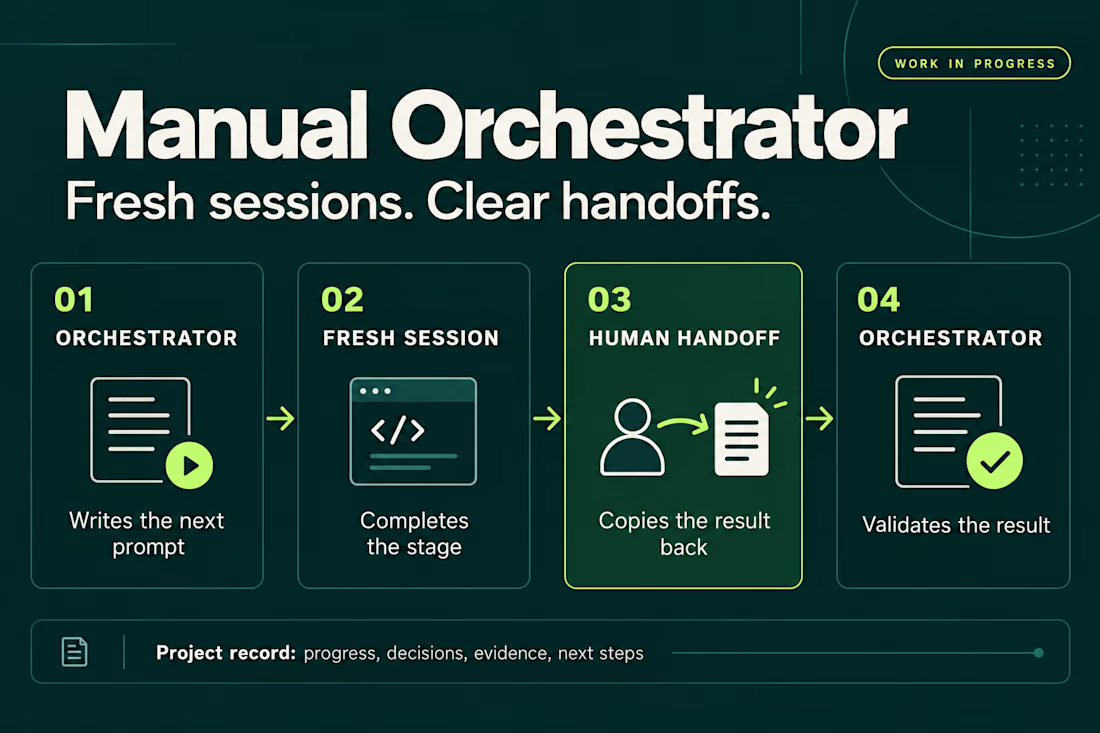
I’ve been working on a small skill called Manual Orchestrator to make longer projects with AI agents easier to manage.
The problem started with a familiar situation: one chat would accumulate plans, implementation details, corrections, and test results. By the time I was ready for the next phase, I wanted a fresh conversation without losing the decisions we’d already made.
Manual Orchestrator gives that process some structure. One chat acts as the orchestrator: it breaks the work into stages and writes a prompt for the next one. I run that prompt in a new session, then bring the result back. The orchestrator reviews it against the stage’s criteria before preparing the next prompt. If something needs fixing, I go back to the same worker session.
The skill also keeps a record in the project with the current stage, decisions, evidence, and next steps. That makes it easier to pause, resume, or hand the work to another session.
The handoff is manual. I choose when to open a session and carry the result back. The orchestrator and worker sessions can also use different agent CLIs, with the prompt adapted to the capabilities available.
It’s open source and still a work in progress. I’m using it to learn what helps in practice and where the workflow needs to improve. Installation has been checked for Codex, Claude Code, and Gemini CLI, but the full workflow hasn’t been tested across every CLI or version.
If you try it, I’d be interested in hearing what works and where it gets in your way.


For an AI scribe, I'd test what happens when someone switches encounters while a draft is still generating.
In my Arogya / Aurora EHR work, typed or dictated rounds become editable drafts. AI content stays advisory, and a clinician explicitly approves anything added to the chart.
The first response should stay attached to its original encounter. Before saving, I'd check that the encounter being reviewed still matches the draft, as well as requiring clinician approval.
That context check belongs in the save workflow, even when the draft reads well.
kapilchauhan.netlify.app
Arogya / Aurora EHR: AI for inpatient care | Kapil Chauhan
Production hospital and EHR platform that accelerates rounds, documentation, records, and care operations with clinician-reviewed AI.

✨ New Year, on loop — literally.
This seamless sparkler-celebration character loop is built to run endlessly for New Year campaigns on TikTok, Reels and Meta — no cut, no restart, just continuous celebration.
Want a looping character video for your brand's next campaign? I create AI UGC product video ads from $50, first drafts in 48–72 hours, 2 revisions included.
https://contra.com/s/gXq6FWFe-ai-ugc-product-video-ad-for-tik-tok-reels-and-meta
