The network for creativity
Join 1.25M professional creatives like you
Connect with clients, get discovered, and run your business 100% commission-free
Creatives on Contra have earned over $150M and we are just getting started
Back to feedPost

Why Your Startup’s Scaling Strategy is a Financial Time Bomb 💣
Most venture-backed founders think recruitment is a matching game of "skills" and "budget."
It isn’t. In high-growth phases, traditional recruitment is a massive cash drain. You review a clean CV, match the candidate's technical skills, onboard them, and then watch them suddenly exit or completely paralyze your team’s culture six months later.
Why? Because you are screening for current capacity while completely ignoring their localized psychological runway.
When scaling an enterprise into hyper-competitive hubs—especially volatile talent markets like the Gulf—failed onboarding happens because a candidate's actual Needs Intensity is fundamentally misaligned with your operational timeline. If you hire someone out of high systemic desperation, you aren't hiring a long-term asset; you are hiring a flight risk who will jump ship or commit high-stakes operational errors the moment an immediate financial patch is cleared.
To protect my clients' profit margins, I don't use standard HR questionnaires. I built and deploy a proprietary structural framework—the Maslow-Siddique Hierarchy Adaptation—to mathematically isolate a candidate's motivational trajectory before they ever sign an offer letter.
We filter out the legacy liabilities and toxic culture matches before they drain your bank account.
Stop treating recruitment like a lottery. If you are ready to engineer an unshakeable organizational architecture, let’s sync.
#humanresources #operationsmanagement #businessstrategy #consulting
The network for creativity
Join 1.25M professional creatives like you
Connect with clients, get discovered, and run your business 100% commission-free
Creatives on Contra have earned over $150M and we are just getting started
Related posts

I ghostwrite for founders, creators, and business owners who have the ideas but not the time.

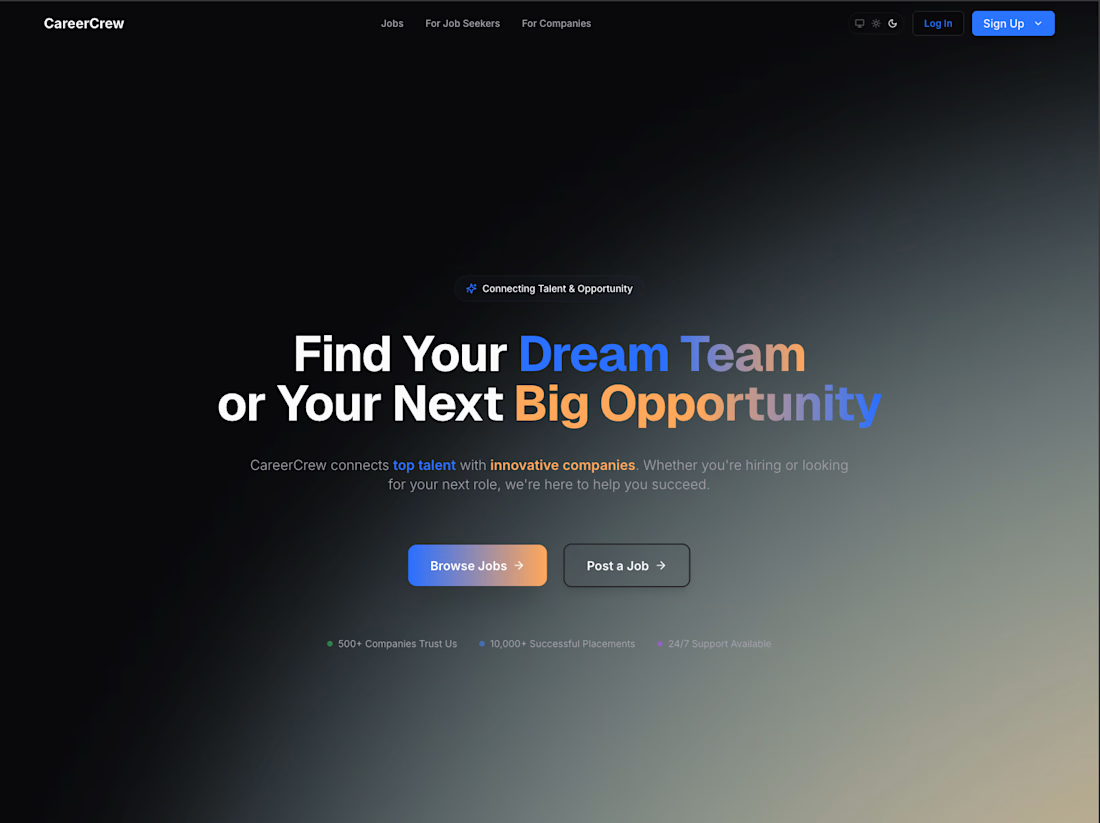
Built a full-stack Job search platform connecting companies with candidates through role-based dashboards and application flows.




Every time, I think the same thing: the legacy system isn't the real problem - the inaction is.
The decision gets pushed to next quarter. Then the quarter after that. Meanwhile, competitors who moved are pulling ahead. They're integrating AI, shipping faster, and serving customers better.
Here's the hard truth: you can't bolt AI onto brittle architecture. The foundation has to be solid first. There is no shortcut around that.
In finance, especially, the stakes are higher than in most industries: regulatory pressure, data complexity, and security requirements that don't forgive technical debt.
The good news: modernization doesn't have to mean ripping everything out and starting over. A phased, architecture-led approach works. It's how we've done it for 15+ years at CodeGeeks Solutions, helping FinTech and finance enterprises untangle legacy systems, rebuild for scale, and lay the groundwork for real AI integration. CTO-level oversight on every engagement.
Before any of that, a few questions worth sitting with:
➤ How far ahead are your competitors while you're still deciding?
➤ Is your current architecture actually ready to support AI - or just ready to fake it?
➤ What's your regulatory exposure if a legacy failure surfaces before you've acted?
➤ And what's the full cost of another quarter of inaction?
















Trending

Claude
Claude has entered the design space. How are you using Claude Design?

Contra University
Learn from expert creatives how to earn more using next-gen AI tools.

MagicPath
The canvas is infinite, and exploration is becoming the workflow. How are you using MagicPath?
creativeaiflow
Creative AI workflows are evolving. What tools do you use, and what are their strengths and weaknesses?
freelancerlife
Freelancer life is wins, pivots, and everything in between. What’s yours right now?