The network for creativity
Join 1.25M professional creatives like you
Connect with clients, get discovered, and run your business 100% commission-free
Creatives on Contra have earned over $150M and we are just getting started
Back to feedPost

73% of finance professionals say their business
is growing faster than their team can handle manually.
That gap doesn't close by hiring more people.
It closes with automation.
Here's what a fully automated finance workflow looks like:
→ Invoice arrives → AI extracts and codes it automatically
→ Approval workflow triggers with no human setup
→ Payment initiated directly from the system
→ Report generated and sent on schedule
→ Everything logged, auditable, compliant
Month-end close: from 5 days to 4 hours.
Zero manual data entry. Zero errors from fatigue.
I've built this for a Moroccan accounting firm
using n8n and Make.com.
The setup took 3 days.
The time savings were immediate and permanent.
If your finance team is still doing this manually —
you're not behind on technology.
You're paying for it in wasted hours every week.
Message me to map your current workflow
and find where automation delivers the fastest ROI.
— Yosr Faris | AI & Finance Automation Expert
n8n · Make.com · Claude API · Next.js
Available worldwide 🌍

The network for creativity
Join 1.25M professional creatives like you
Connect with clients, get discovered, and run your business 100% commission-free
Creatives on Contra have earned over $150M and we are just getting started


Related posts


Clients often start with the same request: "Let's build an AI agent."
My counter-question is always: which manual process actually costs you time, errors, or money right now?
My selection rule: remove it first. If it can't be removed, simplify it. If it's still needed, automate it with a plain script. Only then add an integration or an agent. Often the best result is the process that no longer exists.
Safe automation means real scenarios, error handling, and alerts. Without alerts, a workflow can silently lose data for weeks. I always define what stays with a human and what goes to the system.
Question for you: which process would you automate first, and why is it still manual?
Service for audit and implementation: https://contra.com/s/BmWLbgFU-ai-automation-from-your-dream-to-working-implementation?r=auto_booster



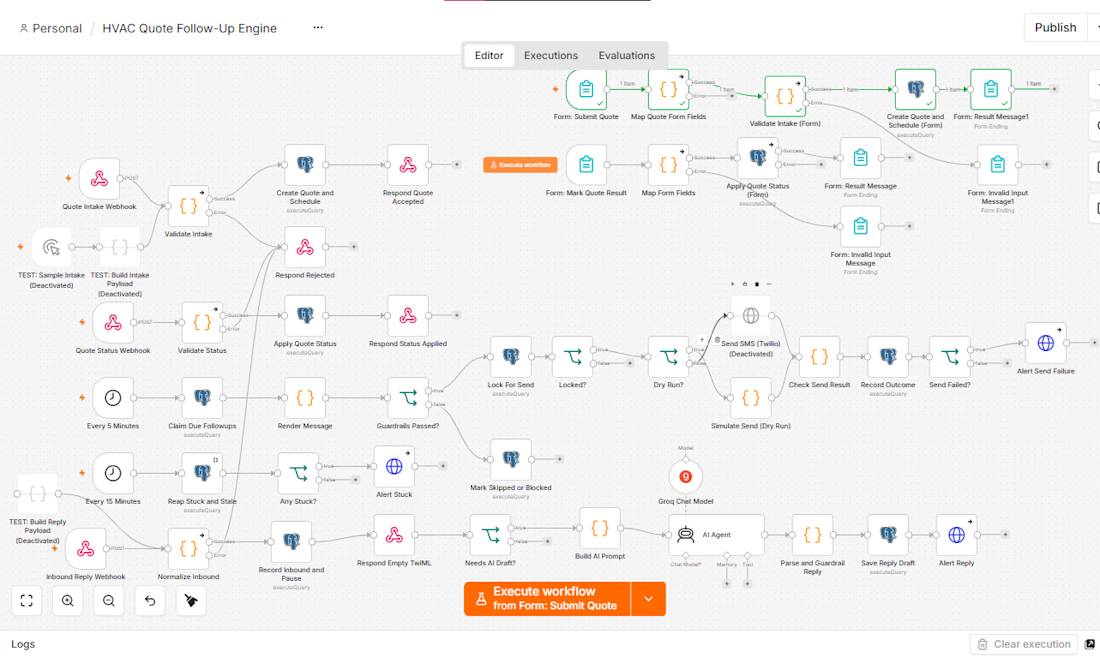
Quote Follow-Up Automation for HVAC & Plumbing
Most home-service quotes don’t get rejected, they just go quiet. I built a system that follows up on them automatically.
What it does
Takes each quote through a simple form
Schedules up to 8 timed texts over 30 days
Stops instantly on a reply, a STOP, or a booked/lost update
Uses AI to draft replies to objections, with a human approving every one
Built with safety first
No duplicate texts, even when processes overlap
Only contractor-approved wording is sent
Texts go out only during local business hours
Opt-outs are honored immediately
Stack: n8n, Postgres, Groq, Docker, Twilio
Status: built and tested end to end, ready to pilot.
I build automation systems like this for service businesses. Message me if you’d like one for yours😊 .