The network for creativity
Join 1.25M professional creatives like you
Connect with clients, get discovered, and run your business 100% commission-free
Creatives on Contra have earned over $150M and we are just getting started
Back to feedPost

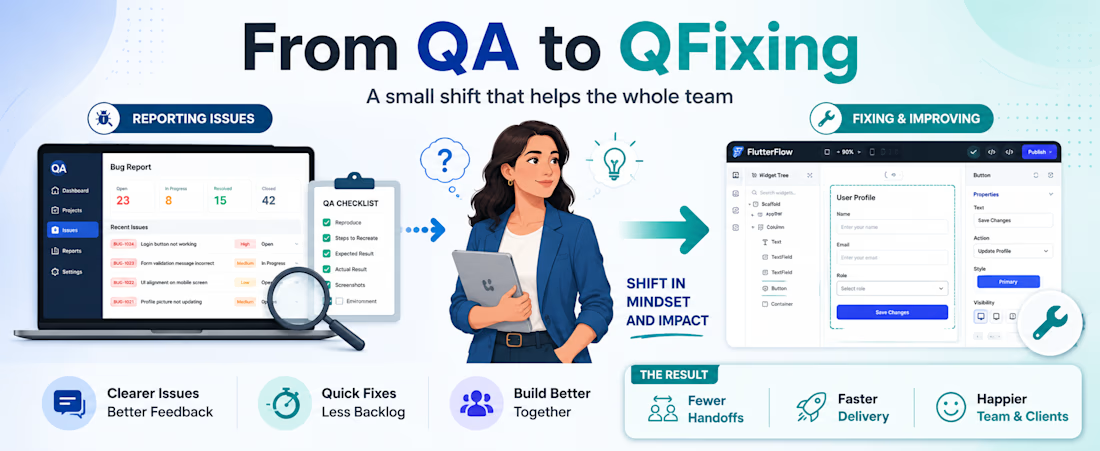
From QA to QFixing: Expanding the Role of Quality Assurance
by Hiba Al Fayssal, Quality Assurance Manager, InfiniteUp
Quality assurance bug fixing is evolving. At InfiniteUp, we call our approach QFixing – a practical way for QA professionals to safely fix small issues while reducing unnecessary developer handoffs.
As a Manual Quality Assurance Manager at InfiniteUp, the role has traditionally focused on finding issues before they reach the user, testing different journeys, exploring edge cases, and documenting anything that does not behave as expected.
Recently, that process started to evolve.
Instead of only reporting smaller FlutterFlow issues, there was an opportunity to investigate them and try fixing them directly.
That experience revealed something unexpected:
Fixing bugs is just as rewarding as finding them – and it creates new ways to bring value to the whole team.
Starting with Small, Clear Issues
Many issues found during testing are not complex development problems. They may involve:
A button opening the wrong page
A widget appearing when it should be hidden
Text overflowing outside the screen
An uploaded image connected to the wrong field
An action running in the wrong order
A typo, color, or translation that needs correcting
These issues may only require a small change to a condition, widget setting, variable, or action flow.
This became the starting point for QFixing: using a QA mindset to investigate small, clear issues, apply a safe fix, and test the result.
The QA Mindset Behind the Fix
Quality assurance already provides a strong foundation for problem-solving.
The investigation usually begins with familiar questions:
What triggers the issue?
What should happen?
What happens instead?
Which widget, condition, action, or variable controls the behavior?
Is there a similar working flow that can be used for comparison?
The difference is that the process does not always end after identifying the cause.
In those cases, the QA tester who already found and understood the issue may also be the fastest person to fix it.
A Win for the Entire Team
The biggest benefit of QFixing is not only that a small bug gets resolved.
It can also remove unnecessary back-and-forth.
Even a small bug can create a long workflow.
QA reproduces the issue, captures screenshots, writes detailed steps, explains the expected result, assigns it to a developer, answers follow-up questions, waits for the fix, and then retests it.
For complex issues, this process is essential.
But for a typo, an incorrect color, a missing visibility condition, or a simple navigation mistake, the process can sometimes take longer than the fix itself.
If the QA tester who already understands the issue can safely correct it, the team gains several benefits:
The issue is resolved faster.
Developers spend less time switching context for small tasks.
Unnecessary explanations and follow-up questions are reduced.
QA can verify the result immediately.
The busiest team members can focus on more complex and valuable work.
This makes QFixing a practical team capability, not only an individual skill.
Expanding the Team’s Capabilities
QFixing does not mean replacing developers or moving away from quality assurance.
It represents a hybridization of skills, where team members gradually become capable of handling a wider range of tasks.
The question becomes:
Who is the right person to handle this issue?
Rather than:
Who is the only person able to handle it?
Complex logic, APIs, architecture, security, performance, and custom code still require the right technical expertise.
QFixing focuses on small, obvious improvements and knowing when something should be escalated.
The value comes from having more than one option.
As the team’s skills become broader, work can be distributed more intelligently and efficiently.
Learning Through Fixing
There is also a long-term team benefit.
Every small fix builds more practical knowledge of FlutterFlow, including state management, Firestore references, responsive layouts, localization, authentication, and navigation.
That knowledge improves future testing, makes bug reports more accurate, and helps the team identify root causes faster.
It also creates career growth by expanding the range of tasks that can be handled confidently over time.
From QA to QFixing
QFixing turns quality assurance into an even more active part of the product-building process.
It reduces unnecessary back-and-forth, protects developer focus, speeds up small fixes, and strengthens the team’s overall capabilities.
The result is not only better use of time.
It is a more flexible, collaborative, and efficient team.
That is the real value of QFixing: more people able to contribute, fewer unnecessary handovers, and faster progress for everyone.
Want to bring AI to your business? Have an idea for an app? Setup an exploratory call with InfiniteUp CEO Barrett Nash here or reach out at nash@infiniteup.dev
Just sharing a digital coffee is a pleasure in and of itself. We love hearing your ideas…. and happy to sign NDAs.
aievaluationqaqualityassuranceFlutterflow Development Quality Assurance EngineeringQuality Assurance TestingChatGPTClickUpFlutterFlow



QFixing seems like a logical evolution of QA right!
The network for creativity
Join 1.25M professional creatives like you
Connect with clients, get discovered, and run your business 100% commission-free
Creatives on Contra have earned over $150M and we are just getting started





Related posts







Great work!




Great!

Meet Maya and BotSpark as they turn an IPO lesson
into a journey from confusion to understanding
through an animated explainer video.
Created using OpenArt AI
Images: GPT Image 2.0
Videos: Seedance 2.5
VO: Seed Audio 1.0, used in voice-cloning mode
Instrumental Music: Lyria 3 Pro
Post-Production: After Effects

