The network for creativity
Join 1.25M professional creatives like you
Connect with clients, get discovered, and run your business 100% commission-free
Creatives on Contra have earned over $150M and we are just getting started
Back to feedPost

The AI Prototype Trap: Why a Working Demo Isn’t a Working Product
A working AI demo can create the illusion that the difficult part is already done. In reality, the demo often shows only the most controlled version of the solution. It may use ideal inputs, a limited environment and a workflow designed specifically to make the system look successful. AI-assisted development has made this illusion easier to create. Teams can now turn an idea into a functional prototype within hours. An AI prototype was built in around four hours compared with nearly three weeks through traditional development. Yet preparing it for production uncovered dead code, hardcoded API keys, duplicated code, privacy concerns and integration problems. Only around 30% of the code was considered salvageable.
The Prototype-Proof Gap
A prototype answers one question: Can we make it work? Production asks a harder one: Can we make it work reliably in the real world? An LLM-powered support assistant or RAG system may perform well with predictable test questions, while real users can provide incomplete information, phrase requests differently or ask unexpected questions. LLMs can also produce different outputs for similar inputs by making consistency harder to evaluate. Data can change as products and user behavior evolve that affect performance over time. Taking the solution live also requires real-time monitoring of latency, errors and output quality, along with controlled access, audit trails and safeguards for sensitive data. Teams also need fallback plans for incorrect responses, API failures and unexpected inputs. A successful demo proves that an idea can work; it does not prove that it is ready for production.
The Reality Check
Industry research shows how difficult it can be to move AI projects beyond the prototype stage. In 2024, a forecast predicted that at least 30% of generative AI projects would be abandoned after the proof-of-concept stage by the end of 2025 due to poor data quality, inadequate risk controls, rising costs or unclear business value. By January 2026, new research reported that at least 50% of GenAI projects had been abandoned after proof of concept by the end of 2025. Together, these findings highlight a clear gap between proving that an AI idea works and turning it into a reliable product.
The New Standard for an AI Prototype
The real value of an AI prototype lies in what it helps a team learn. A convincing demo is useful but it is not enough to justify further investment. The prototype should show whether the idea solves a meaningful problem and has enough business value to move forward.
A production-minded prototype should answer four questions: Does it solve the right problem? Does it create measurable value? Can the team realistically develop and sustain it? Does the expected return justify the investment?
A valuable prototype turns assumptions into evidence. It reveals the solution’s strengths and exposes unresolved limitations. This gives decision-makers a clearer basis for the next move. They can refine the concept, change direction or invest further based on evidence rather than enthusiasm.

The network for creativity
Join 1.25M professional creatives like you
Connect with clients, get discovered, and run your business 100% commission-free
Creatives on Contra have earned over $150M and we are just getting started








Related posts

You have a point but a time is coming when that manual work will be fully automated with Ai.
As most of us are still doing manual work some people are busy training Ai to take over that activities in nearby future

Manual work is always better than ai slop you can use ai for some clips but full video made with ai is unprofessional and a waste of money and resources

The point about people quietly training AI on today's manual tasks is the part most of us underestimate. Do you think the craft shifts to directing and curating those models, rather than disappearing entirely?

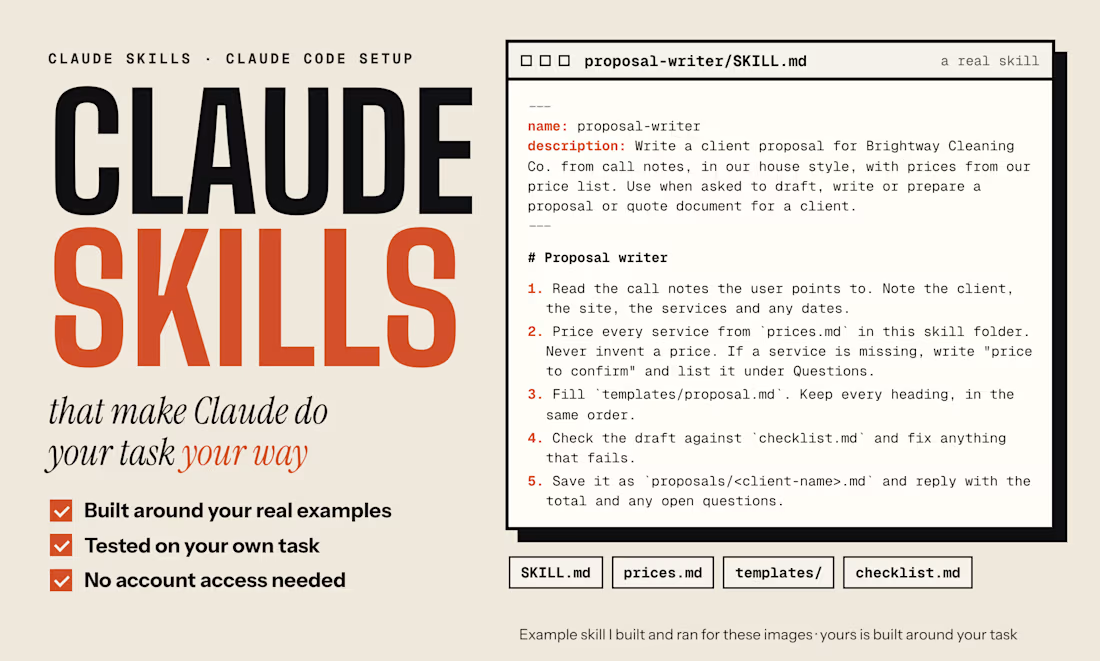
Proposal Writer: a custom Claude Skill that makes Claude follow one business's process every time.
The skill folder holds the steps (SKILL.md), a price list, a proposal template and a checklist. In a real Claude Code run, it turned call notes into a priced proposal in the house style. It used only the skill's own prices, flagged an unmeasured job as "price to confirm" and caught that 7 November 2026 is a Saturday, not a Friday.
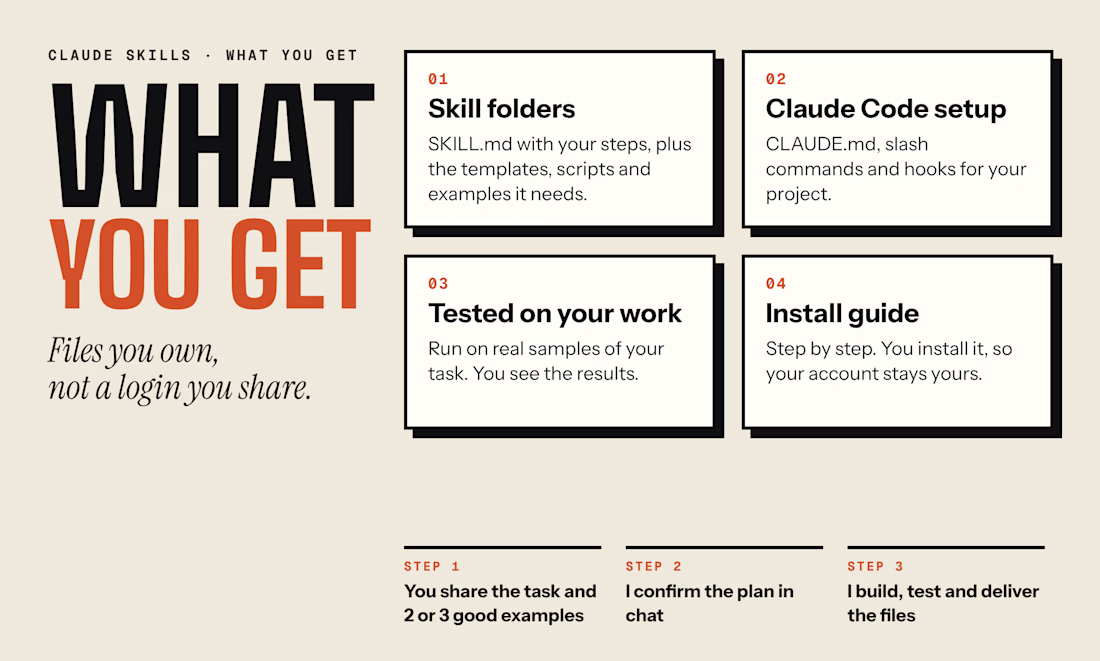
An example I built for my portfolio, with demo data. For clients, I build skills around their own task and test them on their own examples.

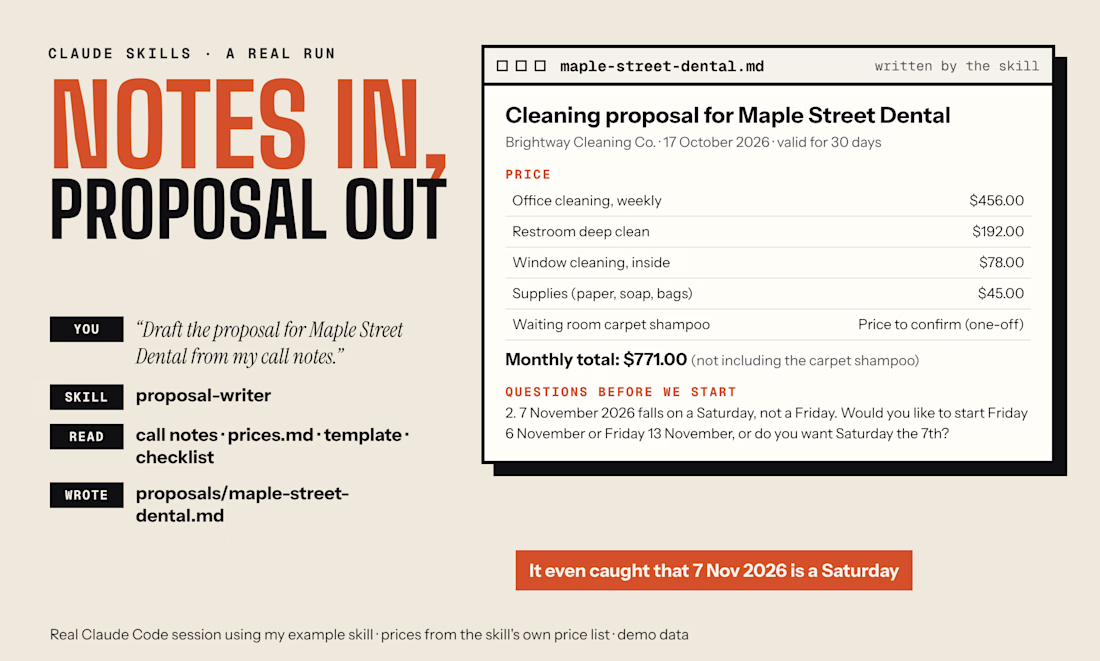

For the "price to confirm" case, I'd test notes with a quantity but no matching unit, such as "12 panels" when the rate is per square metre. Does the skill ask for the missing measurement before calculating a total, even if the notes include the client's suggested budget?

$15,000 from one browser game takes 1 to 15 million plays.
I did the math because my first web game, built with Claude Code, went live on CrazyGames today.
Bolt Pit is a Three.js arena shooter. It has earned $0 so far, because CrazyGames keeps ads off during the Basic Launch test, which runs until November 5.
Only games with good numbers get a Full Launch, and that's where the ad revenue share starts.
The formula:
Revenue = sessions × ads per session × eCPM ÷ 1,000 × your share
eCPM is what advertisers pay per 1,000 ads. CrazyGames allows at most one midgame ad every 3 minutes. The share isn't public, and reports range from 40% to 60%, so I used 50%. The rest are my assumptions, based on reported ad rates:
Low: 1 ad per session, $2 eCPM = $1 per 1,000 plays. You need 15 million plays.
Mid: 2 ads, $5 eCPM = $5 per 1,000 plays. You need 3 million plays.
High: 3 ads, $10 eCPM = $15 per 1,000 plays. You need 1 million plays.
One developer reported about €1.20 per 1,000 CrazyGames plays across eight older games. That's the low case, so I plan around the middle at best.
Is 3 million plays realistic?
CrazyGames reported 320 million play sessions a month this October. Poki says it has 100 million players a month. The players exist. Retention and session length decide which line you land on.
That's the bigger reason I'm here. I have Unity games in progress that were meant for the App Store. On the App Store, I'd only find out if people come back after paying for players.
So the new plan is web first, App Store later:
Launch on CrazyGames and Poki, where test players are free.
Tune retention and session length on real data.
If a game becomes a hit on the web, take it to the app stores.
Both portals' exclusivity rules cover only the web, so the app stores stay open.
I'm also skipping CrazyGames' exclusivity bonus. It pays 50% more for two months if your game stays off other web portals, and I want to test on Poki too.
Getting a Claude Code build accepted took six fixes, including a static build, relative paths, no Google Fonts and cutting the size from 20.5 MB to 12.4 MB. One known bug is still live: on landscape phones the start button sits below the fold.
I'll post the real numbers as they come in. Play it here:
https://crazygames.com/game/bolt-pit
