The network for creativity
Join 1.25M professional creatives like you
Connect with clients, get discovered, and run your business 100% commission-free
Creatives on Contra have earned over $150M and we are just getting started
Back to feedPost

Tokonoma🚪
a Video.js v10 skin shaped like the alcove of a Japanese room
[Live Demo]
I took a few days off of building my Framer template in progress to jump on this challenge last week as soon as I saw it. I went into it with the goal of designing a skin that fits the shoji - aesthetic of the template well but with the ability to be used in much more broad of cases. The immediate first idea that came into my mind was to create a design based on a Japanese "Tokonoma". It was a bit of a challenge getting all the features to fit together properly, but I'm very happy with how it turned out.
A tokonoma is the recessed alcove in a traditional Japanese room where a single scroll or arrangement is displayed. I designed a player that frames a film the same way: quiet while you watch, with the controls built into the room around it. There’s a hinoki frame, a post at the side and a floor that rises when you reach for it.
~~THE DETAILS~~
The room:
- The seek handle is a door pull. Drag it and a preview card hangs from the lintel. Chapter breaks are kumiko joints in the floor’s groove.
- Settings slide out like a shoji door. As it opens, the shadow of its lattice swings across the picture.
- The washi paper picks up a faint tint from the scene, the way paper glows with light behind it.
- A shade falls from the frame, with parallax that follows your pointer or the tilt of your phone.
- When the film ends, a hanko seal is pressed onto the closed door.
Made to fit:
- Four colour schemes: hinoki, black lacquer, indigo and sakura.
- The frame takes the video’s own shape, from 21:9 to 9:16.
- The post can sit on the right or left, tuck away or hide. The floor can tilt, slide or unmask, and there’s a clear frosted seek bar option.
- Every setting is an attribute on one <tokonoma-player> web component. It also comes as a Framer component.
A tool as well as a frame:
- Magnifier (Z): a lens over the picture. The wheel zooms it and Ctrl/⌘ + wheel resizes it.
- Save still (Shift+S): saves the current frame as a PNG.
- Save clip: mark a start and end with I/O, or drag the pegs on the seek bar. The clip saves straight to your device as MP4 or WebM, with sound.
- Frame stepping (, and .), J/K/L, chapter jumps and speed keys. It also remembers where you left off in each video.
Accessibility:
- Everything works from the keyboard and has visible focus.
- Seeks, frame steps and saves are announced to screen readers.
- Touch targets are 44px or larger on touch screens, and there’s a dedicated phone layout.
- Reduced motion is respected: the lattice, floor and seal settle without movement.
- Automated axe checks come back clean on desktop and phone.
- The film streams from Mux, with captions, chapters and storyboard thumbnails.
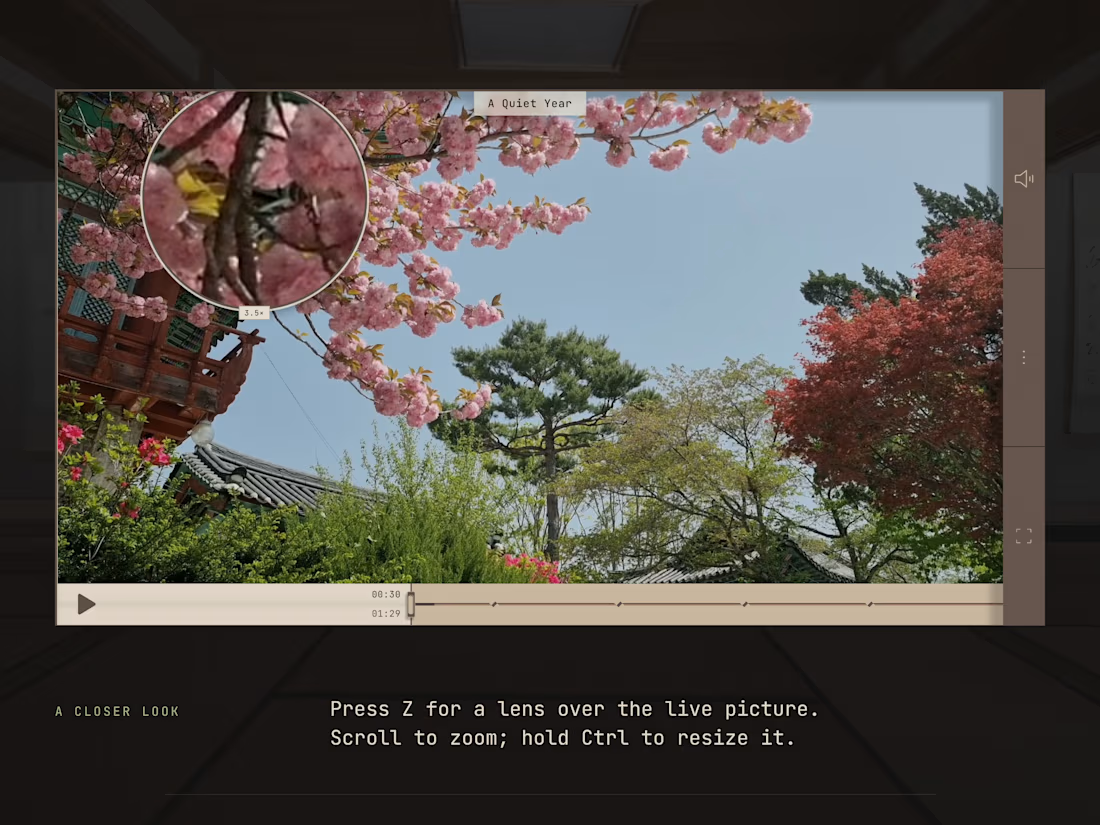
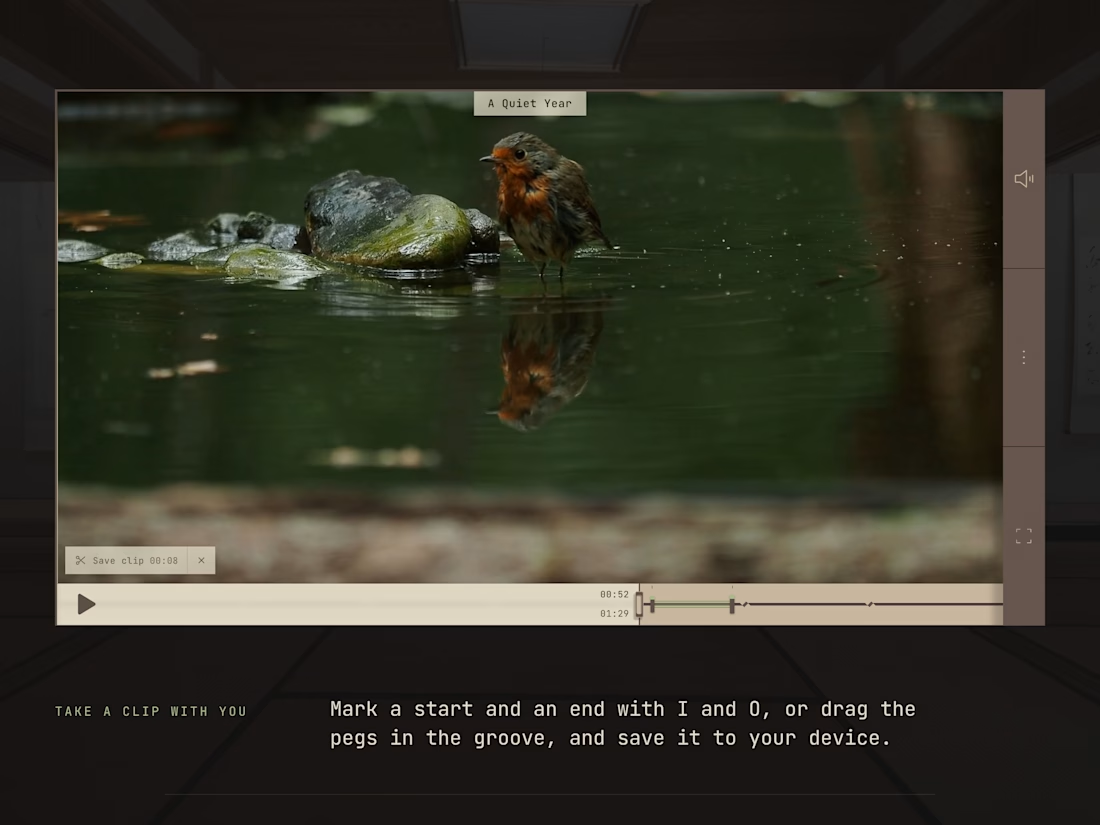
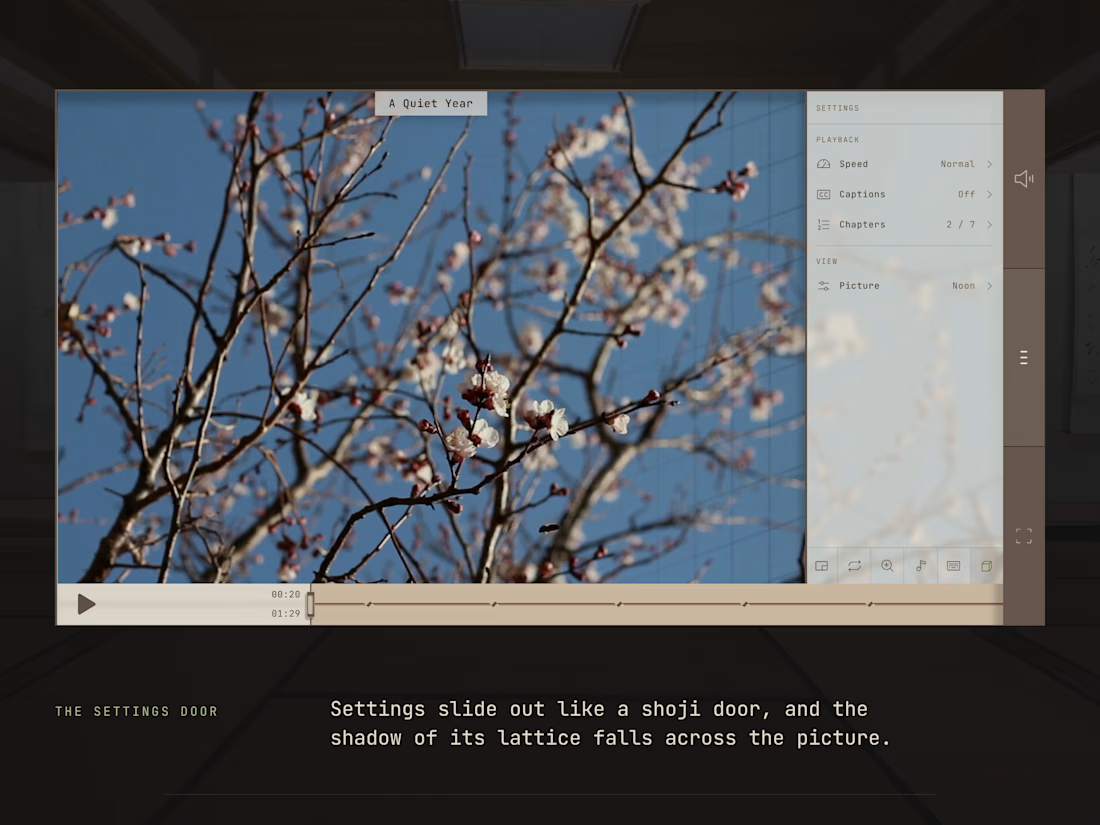

An alcove of a Japanese room as the player, designed to fit your shoji-style template. Lovely and calm.
Thanks, but is this an AI generated response?
The network for creativity
Join 1.25M professional creatives like you
Connect with clients, get discovered, and run your business 100% commission-free
Creatives on Contra have earned over $150M and we are just getting started





Related posts


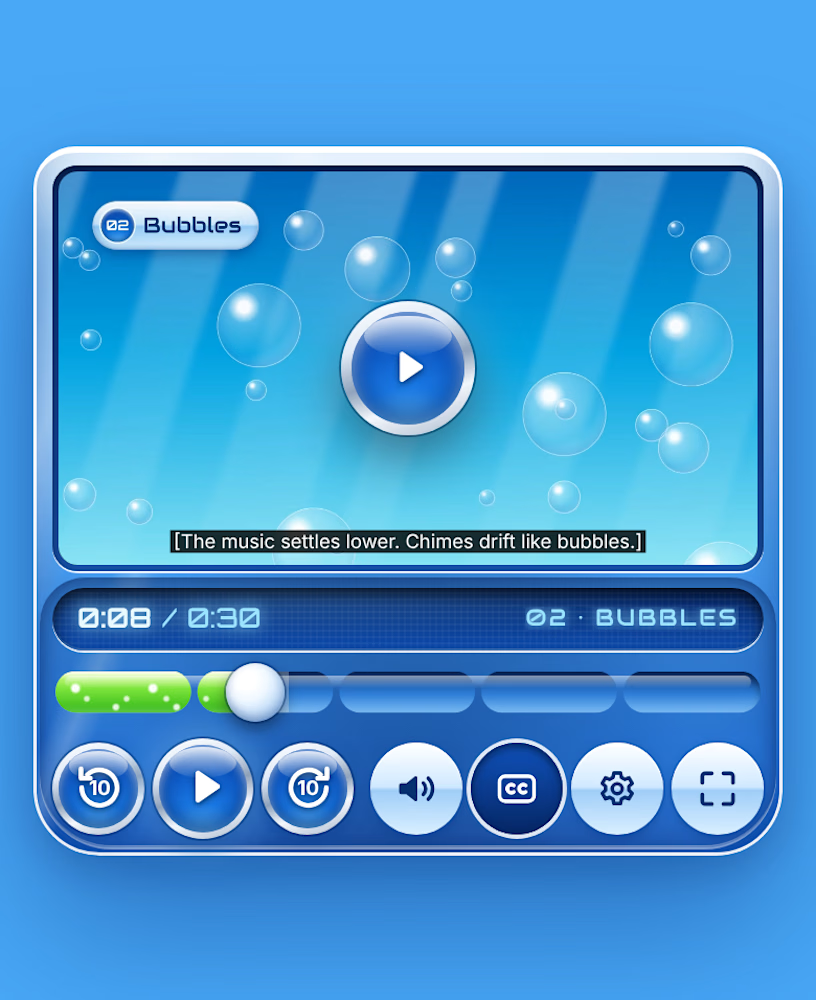
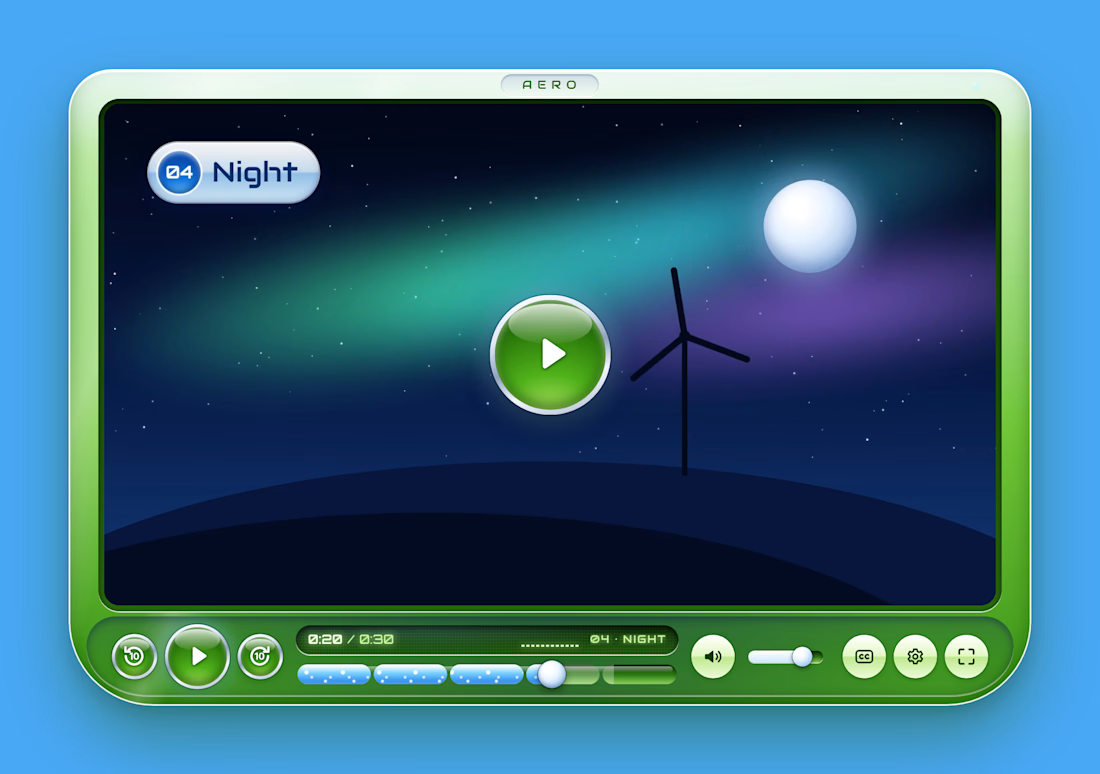
Aero, a Video.js skin that looks like a 2007 media player.
I grew up on that era of glossy, bubbly software and wanted to see if it could work as a modern player without the bad parts. The shell is glass, the buttons are orbs, and the seek bar fills up like a tube of liquid, bubbles and all. It’s split into the video’s chapters.
The gloss stays on the frame. Time and chapter sit on a dark LCD strip so you can always read them, whatever’s playing. There are three colors: Sky, Lime and Berry.
It works on phones, does a floating dock in full screen, and you can run the whole thing from the keyboard.
I made the demo video for it too.
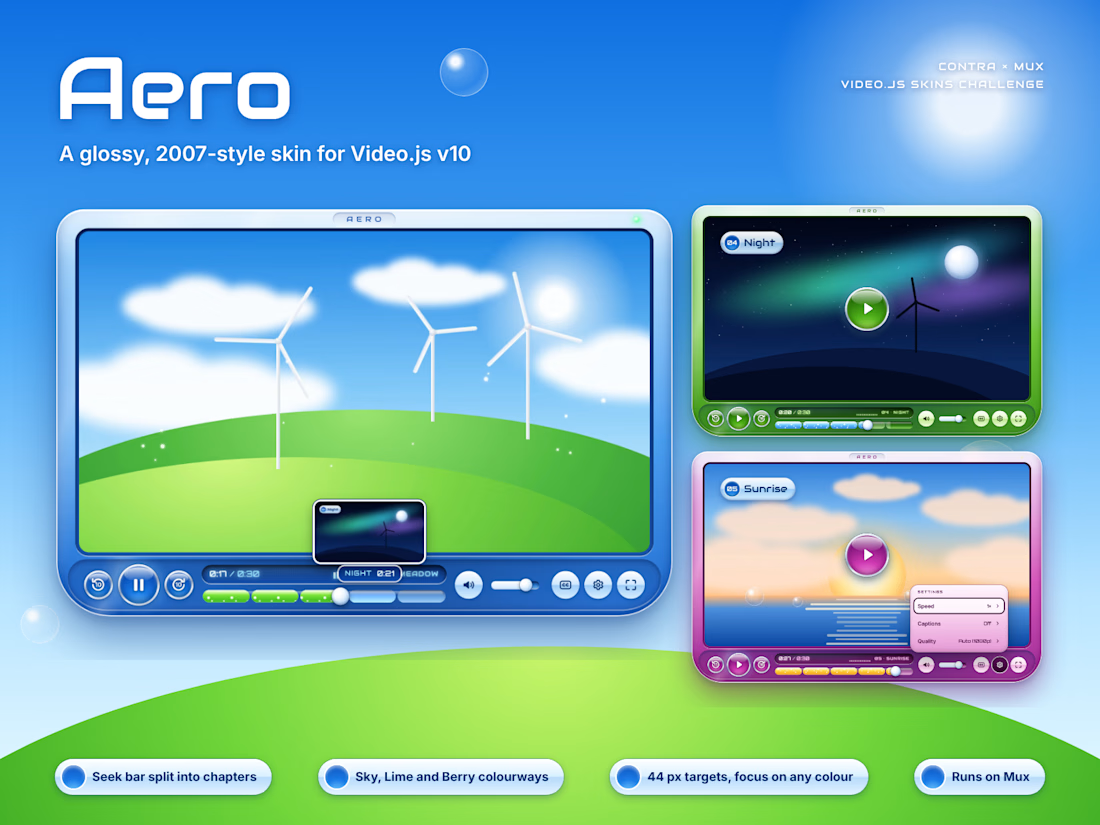

The orb buttons and the glossy shell took me straight back to Vista. Love that the seek bar fills like liquid, we both went for water in our skins 🙂

Bangles — A Playful Video.js v10 React Skin
I built Bangles, a vibrant, jewelry-inspired React video player skin for Video.js v10. Instead of a standard monochrome player, it wraps the video in a warm gradient frame with a colorful, bead-style segmented timeline and a bold, tactile yellow play trigger.
Designed for lifestyle, creator, and e-commerce experiences, Bangles pairs playful aesthetics with full accessibility—dynamically adapting to system themes, RTL/LTR directions, reduced motion, and high-contrast preferences.

Great work 👏🏻

I made a video player whose timeline listens to the film. 🎧
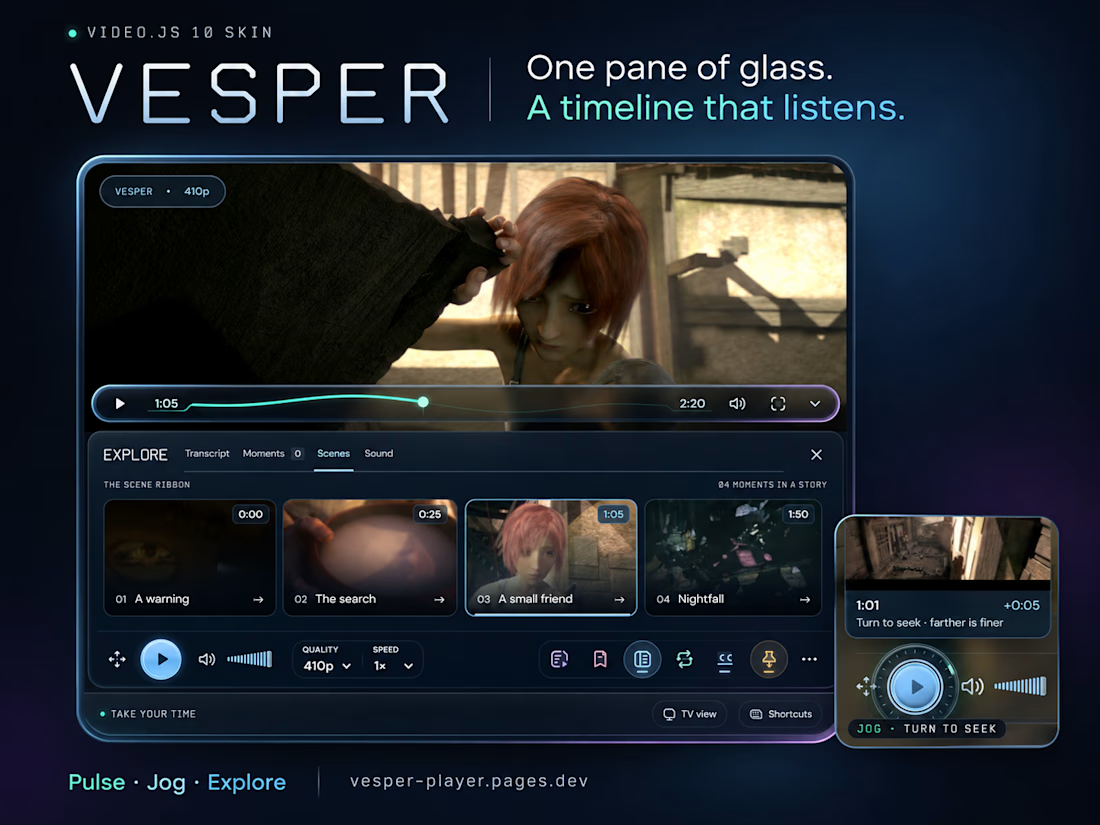
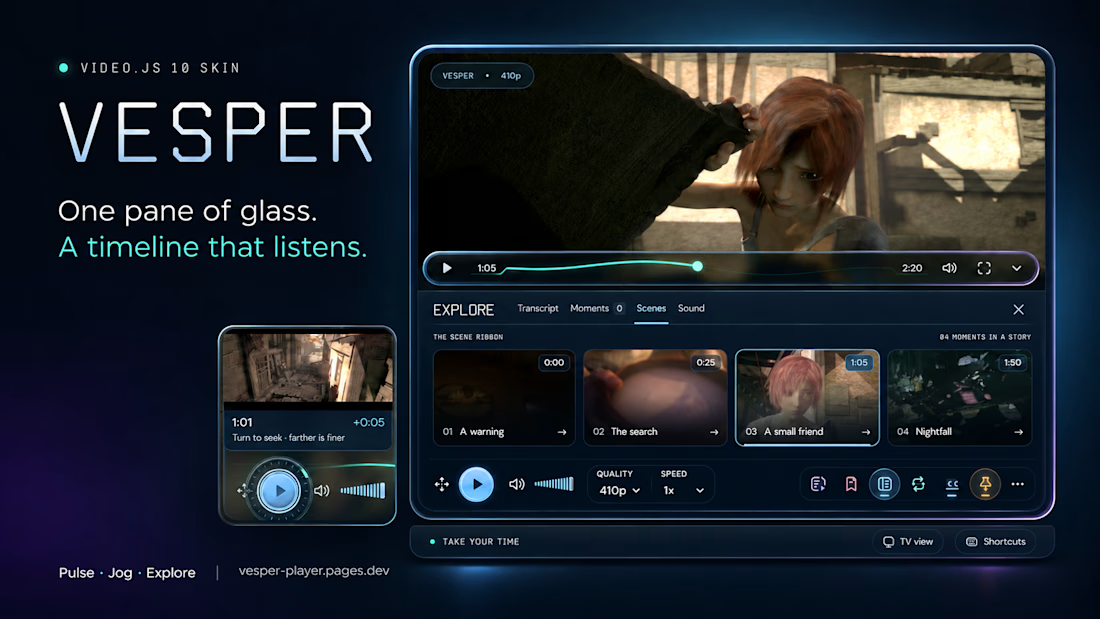
VESPER is my Video.js v10 skin: one pane of glass, and a seek bar drawn from the recording's own sound. Quiet scenes rest flat, dialogue breathes, and the loud moments rise. No fake equaliser bars — that's Pulse, built from the real audio energy of every film.
Everything else waits inside the same glass and opens only when you ask:
→ Jog: hold Play and turn. The farther you turn, the finer it seeks, with the real frame under your finger.
→ Explore: search a word in the transcript and land on that exact line. Scenes and private Moments live here too.
→ Repeat: loop one sentence, or any A–B range.
→ Sound: tap for volume, hold for a five-band glass EQ with four presets.
→ Dock: hold the grip and move the whole panel to any edge. Pin it and it stays.
It's built to work for everyone: full keyboard control with visible focus, 44 px touch targets, captions you can size and place, higher contrast and calm motion when your device asks for it.
The Sintel film is streamed by Mux, and four more demos (a NASA lesson, a scripted meeting, a product concept and an Icelandic waterfall) show the same controls on very different content.
Try it: https://vesper-player.pages.dev
#videojsskinschallenge
A seek bar drawn from the film's own sound is a brilliant idea. Quiet scenes flat, loud moments rising, so good.