The network for creativity
Join 1.25M professional creatives like you
Connect with clients, get discovered, and run your business 100% commission-free
Creatives on Contra have earned over $150M and we are just getting started
Back to feedPost

Autonomous Multi-Agent.
A sleek web interface powering a multi-agent research pipeline. Watch in real-time as autonomous agents accept a topic prompt, break down task sub-goals, query web APIs, and render a structured markdown executive report live on screen.
Key Features: Live agent execution logs, step-by-step progress tracking, interactive source citations, and instant PDF/Markdown export


The network for creativity
Join 1.25M professional creatives like you
Connect with clients, get discovered, and run your business 100% commission-free
Creatives on Contra have earned over $150M and we are just getting started





Related posts

AI Content Automation Pipeline | n8n • ChatGPT • Airtable • Notion
Built an AI-powered content automation system that streamlines content generation, management, and publishing through one connected workflow—reducing repetitive work and improving content production efficiency.
What I Built
AI content generation with ChatGPT / OpenAI API
Automated n8n workflows
Airtable & Google Sheets data automation
Notion draft management and publishing
Custom REST API & webhook integrations
Optimized AI prompt engineering
End-to-end content workflow automation
Tech Stack
n8n • OpenAI API • ChatGPT • Airtable • Notion • Google Sheets • Python • Webhooks • REST APIs
Key Skills
AI Automation • Workflow Automation • Prompt Engineering • API Integration • Content Automation • Database Automation • ChatGPT Integration • n8n Development
SEO Keywords
AI Content Automation • n8n Automation • n8n Developer • ChatGPT Automation • ChatGPT API Integration • OpenAI API Integration • AI Workflow Automation • AI Automation Developer • Content Automation • n8n Workflow Development • OpenAI Automation • Prompt Engineering • API Integration • REST API Integration • Webhook Automation • Airtable Automation • Notion Automation • Google Sheets Automation • Python Automation • Database Automation • Business Process Automation • Marketing Automation • Automated Content Generation • Generative AI • Custom AI Automation • Custom Workflow Development
Result: A scalable AI content pipeline designed to reduce manual work, connect multiple platforms, and make content creation and management faster and easier.
#AIContentAutomation #AIAutomation #n8n #n8nAutomation #ChatGPT #OpenAI #WorkflowAutomation #ContentAutomation #ChatGPTAPI #OpenAIAPI #APIIntegration #PromptEngineering #Airtable #Notion #GoogleSheets #GenerativeAI #BusinessAutomation #AutomationDeveloper #AIDeveloper


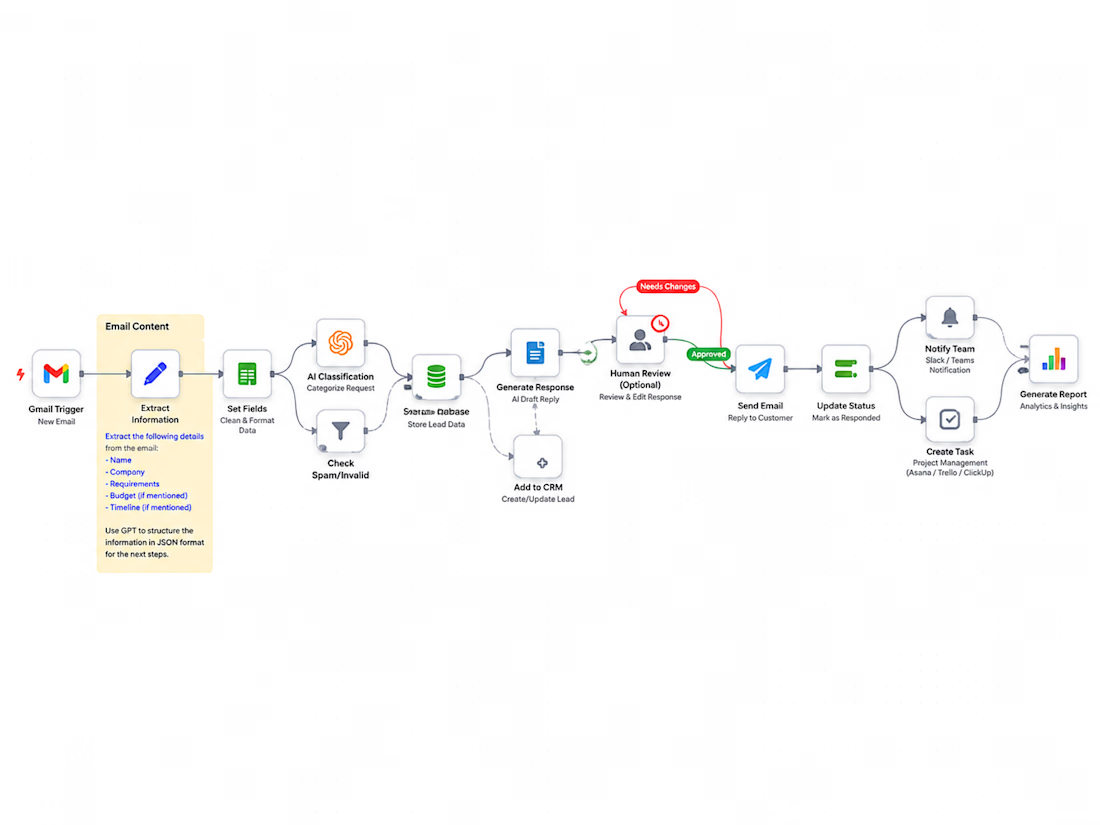
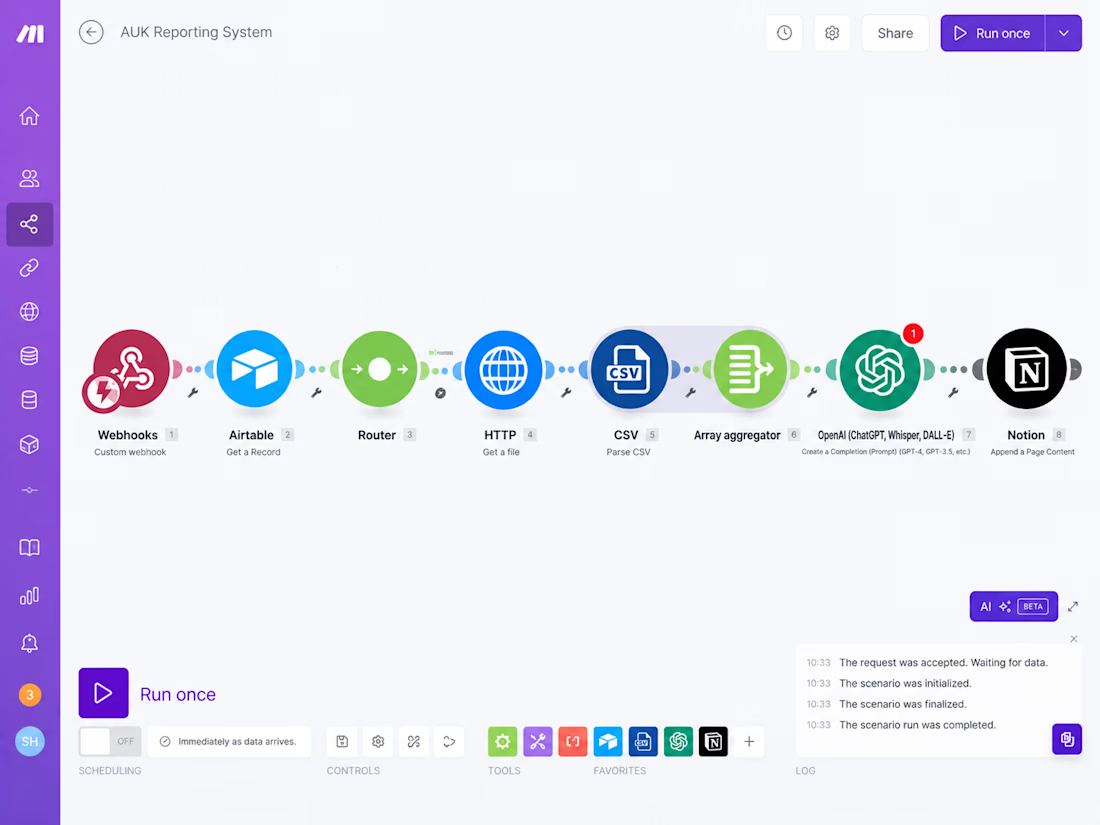

Linking ChatGPT responses to Airtable and Notion in one flow wipes out the manual transfer step. That lets you focus on the creative side instead of data juggling.

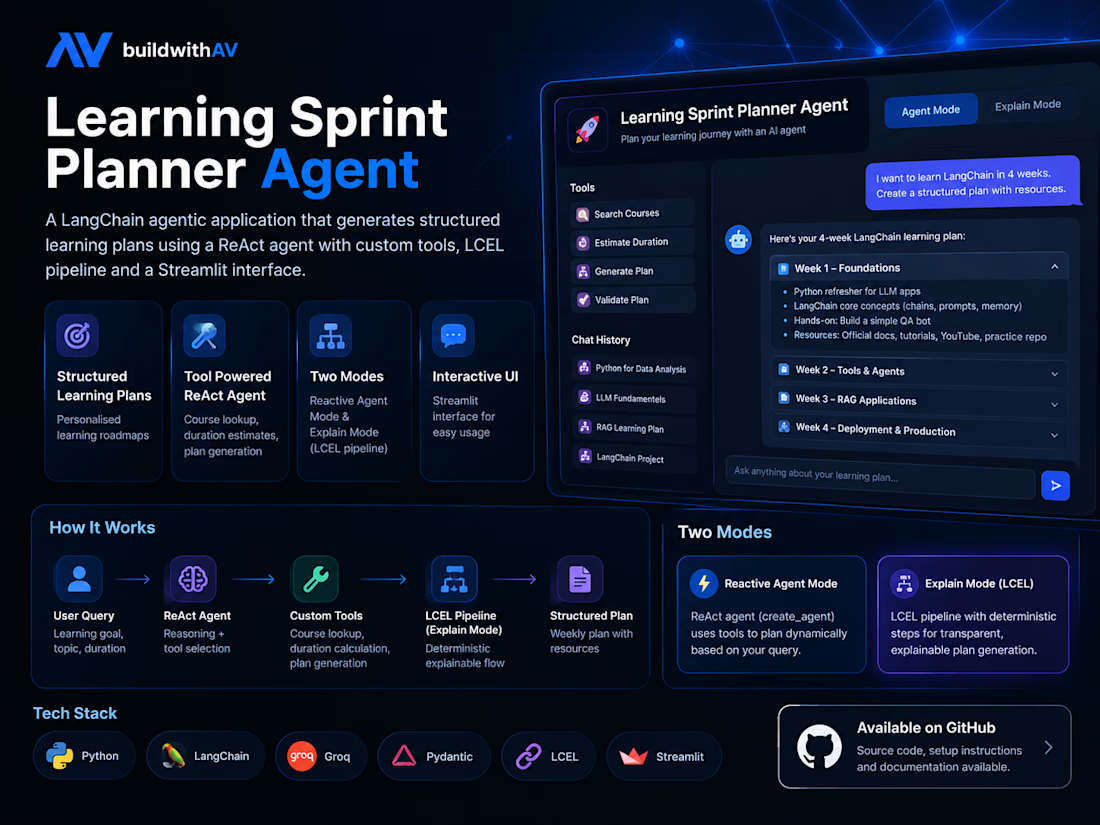
Built a LangChain-based agentic application that turns a learning goal into a structured, personalised learning plan.
The application supports two execution modes:
⚡ ReAct Agent Mode
A tool-using agent dynamically selects custom tools for course lookup, completion-time calculation, and learning-plan generation.
🔍 Explain Mode — LCEL
A deterministic LCEL pipeline executes the planning workflow step-by-step, making the process more transparent, predictable, and easier to debug.
The project also uses Pydantic structured outputs, Groq, Python, Streamlit, and custom LangChain tools, with deterministic logic kept outside the LLM wherever possible.
This project was built to explore the practical engineering side of AI agents — tool calling, agent orchestration, structured outputs, deterministic workflows, and explainability.
The project is not currently deployed, but the complete source code and implementation are available on GitHub.
Tech: Python · LangChain · ReAct · LCEL · Groq · Pydantic · Streamlit


turning a learning goal into an actual plan is such a useful agent use case 🔥

In 90 days, AI stopped being a tool I use and became a teammate I manage.
Here's what actually changed, from where I sit as a software engineer:
→ Agents went mainstream. JetBrains found 90% of professional developers use coding agents weekly and 68% daily. Claude Code usage doubled since January (18% → 39%). Codex went 3% → 16%.
→ Models learned to drive computers. GPT-6 Astra (Sep 3) was pitched on computer use and software engineering, and shipped with gated access over its cyber capabilities.
→ Output limits blew open. Gemini 4 Argon (Sep 30) can write up to 1M tokens in one response, up from 64K. Also gated at launch.
→ Agents did real, checkable work. Dozens of Claude agents formalized Fermat's Last Theorem in Lean in 11 days: 13M lines, machine-verified. (Formalization, not a new proof. The verification is the point.)
→ The plumbing grew up. MCP's July spec went stateless, so agent tooling now deploys like ordinary web infrastructure.
→ Open weights kept pace. Alibaba released Qwen3.8-Max as a 2.4T-parameter open-weights model.
My take: code generation is getting cheap. Judgment isn't.
Anthropic's agentic coding report says engineers use AI in roughly 60% of their work but can fully delegate only 0–20% of tasks. The bottleneck has moved to architecture, review, testing, security, and keeping things alive in production.
That's where I spend my time: shipping AI features (agents, RAG, LLM integrations) into real products, with the guardrails that make them survive contact with users.
What's one task you'd hand to an agent tomorrow, and one you never would?
#AI #SoftwareEngineering #AIAgents #LLM #FullStack

managing agents instead of just using them is exactly the shift I've felt too ngl