The network for creativity
Join 1.25M professional creatives like you
Connect with clients, get discovered, and run your business 100% commission-free
Creatives on Contra have earned over $150M and we are just getting started
Back to feedPost

Can you answer these 5 system design questions in 30 seconds each? ⏱️
Out loud, while an interviewer is watching 👇
1️⃣ 1,000 requests hit one expired cache key at the same moment. How do you protect the database?
2️⃣ You add 1 node to a 3-node cache using key mod N. Roughly how many keys move?
3️⃣ 3 partitions, 4 consumers in one Kafka group. What does the 4th consumer do?
4️⃣ 3 service layers each retry 3 times. How much traffic hits the failing service?
5️⃣ A client retries a payment with the same idempotency key but a different amount. 200, 409 or 422?
If you hesitated on even one, you're not alone. Most engineers know these topics. The hard part is explaining the trade-off clearly, saying when not to use it, and surviving the follow-up.
That's why I built the System Design Interview Crack Sheet 📘
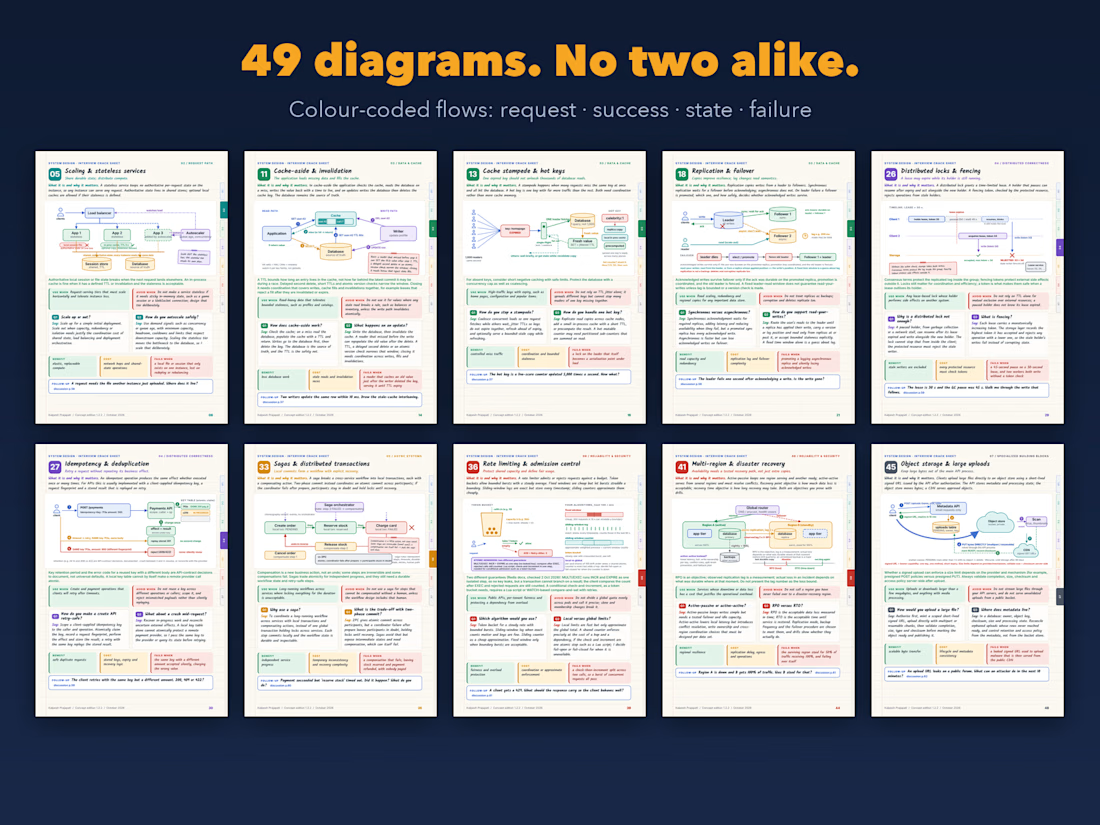
✅ 49 concepts, one page each
✅ 98 interviewer questions with ready 30-second answers
✅ 49 colour-coded diagrams that show the real mechanism
✅ Use when / avoid when / how it fails, for every concept
✅ 49 follow-up questions interviewers use to dig deeper
✅ Decision matrix, acronym glossary and a clickable revision map
Covers caching, sharding, consistent hashing, replication, Kafka, sagas, outbox & CDC, CAP & PACELC, consensus, idempotency, rate limiting, circuit breakers, multi-region & DR, and more.
🎯 Made for backend, SDE-2, senior and staff interviews
⚡ 64-page PDF · instant download · free updates
📘 Get the full crack sheet here:
https://contra.com/products/moOF13Ea-system-design-interview-crack-sheet
The network for creativity
Join 1.25M professional creatives like you
Connect with clients, get discovered, and run your business 100% commission-free
Creatives on Contra have earned over $150M and we are just getting started





Related posts


What if anyone on your team could ask your data a question and get a live dashboard back in under a minute?
That was the brief. Business users were locked out of their own data. Every question waited on someone who could write SQL, data sat across disconnected systems, and security teams refused to send sensitive records to third-party AI tools.
So we flipped the model. Instead of moving enterprise data to an AI product, we moved the AI analytics product into the customer's AWS account.
What we built:
• Natural-language querying that turns plain-English questions into governed dashboards in under 60 seconds
• Federated queries across SQL and NoSQL sources through Trino
• AI query generation on AWS Bedrock Agents, with Bedrock Guardrails keeping model output in bounds
• Dashboards generated with Apache Superset, plus proactive anomaly and trend alerts
• A white-label React widget that embeds in any product
• Role-based access, row-level security and enterprise SSO enforced at every layer
The result:
Zero data egress. The whole platform deploys inside the customer's VPC and is live on AWS Marketplace.
Building AI features for a data-heavy or regulated product? Let's talk about doing it without your data leaving your cloud.


The problem
AI tools changed how fast good work gets made, but hiring still looks like 2015: long specs, hourly guesses, and no clear line between a prompt and a finished product. Clients want the result. Skilled people who build with AI want to be paid for outcomes, not hours.
What we built
VibeBay is a two-sided marketplace for finished AI work. A client posts what they need in plain words. Matched talent reply with a price, a delivery date and real samples. The client picks one, pays into escrow, and the money is released when they approve the work, or 7 days after delivery.
Inside the product:
Explore and search across six kinds of work, with talent profiles, portfolios, levels and reviews
Task posting, proposals with milestones, and checkout with escrow through Stripe
Real-time messaging between clients and talent
An AI assistant that helps clients describe the work and find the right person
Skill tests graded by AI, and profile import that turns an existing portfolio into a VibeBay profile
A full admin panel: approvals, moderation, support, orders and live campaign numbers
A pre-launch system with founding seats per country, referral codes and a countdown to opening day
How it's built
Next.js on Netlify, Supabase for the database, sign-in and file storage, Stripe for payments and escrow, Claude for the AI features, and Resend for email. Every page is checked automatically on each change at four screen sizes, from a small phone to a wide desktop, for accessibility and for broken buttons and links.
Where it is now
Founding seats are opening country by country, and the full marketplace opens on 31 October 2026.
Designed and built by Dreamec Studios.:


🚨 What if your business could manage SMS, WhatsApp, Email, users, and messaging gateways from ONE dashboard?
Not 5 different tools.
Not endless switching between platforms.
Not a messy communication workflow.
I built a centralized Business Messaging Platform designed to bring business communication and user management under one roof. 🚀
Instead of building just another admin dashboard, I focused on a real business problem:
Too many communication channels. Too many disconnected tools. Too much manual work.
So I built a system where businesses can:
💬 Manage SMS, WhatsApp & Email communication
👥 Control users, roles & permissions
📧 Create and manage email communication workflows
⚙️ Configure multiple messaging/API gateways
📊 Monitor messaging statistics from one dashboard
🔐 Protect operations with authentication & RBAC
🔌 Connect external services through REST APIs
⚡ Scale the platform as communication volume grows
Under the Hood
Laravel → Secure & scalable backend
React.js → Fast, responsive dashboards
MySQL → Structured data management
REST APIs → Integration-ready architecture
RBAC → Secure user & permission management
API Integrations → Messaging gateways & external services
But the important part isn't the tech stack.
It's what the technology can remove from a business.
Less platform switching.
Less repetitive communication work.
Less fragmented user management.
And one centralized system built around the company's actual workflow.
💡 That’s the kind of software I like building — not just websites, but systems that solve expensive business problems.
If your company is still managing customers, messaging, internal workflows, or integrations across disconnected tools, there may be a much better way to build it.
📩 Need a custom SaaS platform, business dashboard, messaging system, API integration, or automation solution? Let’s build it.
#LaravelDeveloper #FullStackDeveloper #ReactDeveloper #PHPDeveloper #SaaSDevelopment #WebApplicationDevelopment #BusinessAutomation #WorkflowAutomation #APIIntegration #RESTAPI #WhatsAppAPI #SMSAPI #EmailAutomation #AdminDashboard #CustomSoftwareDevelopment #BackendDevelopment #MySQL #Laravel #ReactJS #SaaS #BusinessSoftware


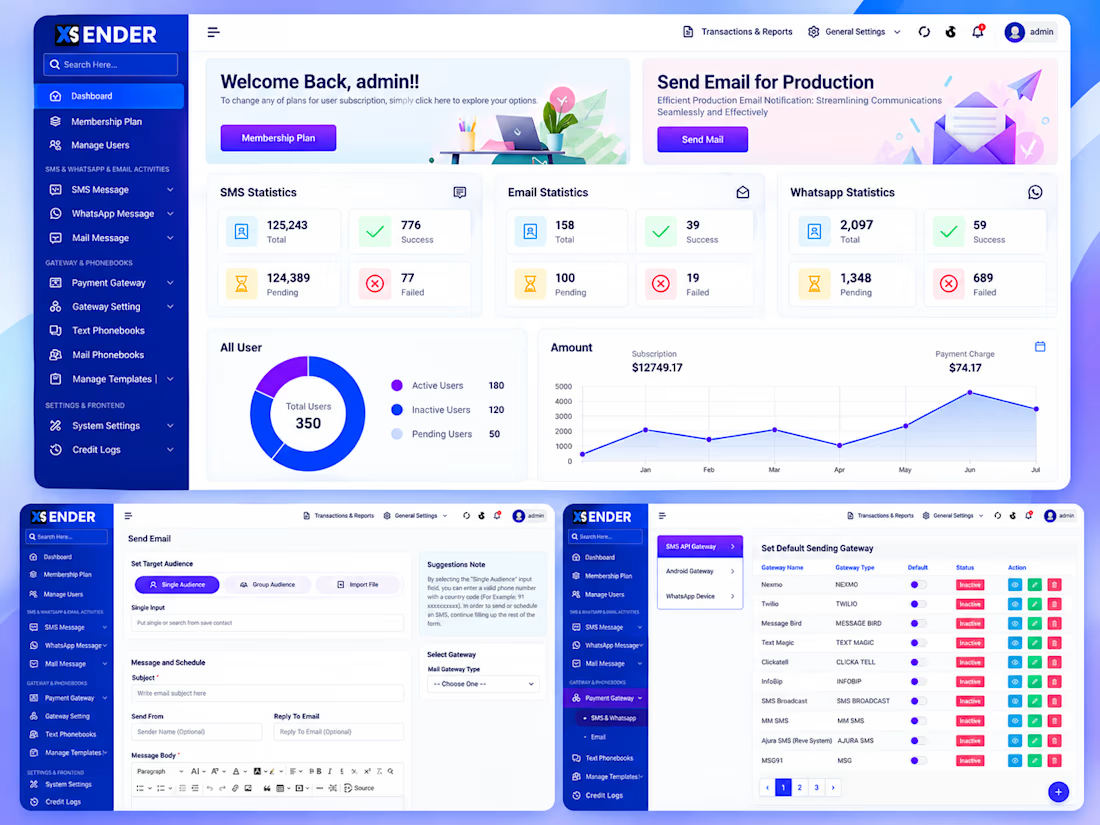

Seeing the single pane for SMS, WhatsApp and email cuts the back and forth you'd otherwise spend juggling tools.