The network for creativity
Join 1.25M professional creatives like you
Connect with clients, get discovered, and run your business 100% commission-free
Creatives on Contra have earned over $150M and we are just getting started
Back to feedPost

RepairRoute
Repairs Routed by Urgency, From Report to Fixed.
Problem: Most landlords don't live next door to their tenants. When a pipe bursts at 2 a.m. and a kitchen floods, the tenant has to reach someone who may be hours or countries away, and hope the message gets read. A flood and a loose cabinet hinge land in the same pile of texts and calls. Nobody knows what to handle first, vendors are found in a scramble, and tenants are left wondering whether anyone is coming.
The solution:
RepairRoute connects tenants, landlords, and vendors in one flow. A tenant reports a problem with a photo and a short description. The app checks the urgency immediately, tells the landlord why, and routes the job to the right kind of vendor. The tenant can follow each step until the repair is confirmed fixed.
How it works💯
Tenants:
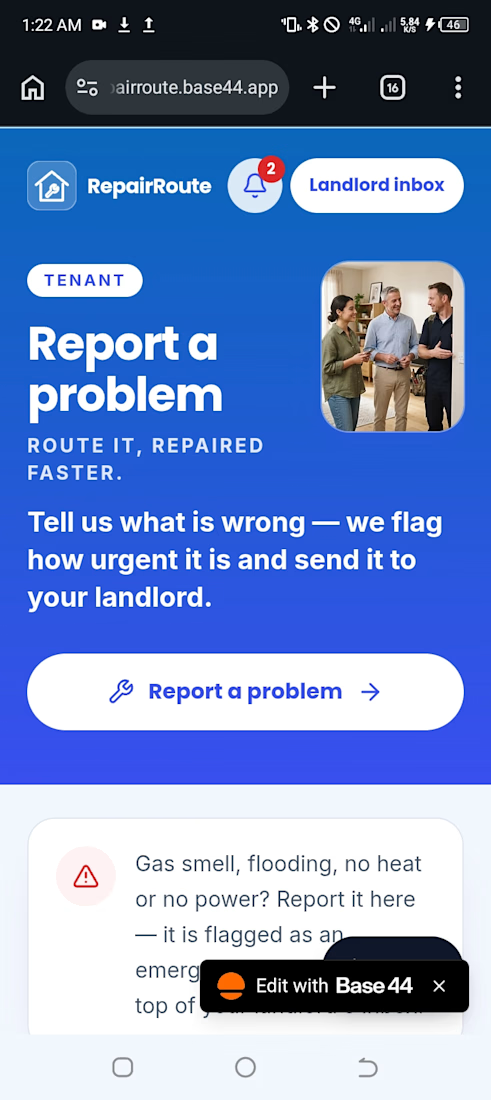
No signup or login. The device is recognized automatically.
Report a problem with a photo, a one-line description, and a location in the unit.
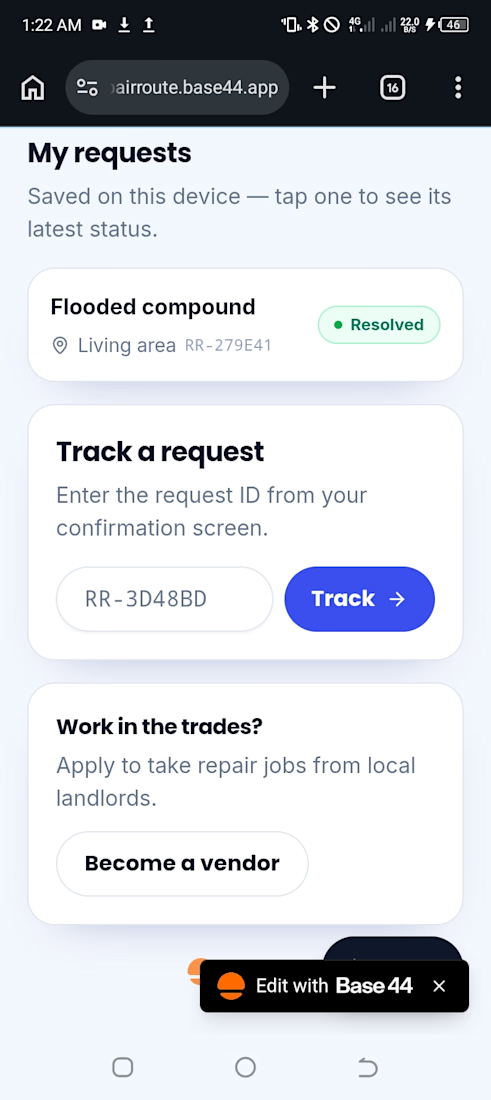
Each report gets a request ID, an urgency label, and a four-step tracker: Received, Triaged, Scheduled, Resolved.
The tenant confirms when the repair is fixed, so the person living with the problem has the final say.
Landlords:
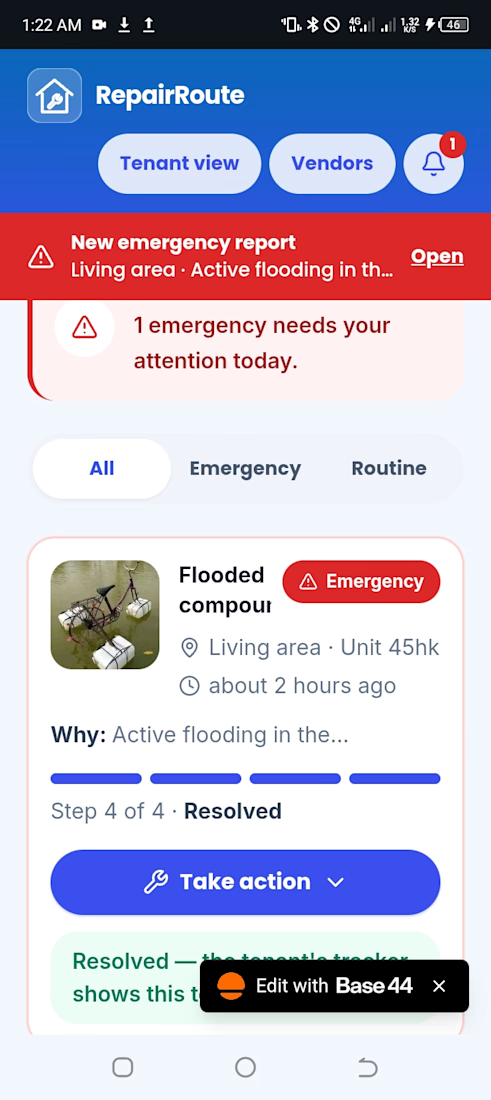
A triage inbox sorts emergencies first, with a red banner and a count of emergencies needing attention.
Every card shows the photo, the urgency, the reason ("Active flooding on property premises"), the location, and the time.
Routine jobs get a suggested vendor, an estimate range based on the vendor's rate, and a one-line reason.
The landlord can hire the suggested vendor, choose another, message the tenant, or change the urgency.
Emergencies skip vendor matching and show a "Call emergency contact" action.
Vendors:
Vendors apply through a "Become a vendor" form with their trade, rate, callout fee, and service area.
Only approved vendors appear in routing. The creator reviews applications from a private admin page.
Approved vendors receive job offers and can accept or decline with a proposed time.
Payments (demo): will be fully integrated soon.
Notifications:
Each role has its own bell and unread count, and sees only its own alerts.
My process🧠 :
I built RepairRoute in steps, testing after each one:
Idea selection. I started with several ideas, including voice-first apps, document tools, and caregiver handoffs, and chose tenant repair triage because it has a clear user, a clear before-and-after, and several automated decisions.
Core build. I wrote the first Base44 prompt for the tenant report form and the landlord inbox with urgency classification.
Vendor routing and tracking. I added the vendor list, estimates, approval, and the four-step tracker for both sides.
Testing like a user. I submitted real test reports and found problems: landlord replies didn't reach tenants, tenants had no way to find their requests, and some buttons didn't respond.
Full audit. I asked Base44 to audit the whole app without changing anything. It found that triage ran too late, demo data wasn't linked to devices, white text on the gradient was low in contrast, and the logo was unclear at small sizes. I fixed each issue with its own prompt and retested.
Design and branding. I moved from a plain default look to a blue gradient, pill buttons, rounded cards, clear urgency colors, a route-line logo, and restrained motion that respects reduced-motion settings.
Vendor approval and payments. I added the vendor application and approval flow, then the tenant-confirmed completion and deposit flow.
Design decisions✍️:
Red only for emergencies, so urgency is visible at a glance.
A visible reason for every classification, so landlords can trust the triage and override it.
One route line as the brand idea: from tenant, through the landlord, to the vendor, ending in a check mark for "fixed."
Mobile first, because tenants report problems from their phones, usually at the worst moment.
Tenant confirmation before final payment, so a landlord isn't asked to pay for unfinished work.
What I'd build next
Real payment holding through a payment provider
Background push, email, and SMS notifications
Vendor ratings and a verified-documents check
Multi-property and multi-landlord accounts
Tenant history by unit, so landlords can see recurring problems
Limits I'm upfront about
Payments are a demo.
Tenant recognition is per browser. Clearing browser data means a tenant has to look up a request by its ID.
The admin page uses a passcode, which suits a demo but not a live product.
Notifications currently work in-app.
Built with
Base44 for the app, backend, and data. Work through on google drive. Every prompt, test, and fix was done by me, step by step.

The network for creativity
Join 1.25M professional creatives like you
Connect with clients, get discovered, and run your business 100% commission-free
Creatives on Contra have earned over $150M and we are just getting started








Related posts

Ripcord. One pull for the day you can't go in.
You wake up ill. Client meetings, a deadline, people waiting on you. The worst part isn't the fever. It's the admin.
So I built a cord. Drag it down, say how long you're out, and Ripcord does the rest:
Moves your real Google Calendar meetings to your next free slots
Shifts your deadlines by the days you lose
Writes one short note per client in your voice, sent from your own Gmail
Plans your first morning back
Keeps a receipt for every change. Hold to undo any of it.
Can't face another app? There's an MCP server too. Tell Claude "I've got the flu, clear my week" and it pulls the cord for you.
Built entirely on Base44: entities with owner-only security, 27 backend functions, Google Calendar and Gmail connectors so each user connects their own account, InvokeLLM for the notes, and an hourly workflow for the heads-up and welcome-back emails. I tested it on my own calendar: the meetings moved, the notes landed, and undo put everything back.
The design is a "Signal Room": one glowing red cord on an LED wall. It works on your phone, one-handed, from bed.
Try the demo, no sign-up: https://ripcord.base44.app/demo/week


Great work as always, AJ 😊

Every morning, before the sun is fully up, Nigeria's motor parks are already moving.
At Jibowu, Ojota, Utako, Mile 1 and hundreds of parks across the country, buses are loading, and tucked between the passengers' bags are parcels. A mother sending foodstuff to her son at university in Sokoto. A trader in Onitsha restocking a shop in Kano. Documents, phones, fabric, medicine, gifts. All of it riding to towns and villages that most courier companies don't even list on their website.
This is Africa's real delivery network. It is fast, it is everywhere, and it runs on trust. But it's also invisible.
You hand your parcel to a driver you just met. You collect a number scribbled on paper. Then you wait, and you call, and you call again. Is it on the road? Has it arrived? Did it get lost at the next park? There's no tracking, no receipt and no record. When something goes wrong, there's no one to turn to.
The drivers aren't the problem. They are the heroes of this story. They drive these routes every single day. What's missing is the layer that connects them to the people who need them.
So for Base44's #GiveItAGlow challenge x Contra, I gave that network a glow-up and called it Waybill.
Waybill puts your parcel on a bus that's already going. You search your route and see the drivers who are loading or about to depart, with their price, vehicle and rating. You pay safely in the app, and the driver's number unlocks. At the park, the parcel is photographed and weighed. Then you and your receiver watch it move, town by town, until it's delivered.
Then I made sure nobody has to chase anybody. Ten automations run quietly in the background:
• You book, and an animated email confirms it's waiting for the driver to accept
• Drivers on that exact route are alerted the moment a paid parcel appears
• The receiver gets a tracking link at every stage, with no app or account needed
• Unpaid bookings get a reminder, then cancel themselves
• A parcel that goes quiet for 6 hours nudges its driver. After 12, the team is alerted
• Drivers who stop updating drop out of search, so you only see who is really moving
• Every Monday, drivers get their earnings. Every morning, the team gets an ops digest
The design comes straight from the park: headlines set like painted route boards, danfo yellow and road-sign green, and a waybill slip, the same paper ticket every park hands you, that fills itself in and gets stamped CONFIRMED.
For a driver, this means extra income from seats and space that already exist. For a sender, it means peace of mind. For a small business, it means reaching customers in towns that were too far before. Multiply that across every park in Nigeria, then across Africa, and you start to see how big this can be.
The infrastructure is already on the road. It just needed a glow-up. 🇳🇬
Built end to end with @Base44: the app, database, workflows and emails. Made in Sokoto by Low Code Africa.
(Video: a walkthrough of Waybill)
Try it: https://waybill.base44.app
#GiveItAGlow #Base44Challenge #BuiltWithBase44 #Nigeria #Africa #Logistics
https://contra.com/community/topic/base44giveitaglowchallenge

This is a brilliant solution to a real African problem! 🔥👏 Turning our existing transport network into a reliable, trackable delivery system is a smart move. Waybill is more than an app; it’s a bridge between trust, technology, and everyday logistics. 🇳🇬🚀


How often do you actually run the manual accessibility checks on your site? And do you have a screen reader installed? People deserve to use your website no matter how they experience the web.
My entry for the Base44 Challenge is Rampa. It walks through your website the way a keyboard and screen reader user would, with AI agents covering the checks that usually fall through the cracks of automated WCAG tools. Using Browserless and Gemini, it also finds images with missing or weak alt text and suggests descriptions that fit the page, in the page's language.
Use it alongside a proper accessibility audit. It's built so builders who think visually can catch more on their own.
Try it on your own site: https://rampa-scan-flow.base44.app
How does your site rank?
#Base44Challenge

Walking a site the way a keyboard and screen reader user would is such a good framing for this. The alt text suggestions in the page's own language is a detail I hadn't seen before. Did Browserless plus Gemini handle the whole scan flow, or did you wire in custom checks too?