The network for creativity
Join 1.25M professional creatives like you
Connect with clients, get discovered, and run your business 100% commission-free
Creatives on Contra have earned over $150M and we are just getting started
Back to feedPost

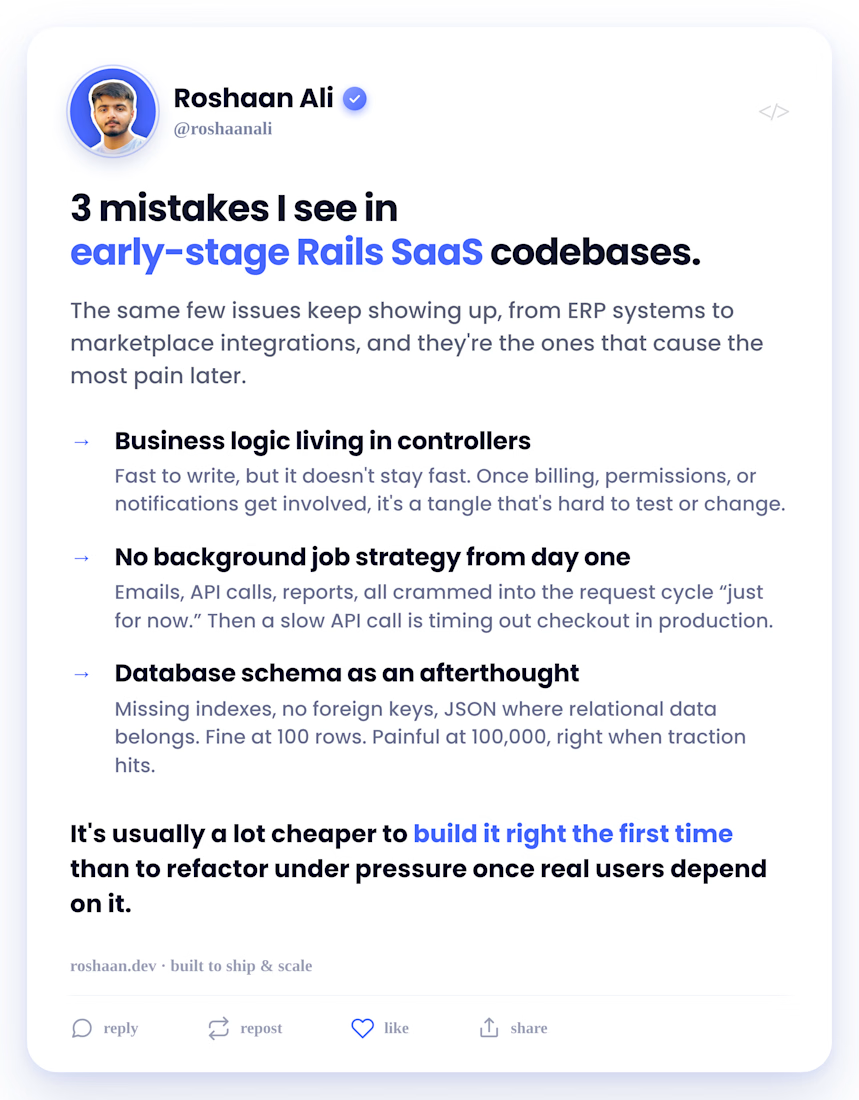
3 Mistakes I See in Early-Stage Rails SaaS Codebases
I've worked across a range of Rails/React SaaS projects, from ERP systems to marketplace integrations, and the same few issues keep showing up in early-stage codebases. Here are the three that cause the most pain later:
1. Business logic living in controllers
It's fast to write, but it doesn't stay fast. Once a feature touches billing, permissions, or notifications, controllers become a tangle that's hard to test and harder to change. Pulling logic into service objects or models early saves months of pain later.
2. No background job strategy from day one
Sending emails, calling third-party APIs, generating reports, all of it ends up in the request cycle "just for now." Then the app is in production, and a slow API call is timing out checkout. Setting up Sidekiq (or similar) early, even for a handful of jobs, makes it trivial to expand later instead of a painful retrofit.
3. Treating the database schema as an afterthought
Missing indexes, no foreign key constraints, JSON columns used where relational data belongs. These don't hurt at 100 rows. They hurt at 100,000 rows, right when the product is finally gaining traction and can least afford a slowdown.
None of these are hard to avoid. They just require thinking about where the app will be in a year, not just what ships this week. It's usually a lot cheaper to build it right the first time than to refactor under pressure once real users depend on it.
The network for creativity
Join 1.25M professional creatives like you
Connect with clients, get discovered, and run your business 100% commission-free
Creatives on Contra have earned over $150M and we are just getting started



Related posts

Tennis league organizers coordinate seasons, tournaments, teams, match results, and rankings. When those workflows are spread across different tools, it can be difficult to keep information organized.
Fragstat brings league management into one SaaS dashboard. Organizers can navigate between seasons, brackets, teams, analytics, and moderation, while the overview surfaces tournament activity, match status, and team performance.
The visual direction pairs tennis photography and vivid green accents with structured dashboard components to make complex information easier to scan.


Super clean solution! Tennis league ops is such a messy workflow - consolidating seasons, teams, rankings into one SaaS dashboard is smart. Match Central UI looks sleek too!

🚀 Building Binary3D Gallery — A Full-Stack NFT Marketplace
I contributed to the full-stack development of Binary3D Gallery, an NFT marketplace designed to deliver a seamless experience for exploring and trading digital assets.
💻 Key Contributions
Frontend Development: Built intuitive, responsive interfaces for smooth digital asset browsing.
Backend Development: Developed backend services to support core marketplace functionality.
Rust API Integration: Integrated Rust-based APIs for wallet creation.
Database Development: Implemented database functionality to support reliable data management.
Performance & Security: Focused on building a responsive, secure, and maintainable platform.
✨ I enjoy tackling complex engineering challenges and turning ideas into reliable, user-friendly applications. Working on Binary3D Gallery allowed me to contribute across the stack while exploring the technologies behind blockchain-powered digital marketplaces.
I'm always excited to connect with developers, founders, and teams building innovative products!

I like 3d things it looks really nice

Business website built with React and the Django REST Framework, featuring a clean, modern design and a seamless user experience.
ReactBackend DevelopmentFull Stack DevelopmentWeb DevelopmentBootstrapDjangobusinesswebsitewebsitedesignwebdevepment


