The network for creativity
Join 1.25M professional creatives like you
Connect with clients, get discovered, and run your business 100% commission-free
Creatives on Contra have earned over $150M and we are just getting started
Back to feedPost

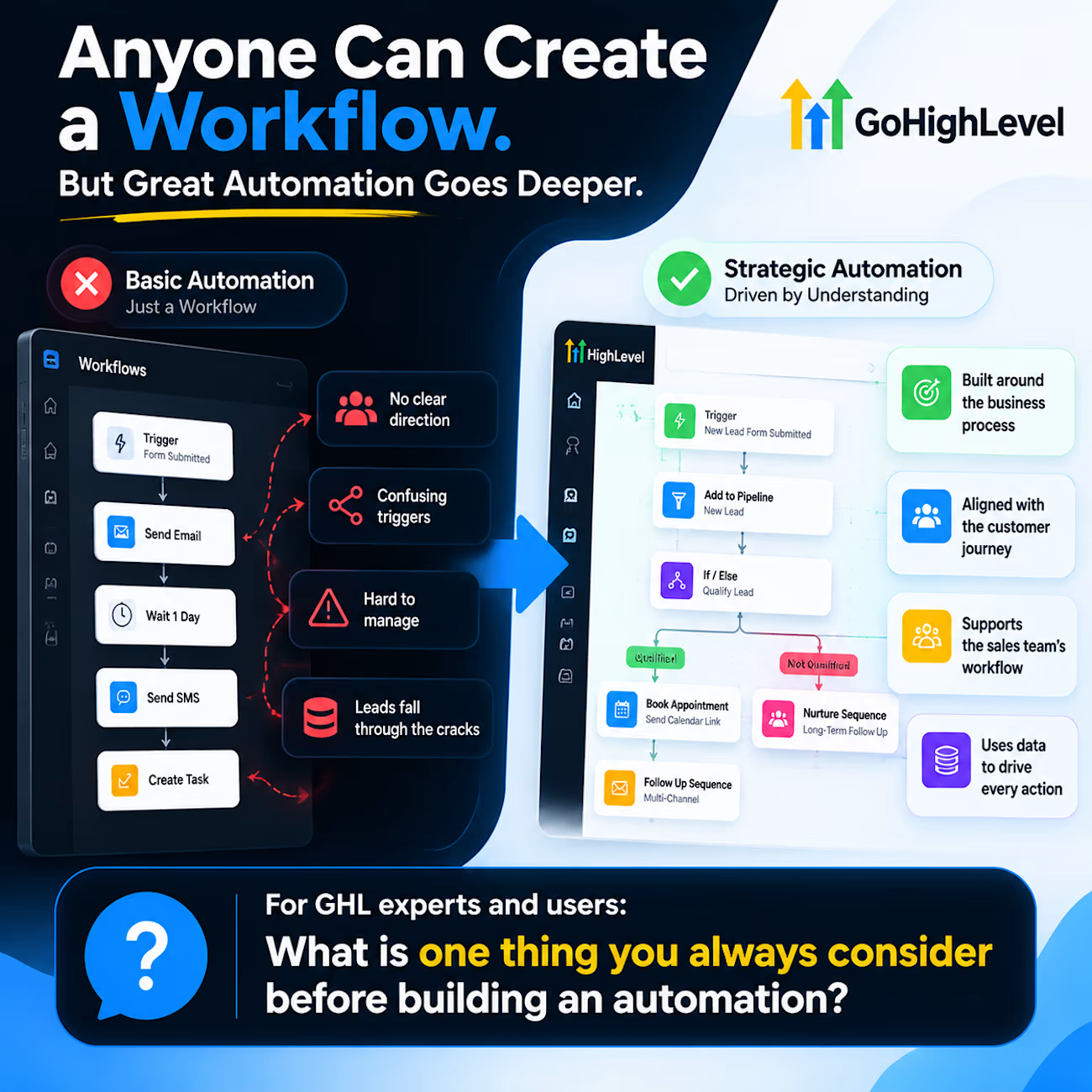
Anyone can create a workflow.
But great automation is not about adding more steps or creating more triggers.
It starts with understanding:
• The business process behind the automation
• The customer journey from first touch to conversion
• How the sales team actually works
• The data that drives every action
The best GoHighLevel systems are not the ones with the most workflows.
They are the ones that create better experiences, save time, and produce better outcomes.
For GHL experts and users:
What is one thing you always consider before building an automation?
The network for creativity
Join 1.25M professional creatives like you
Connect with clients, get discovered, and run your business 100% commission-free
Creatives on Contra have earned over $150M and we are just getting started




Related posts

Most businesses don’t need more AI. They need fewer manual problems.
I work at the intersection of data, AI, and software, turning repetitive workflows, disconnected data, and operational challenges into practical business solutions.
From data analytics and intelligent automation to AI-powered systems, my focus is simple: use technology where it creates measurable value.
Here’s a quick look at what we’re building at D-SAi.
What’s one repetitive process in your business you’d automate if you could?

AI May Not Take Your Job. It May Remove the First Step Into It.
AI does not need to fire millions of people overnight to transform the labor market.
It can begin by removing the first step into a profession.
A graduate enters software development in 2026. A company that once hired six junior developers now wants two experienced specialists who can supervise AI agents and remain accountable for the code.
No dismissal. No severance. No alarming statistic. The graduate was never employed.
Now consider a support agent in the same organization. An AI assistant retrieves relevant cases, explains expert decisions, and helps a newcomer reach competence faster. The technology that closed one career entrance has improved another.
One tool. Two futures.
Models automate tasks. Organizations decide what happens next. They can use the released capacity to improve quality, shorten working time, raise wages, increase profit, or reduce headcount. None of those outcomes is contained inside the model itself.
The evidence available in 2026 supports neither a simple apocalypse nor a simple promise:
• Roughly one in four workers is in an occupation with some exposure to generative AI, according to the ILO, but exposure is not dismissal.
• The highest exposure category covers about 3.3% of global employment.
• Some structured tasks show substantial productivity gains, especially for less experienced workers.
• Other experiments show experienced professionals becoming slower when verification and context are difficult.
• Early pressure is visible in hiring pipelines and younger workers, even though mass unemployment has not appeared in aggregate data.
My fifth long-form article maps six scenarios through 2046: the Augmentation Dividend, the Broken Career Ladder, the Core-and-Agent Firm, Algorithmic Taylorism, Robotic Displacement, and the Managed Transition.
The article follows four composite workers: a graduate locked out of a first role, an accountant whose saved time becomes a higher quota, a support agent who learns faster, and a care worker who remains indispensable but faces tighter algorithmic control.
The central question is not whether a job survives on paper. It is whether the person keeps income, autonomy, a path to expertise, and the right to challenge the system evaluating them.
Read the full research article:
Earlier in the series:
Where do you already see the strongest change: fewer entry-level opportunities, higher individual output, smaller teams, or more algorithmic monitoring?
artificialintelligencefutureofworkautomationContent ResearchContent WritingSearch Engine MarketingChatGPTOpenAI


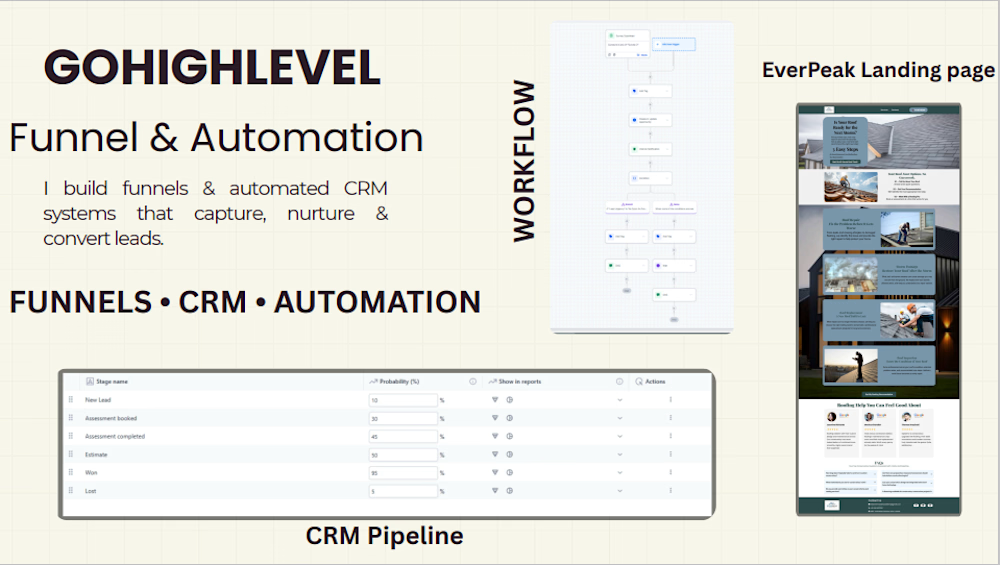
Landing Page / Funnel
CRM / Pipeline
Workflow Automation