The network for creativity
Join 1.25M professional creatives like you
Connect with clients, get discovered, and run your business 100% commission-free
Creatives on Contra have earned over $150M and we are just getting started
Back to feedPost

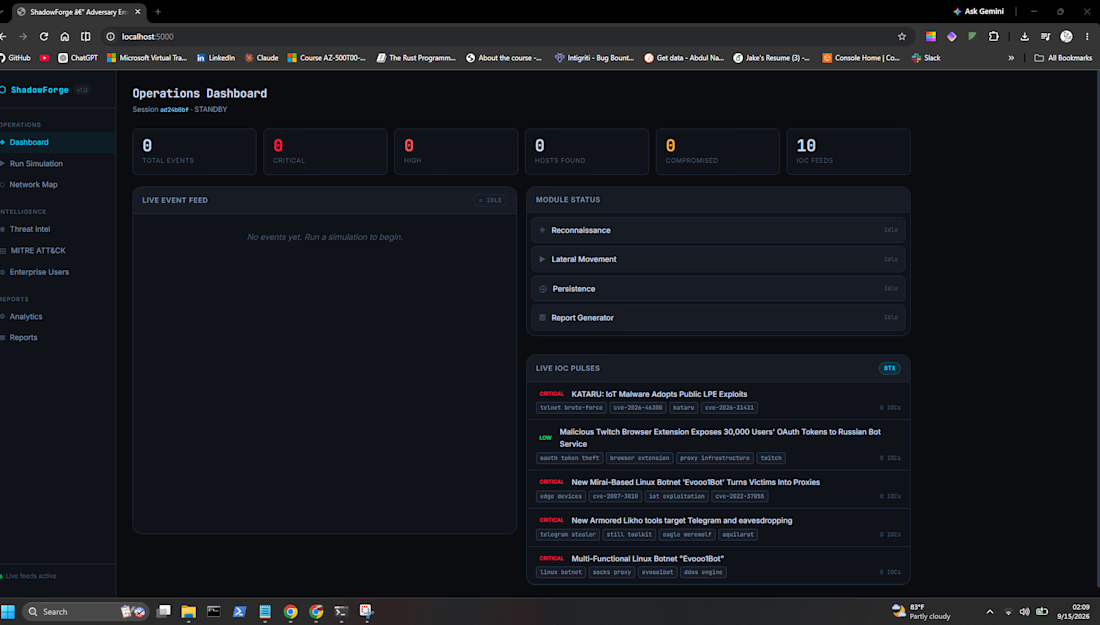
ShadowForge is an adversary-emulation and security-validation platform I built to help security teams model attack scenarios, visualize activity, correlate threat intelligence, and evaluate defensive visibility from a single operations interface.
The platform brings together scenario orchestration, network visualization, threat intelligence, MITRE ATT&CK mapping, enterprise identity simulation, analytics, and reporting into one unified workflow.
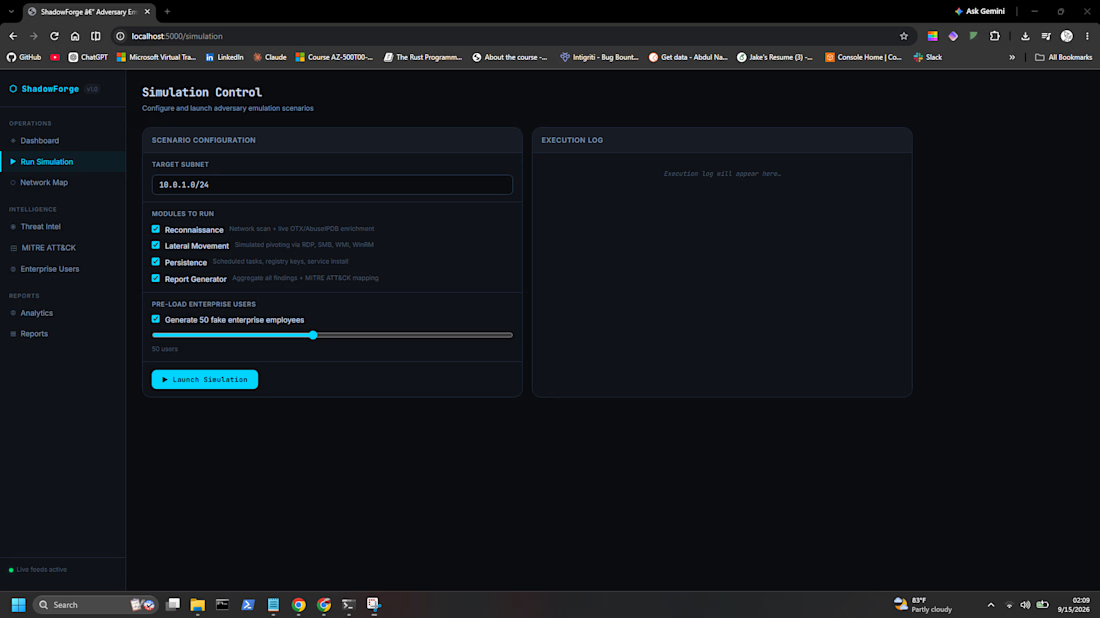
I designed the application around modular simulation components so authorized lab and security-validation exercises can be configured, observed, and translated into useful defensive findings rather than scattered logs and manual notes.
Key engineering work included:
Centralized security operations dashboard
Configurable adversary-emulation scenarios
Reconnaissance and environment-discovery simulation
Lateral-movement and persistence scenario modeling
Live execution-event visualization
Network topology and host mapping
MITRE ATT&CK technique mapping
Threat-intelligence and IOC enrichment
Enterprise user simulation for realistic lab scenarios
Security analytics and severity tracking
Automated findings and report generation
Modular architecture designed for controlled security testing
ShadowForge turns an authorized security exercise into something measurable: operators can configure a scenario, observe activity as it happens, correlate findings with threat intelligence and ATT&CK techniques, and produce structured results for defensive analysis.
Built for controlled labs, security validation, and authorized adversary-emulation environments.


The network for creativity
Join 1.25M professional creatives like you
Connect with clients, get discovered, and run your business 100% commission-free
Creatives on Contra have earned over $150M and we are just getting started



Related posts

The agent found the leak, rotated the key and synced every environment.
I will only approve
Light or Dark?
1 voted
25%
3 voted
75%
4 votes
Closed

Great idea, nicely executed.


Something new is taking shape. 👣
Strategy, identity, type, system, and website are done. The last step is loading: 83% 🟦
Designed and shipped as code, the same way I build for clients. 🛠️
Follow along to see the launch first.

Strategy through to a coded site, all by yourself, is a nice way to show clients exactly how you work. Looking forward to seeing that last 17% land!

The danger of SaaS Git dependency: When a vendor outage, account suspension, or price hike halts your entire engineering lifecycle.
Most modern technology companies anchor their entire software supply chain—source code, CI/CD pipelines, secret management, package registries, and issue tracking—to a single external SaaS provider (GitHub or GitLab).
While convenient, this model creates massive single-point-of-failure vulnerabilities and compliance liabilities:
1. Cascading Outage Disruption: When the SaaS provider suffers an incident, your developers cannot push code, CI pipelines cannot run security scans, and production emergency hotfixes are completely paralyzed.
2. IP Sovereignty & Data Exfiltration: Hosting sensitive proprietary algorithms, enterprise encryption keys, or regulated financial/healthcare intellectual property on multi-tenant commercial clouds carries inherent data exposure and regulatory audit friction.
3. Unpredictable Tier Pricing: Public SaaS platforms continually monetize developer seats, build minutes, and artifact storage, driving unexpected 40%+ operational cost increases.
The modern solution for resilient engineering organizations is deploying a self-hosted, sovereign Git forge (such as Forgejo or Gitea) integrated with dedicated, air-gapped CI/CD runners:
• Mathematical Resource Efficiency: Forgejo is a lightweight Go binary with a PostgreSQL backend. It delivers full Git hosting, PR reviews, issue management, and container registries consuming under 250MB of RAM—compared to 16GB+ for heavy alternatives.
• Native Actions Compatibility: Run standard, modern CI/CD workflows utilizing your existing YAML configurations with dedicated, bare-metal ephemeral execution runners.
• True Data Sovereignty: Store all git repositories, artifacts, and build logs on your own encrypted storage volumes (NVMe/Ceph) behind your zero-trust network perimeter.
• Hybrid Synchronization: Mirror external open-source dependencies locally for air-gapped security, while maintaining automated bidirectional replication to public repos when desired.
Take back control of your source code, your intellectual property, and your developer workflow.
Deploy a production-hardened sovereign Git forge with our 1–2 week Sprint on Contra:
#DevOps #Infrastructure #Security #CyberSecurity #Automation #Linux #SRE #Architecture