The network for creativity
Join 1.25M professional creatives like you
Connect with clients, get discovered, and run your business 100% commission-free
Creatives on Contra have earned over $150M and we are just getting started
Back to feedPost

While building Mahir AI, a service booking app for the Pakistani market, I needed the assistant to recommend real services based on natural language queries, not just keyword matches. That meant building a RAG pipeline on top of Supabase's pgvector extension.
The first version was straightforward: embed every service listing as is, store the vectors, run similarity search. Results were mediocre. A user asking for "someone to fix my kitchen sink" wasn't reliably matching plumbers, because the raw listing data was too sparse and inconsistent, some entries were a single line, others had five.
The fix was in the preprocessing, not the retrieval logic. I restructured each listing into a consistent, context rich chunk before embedding: service type, common problem descriptions, location context, and price range folded into a short natural language paragraph. That alone improved match quality more than any tuning I did on the retrieval side.
This pipeline now sits behind a Gemini based multi agent layer that handles the conversation, decides when to search, and formats the final recommendation. But the lesson that stuck with me: in RAG systems, embedding quality is a data problem before it's a model problem. Most teams over invest in the model and under invest in how they structure what goes into it.

The network for creativity
Join 1.25M professional creatives like you
Connect with clients, get discovered, and run your business 100% commission-free
Creatives on Contra have earned over $150M and we are just getting started
Related posts

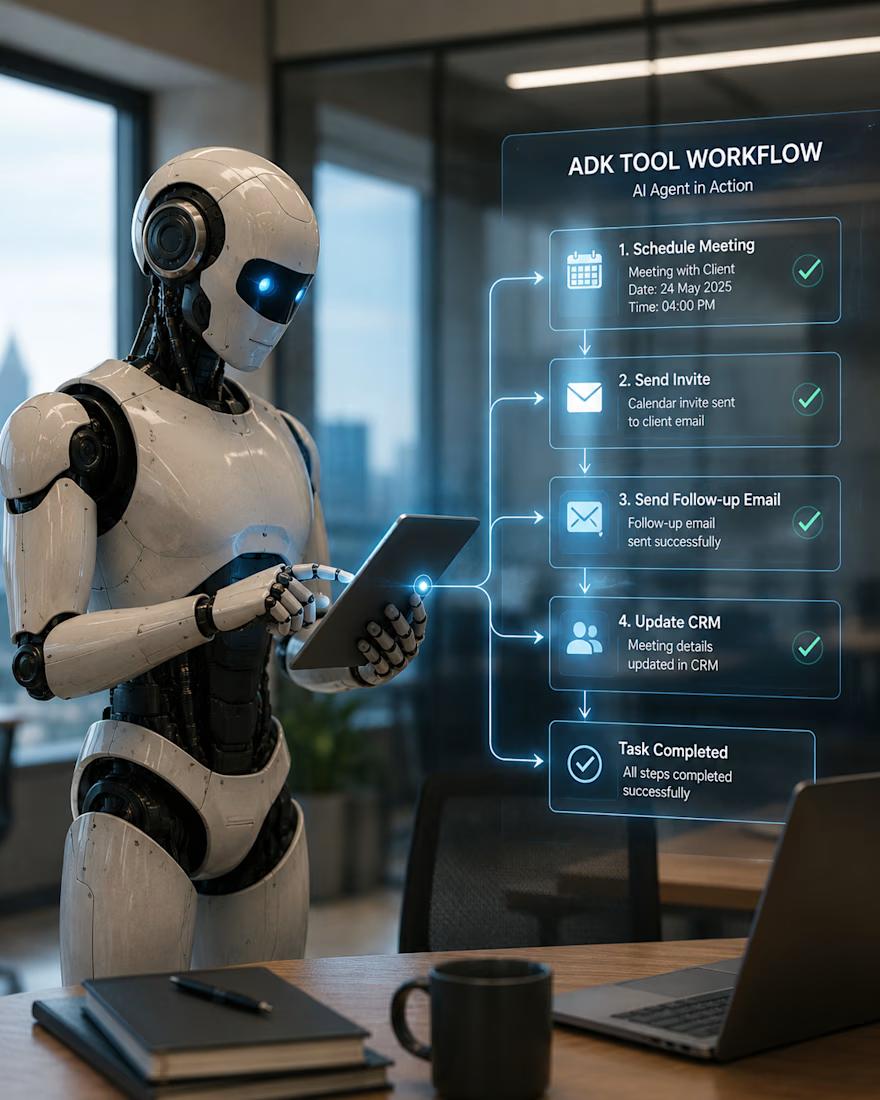
ADK (Agent Development Kit) might be one of the most important AI technologies developers should start learning.
We've spent the last few years building AI that can answer questions.
Now, with ADK, we're building AI that can perform tasks.
Think about it:
Instead of asking AI "How do I book a meeting?"
You can simply say:
"Book a meeting with the client, send the invitation, and update the CRM."
An AI Agent built with ADK can understand the request, use APIs and tools, and complete the workflow.
That's the difference.
ADK enables developers to build AI agents that can:
✅ Use APIs
✅ Access databases
✅ Connect external tools
✅ Automate repetitive workflows
✅ Complete multi-step tasks with minimal human input
This is why ADK is becoming an important building block for the next generation of AI applications.
We're moving beyond chatbots.
We're building AI agents that can actually work.
If you're a developer, ADK is definitely worth exploring.
Have you started learning ADK yet?
#ADK #AIAgents #AI #ArtificialIntelligence #Automation #SoftwareDevelopment #Developers #Tech

A website should not throw every lead straight into a booking link.
Better flow:
content → website → form → summary → call
The visitor sees a simple form.
The business gets context before the call.
That is the kind of AI automation I actually care about.


Beautifully solved.

Just finished my submission for the #GiveItAGlow challenge by @Base44! 🚀
I transformed a real local dental clinic's online presence into a modern, responsive website with an AI-powered booking assistant, automated appointment workflows, and a complete admin dashboard designed to save time and improve the patient experience.
This project was a great opportunity to combine design, AI, and automation into a solution built for a real business.
Live Link: https://functional-bright-smile-flow.base44.app/
Live Admin Dashboard: https://functional-bright-smile-flow.base44.app/admin
Would love to hear your thoughts!


Challenges
View all



Trending

Claude
Claude has entered the design space. How are you using Claude Design?

Contra University
Learn from expert creatives how to earn more using next-gen AI tools.
fifaworldcup2026
The World Cup is here and the whole world's watching. How are you designing for the world stage?
creativeaiflow
Creative AI workflows are evolving. What tools do you use, and what are their strengths and weaknesses?
freelancerlife
Freelancer life is wins, pivots, and everything in between. What’s yours right now?