The network for creativity
Join 1.25M professional creatives like you
Connect with clients, get discovered, and run your business 100% commission-free
Creatives on Contra have earned over $150M and we are just getting started
Back to feedPost
Most of the design work in Publizo is stuff you never see on screen.
Take credits. The obvious way to build an AI writer is to write the article first and publish it after. But if your WordPress password expired or a token was revoked, the publish fails and you've already paid for an article that went nowhere.
So Publizo checks the connection to your site before it writes a word. If it can't publish, it stops, tells you what's wrong, and doesn't charge a credit.
Same with images. AI-generated photos are easy to spot, and stock photos repeat fast on a niche blog. Publizo uses real photos and keeps track of them per site, so the same photo never shows up twice on one blog.
And every article is saved to your library before it goes out. If the site times out halfway through, you still have the full piece, the image and the SEO fields.
None of this shows up in a feature list. It's what had to be right before I'd let it publish to my own three sites every day.
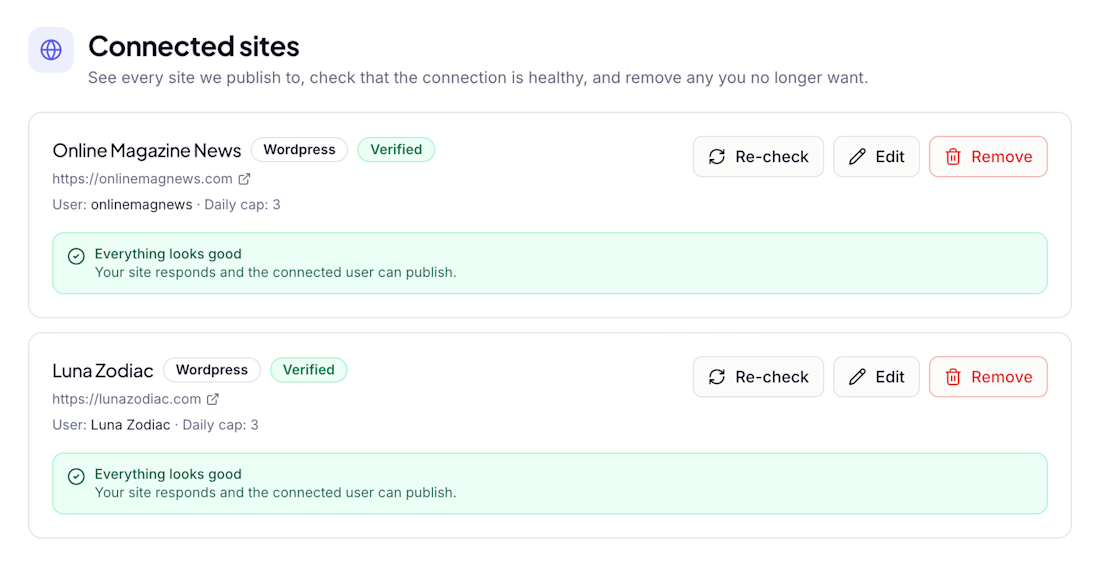


Thanks! It felt wrong to charge for an article that couldn’t publish, so it checks the site connection first now. No credit is spent until it knows the article can go live.
The network for creativity
Join 1.25M professional creatives like you
Connect with clients, get discovered, and run your business 100% commission-free
Creatives on Contra have earned over $150M and we are just getting started



Related posts

What if one of the most meaningful messages you ever receive… is written by a version of you that no longer exists?
That question became Dear Future my submission for the #Base44Challenge.
We save photos.
We save messages.
We save memories.
But we rarely preserve who we were in that exact moment what we were thinking, hoping for, afraid of, or becoming.
So I designed a digital time capsule where your words don’t just get stored.
They wait for you.
With Dear Future, you can:
✦ Write a letter to your future self or someone else
✦ Add memories and images
✦ Choose the exact future date it should return
✦ Personalize your capsule with colours and seals
✦ Seal it so it can’t be read or edited before its opening date
✦ Watch the countdown inside your personal archive
✦ Return later and experience the letter as something preserved not just another notification
But the biggest design challenge wasn’t creating a way to send a letter later.
It was designing the wait.
As a Senior Product & UI/UX Designer, I wanted every interaction to support that idea.
The archive.
The physical capsule metaphor.
The vintage television.
The sealing ritual.
The countdown.
The responsive mobile experience.
None of them are there just for decoration. Together, they turn anticipation into part of the product.
I designed the UX, visual system, interaction language, responsive experience, storytelling, and complete product flow then built and shipped the working experience with @Base44.
This project reminded me why I love product design:
A good interface helps someone complete a task.
A meaningful experience makes them feel something while doing it.
Dear Future Words outlive the moment.
Experience the project ↓
Dear future capsule
Would you write something for yourself five years from now?


AI isn't the designer. It's the tool.
You're the designer. The art director.
It can't design without your direction.

yes, we are like a boss to AI. its all upto us how we get done our work from subordinate.

Which Skill Gap Test experience would you choose? 👀
I designed two different experiences for the same Skill Gap Test.
Option A: A modal inside the dashboard — users stay in context.
Option B: A dedicated page — a cleaner, distraction-free experience.
If you were using this platform as a student, which experience would you prefer?
A or B? Why? 👇
#UIDesign #UXDesign #ProductDesign
4 voted
36%

7 voted
64%

11 votes
Closed

Dedecated Page is more professional and minimalistic ❤️