The network for creativity
Join 1.25M professional creatives like you
Connect with clients, get discovered, and run your business 100% commission-free
Creatives on Contra have earned over $150M and we are just getting started
Back to feedPost

QA-Driven Testing of Purchase, Access & Email Automation Flows
This work involved QA-driven testing and validation of complete digital purchase and access flows for online products and summit-related offers.
The scope covered functional verification of the full user journey — from checkout to post-purchase access — with a focus on system reliability, logical consistency, edge cases, and real user behavior.
Key responsibilities included:
- End-to-end testing of purchase flows (products, add-ons, upsells, all possible paths)
- Verification of checkout behavior, pricing logic, and product availability
- Validation of redirects, thank-you pages, and upsell sequences
- Testing of post-purchase access logic (email delivery, member area access, product unlocks)
- QA checks of email automation systems (tags, lists, sequences)
- Validation of form logic and embedded workflows (e.g. Typeform)
- Re-testing after implemented fixes to ensure stable behavior
Testing was performed with a strict QA mindset, focusing on functional correctness and system behavior — not on visual design, UX/UI, or business strategy.
Service Output:
Documented QA findings and a validated purchase & access flow, including minor fixes where feasible.
Scope boundary:
This work concludes with documented QA validation and implemented minor fixes. Ongoing optimization, redesign, or long-term system responsibility are excluded.



The network for creativity
Join 1.25M professional creatives like you
Connect with clients, get discovered, and run your business 100% commission-free
Creatives on Contra have earned over $150M and we are just getting started

Challenges
View all


Related posts

A motion piece showing a complete ordering flow I designed: menu, allergy filters, item options, live tracking, cart, pickup slots, scan-to-pay, booking, grid view.
Three specific questions, answer any one:
At real phone size, is the small text (allergens, meta labels) legible or did I go too fine?
Warm paper + near-black + one forest green for all actions - premium hospitality, or unfinished?
Which one of the 9 screens is the weakest? I'll redesign it.
Roast away.

Warm paper + near-black + one forest green reads as restraint, not incompleteness - the risk isn't the palette, it's the allergen text. That's the screen someone reads under time pressure with a hungry line behind them; widen it before touching the color system.

⚠️ The Challenge
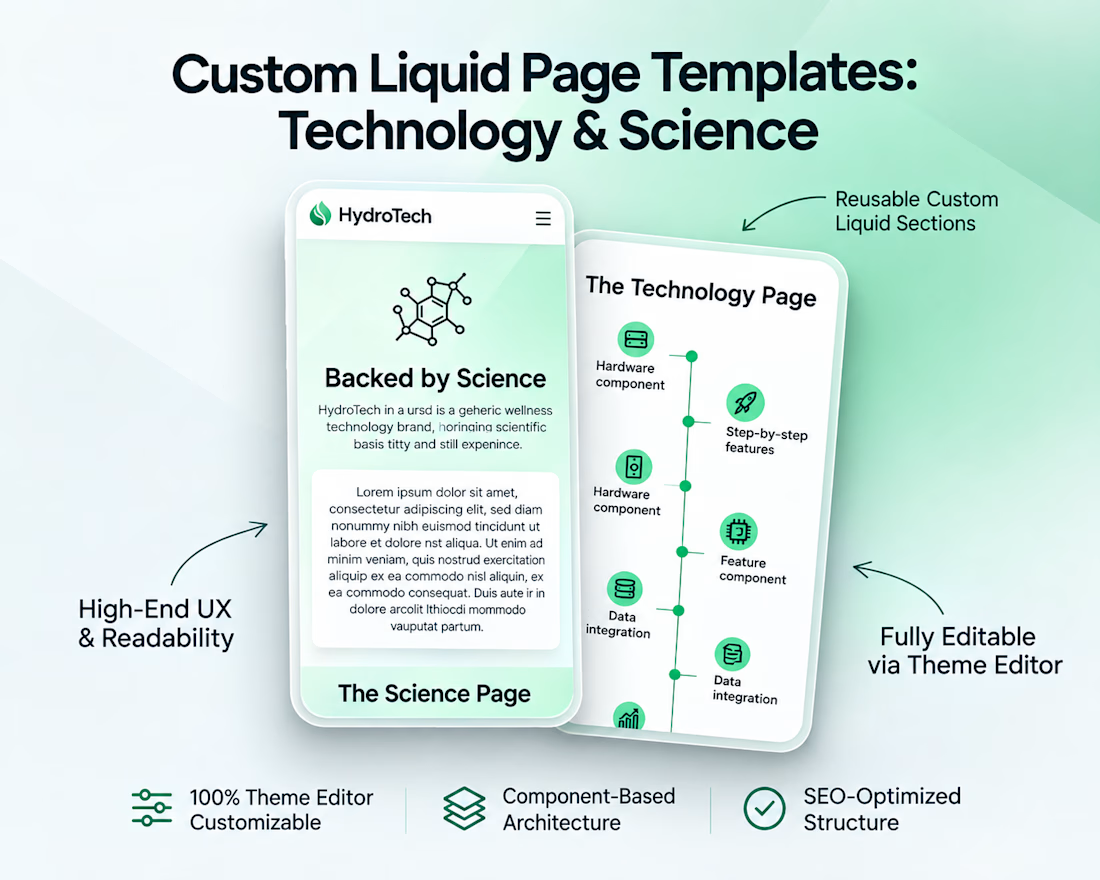
The client’s legacy theme was actively hindering their growth. It was visually outdated compared to their top competitors and notoriously difficult for their team to update internally. They needed a polished, high-converting look without losing the ability to manage their own content.
💡 The Solution
I engineered a complete overhaul of their core informational pages (Science, Technology) and Best Seller collection using custom, responsive Liquid templates built on Shopify OS 2.0 architecture. By implementing a modern, component-based design system, I delivered a sleek, premium aesthetic—reminiscent of top-tier SaaS platforms—that immediately elevated their brand positioning.
🎯 Key Deliverables & Impact
🛠️ Shopify OS 2.0 Architecture: Engineered modular, highly responsive Liquid templates tailored specifically to the brand's unique content needs.
🎮 Zero-Code Client Control: Delivered a 100% editable infrastructure directly within the Shopify Theme Editor, empowering the client's team to update text, swap imagery, and build new layouts without touching a line of code.
✨ Premium UX/UI Elevation: Completely redesigned critical touchpoints to build customer trust, highlight product science, and streamline the path to purchase.
⚡ Performance & SEO Optimized: Ensured lightweight code and lightning-fast load times to maximize retention and boost organic search visibility.
💻 Skills & Tools
Shopify OS 2.0 • Custom Liquid Development • UX/UI Design • E-Commerce Optimization • Responsive Design



Curious how the Core Web Vitals actually moved after the OS 2.0 rebuild - custom Liquid on component-heavy pages can go either way depending on JS payload. Did you benchmark load time before and after, or was the win mostly on editability and brand trust?
Shopify quietly added WhatsApp marketing consent to checkout on September 10.
Until now, getting a customer's OK to message them on WhatsApp meant a separate form or app, usually after the sale when intent had already cooled. Now it sits right where SMS and email opt-in already live, under Settings, Checkout, Marketing opt-in. Turn on the WhatsApp toggle and every completed order becomes a chance to add a real subscriber, not just an email address that may never get opened.
A few things worth checking this week if you sell into WhatsApp-heavy markets.
Leave the box unchecked by default. Consent captured pre-ticked does not hold up under GDPR, and Meta enforces the same standard - only a box the customer ticks themselves counts.
Check what actually sends to that list. Consent on its own does nothing without a helpdesk or marketing tool reading that field and sending through it.
Test the wording once it is live. A checkout opt-in only grows your list if customers notice it, and the default copy is not guaranteed to be the best performing version for your audience.
Five minute self-check. Open Settings, then Checkout, then Marketing opt-in, and see if WhatsApp shows up as a channel next to SMS and email. If it is not there yet, the rollout has not reached your store.
Ecom Swift LLC - Shopify Partner since 2018.