The network for creativity
Join 1.25M professional creatives like you
Connect with clients, get discovered, and run your business 100% commission-free
Creatives on Contra have earned over $150M and we are just getting started
Back to feedPost

Synthetic Data: Unlocking Healthcare AI Without Compromising Patient Privacy
Healthcare has no shortage of data. The challenge is using it safely. AI has changed almost every industry and healthcare is no exception. Still one major challenge remains. Data.
Medical records are protected by privacy regulations such as HIPAA and GDPR. These rules keep patient information secure but can also make access difficult for researchers and developers. In the past organizations often relied on dummy datasets or spent months waiting for approvals. This made research and development slower than it needed to be.
Today synthetic data offers a more practical option. It creates realistic healthcare information without exposing actual patient records. This gives teams useful data for AI training and development while keeping privacy in focus.
This article explores how synthetic data is helping solve healthcare’s data challenge and what it could mean for the future of AI driven care.
What is synthetic data?
Synthetic data is artificial information that computers create instead of collecting from real-life happenings. It looks and behaves like original data, but it doesn't contain any actual personal details, which makes it safer to share and use for testing or training purposes.
For instance, A remote clinic in a rural area wants to improve its X-ray diagnosis system, but they do not have enough real images of rare bone fractures to train their AI properly to fix this, they generate synthetic X-ray images. These are artificial but realistic scans showing various fracture types, angles, and severities, and they look just like genuine ones.
Consequently, the AI becomes skilled at detecting breaks even in unusual cases. Furthermore, the clinic can share this synthetic data with other hospitals without worrying about patient consent or identity exposure, since no real person's scan is involved.
How Synthetic Data is Transforming Healthcare
A Paradigm Shift
Healthcare generates an enormous amount of information, yet much of it cannot be freely used for research or AI development. Real patient data requires careful handling, which can slow down innovation. Synthetic data offers an alternative by producing realistic datasets that support development without depending entirely on actual patient records.
Enabling Privacy-Preserving Research
Patient information is highly sensitive and makes data sharing a serious concern.Synthetic datasets can give researchers useful information without revealing an individual’s medical history. This creates more room for collaboration and experimentation, allowing valuable research to move forward with fewer privacy barriers.
Accelerating AI Development
AI systems rely on quality data, but obtaining suitable healthcare datasets can be challenging. Synthetic data can supplement existing information and provide additional material for training and testing. As a result, developers can refine healthcare models more efficiently and explore applications such as medical imaging and predictive analysis.
Key Innovators
Several companies are advancing the use of synthetic data in healthcare. Philips, Syntegra, MDClone, and MOSTLY AI are developing solutions for real-world healthcare needs. Their work is turning synthetic data into a practical resource that could reshape how healthcare organizations handle data and build the next generation of AI-driven solutions.
Growing Adoption
The numbers speak for themselves. The global synthetic data in healthcare market was valued at US$657.92 million in 2025 and is projected to reach US$5.88 billion by 2033, growing at a 31.5 percent CAGR. North America leads with a 44.8 percent share, while Asia-Pacific is the fastest-growing region. Source
According to a March 2025 SAS study, 46 percent of healthcare entities and 56 percent of life sciences organizations are already using or considering synthetic data. The momentum is real.
Source:
Challenges and How to Overcome Them
Synthetic data can open new doors for healthcare AI but it still comes with limitations that cannot be ignored. The key is understanding where generated information may fall short and finding the right way to use it.
Domain Gap
Healthcare data has its own complexity, and even minor differences can affect how an AI model performs. A synthetic dataset might look highly realistic but still leave out uncommon conditions or subtle clinical details. This difference can become noticeable when the model is used with actual patient data. That is why thorough testing and validation are important before using synthetic data in real healthcare applications.
Bias Inheritance
Synthetic data does not automatically fix bias. If the original information contains gaps or underrepresents certain patient groups, those issues can appear in the generated dataset too. Therefore, checking the data across different populations is crucial for building fairer and more dependable AI systems.
The Hybrid Solution
A hybrid approach combines synthetic and actual healthcare data. Real patient data provides accurate clinical context. Synthetic datasets can then expand limited samples and support model development without exposing additional patient records. This approach gives developers more data to work with while keeping privacy in focus. It also allows AI systems to be tested against both generated and authentic information before practical use.

The network for creativity
Join 1.25M professional creatives like you
Connect with clients, get discovered, and run your business 100% commission-free
Creatives on Contra have earned over $150M and we are just getting started








Related posts


Hospitals don't have a software problem. They have a coordination problem.
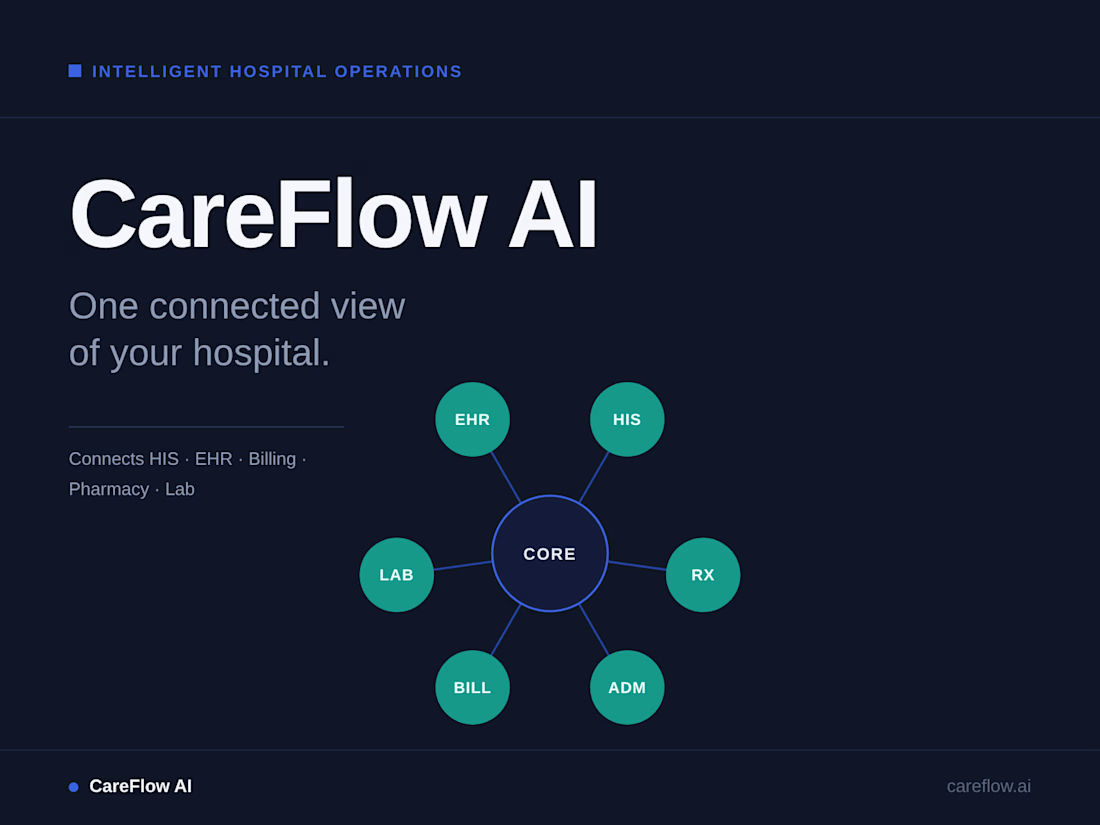
Most hospitals run a dozen+ systems — HIS, EHR, billing, pharmacy, lab, inventory — each one solid on its own. The cost shows up in the space between them: a bed that sits empty because housekeeping wasn't told, a discharge that stalls because three departments find out separately, a leadership team reading last week's numbers instead of today's operations.
We've been building CareFlow AI to close that gap — not another system to replace what you have, but an operational intelligence layer that sits above it. It connects your existing systems, turns their signals into one live view, and automates the hand-offs that used to run on phone calls and pagers.
Just put together a look at how it works, the architecture behind it, and what changes when a hospital runs as one connected system instead of a dozen disconnected ones.


For the bed-to-housekeeping handoff, I'd keep "discharge planned" separate from "patient has left and bed is released." Which system's event is authoritative for starting that task, and how do you handle a discharge being cancelled?





Great job Stizzy 🎉🎉🔥🔥

Launched my new AI Avatar service with driven performance! If you are interested in getting a custom AI Avatar created with driven performance, please contact me.
I offer:
-Scriptwriting.
-Real voice, or custom voice.
-Real AI Avatar performance
-Original music, composed and performed in my studio, using a real guitar, and enhanced using Suno AI.
-30 seconds of video, enhanced or customized using Runway Aleph.

Thats looks so real, almost like not AI product. Isint it so scary how real it has started to look. I feel bit more humanly eye blinking is only left for AI to achieve