The network for creativity
Join 1.25M professional creatives like you
Connect with clients, get discovered, and run your business 100% commission-free
Creatives on Contra have earned over $150M and we are just getting started
Back to feedPost

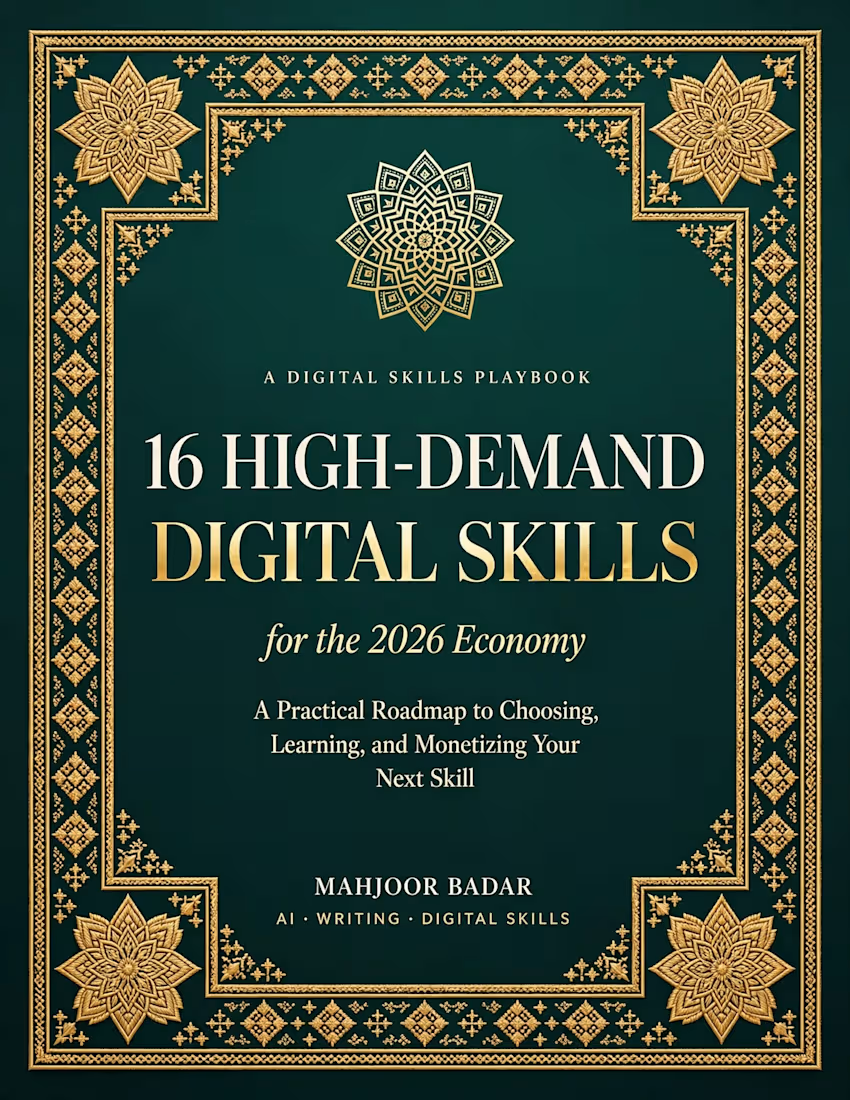
16 High-Demand Digital Skills for the 2026 Economy
A Practical Roadmap to Choosing, Learning, and Monetizing Your Next Skill
The world of work is changing faster than ever.
Artificial intelligence, remote work, automation, digital businesses, and the creator economy are transforming how people learn, work, and earn online.
A traditional degree can still be valuable, but having practical digital skills can give you another powerful advantage: the ability to create value from anywhere.
The real question is no longer:
«“What job should I get?”»
It is increasingly becoming:
«“What valuable skill can I learn and use to solve problems for people and businesses?”»
Here are 16 high-demand digital skills worth exploring in the 2026 economy.
---
1. Artificial Intelligence & Prompt Engineering
AI has become a practical productivity tool for writers, designers, marketers, developers, researchers, and business owners.
Learning how to work effectively with AI can help you:
- Generate and improve ideas
- Research information
- Create content
- Automate repetitive tasks
- Analyze data
- Build AI-powered workflows
Prompt engineering is only one part of the skill. The bigger opportunity is learning how to use AI to solve real problems.
---
2. AI-Assisted Content Creation
Businesses constantly need content.
That includes blog posts, social media content, newsletters, scripts, product descriptions, presentations, and marketing materials.
AI can dramatically speed up the process, but human judgment, editing, originality, and strategy remain important.
The valuable skill is not simply “using AI.”
It is creating useful content faster with AI while maintaining quality.
---
3. Graphic Design
Visual communication remains essential.
Businesses need:
- Social media graphics
- Presentations
- Advertisements
- Brand materials
- eBook covers
- Thumbnails
- Digital products
Tools such as Canva and other modern design platforms have made design more accessible.
However, knowing which template button to press is not the same as understanding design.
Typography, composition, hierarchy, branding, and visual communication still matter.
---
4. Video Editing
Video has become one of the most important forms of digital communication.
You can build a career by learning:
- Short-form video editing
- YouTube editing
- Educational videos
- Promotional videos
- Social media reels
- AI-assisted video production
You do not necessarily need expensive equipment.
A capable computer or even a smartphone, combined with the right software and skills, can be enough to start.
---
5. SEO
Search Engine Optimization helps websites and content become more discoverable through search engines.
SEO involves much more than adding keywords.
Important areas include:
- Keyword research
- Search intent
- Content strategy
- On-page SEO
- Technical SEO
- Internal linking
- Backlink strategy
- Content optimization
SEO can become particularly valuable when combined with writing, content marketing, or website development.
---
6. Copywriting
Copywriting is the art of using words to encourage a specific action.
That action could be:
- Buying a product
- Signing up for a newsletter
- Booking a service
- Downloading a resource
- Clicking an advertisement
Good copywriters understand psychology, customer problems, benefits, clarity, and persuasion.
AI can generate text.
But businesses still need people who understand what should be said, who it should be said to, and why it should matter.
---
7. Social Media Marketing
Social media is no longer simply a place to share photos and updates.
Businesses use platforms such as LinkedIn, Instagram, Facebook, TikTok, YouTube, and others to build audiences and generate customers.
A social media marketer may work on:
- Content planning
- Strategy
- Community management
- Analytics
- Advertising
- Brand positioning
- Content creation
The strongest marketers focus on business outcomes rather than simply chasing likes.
---
8. Web Design
Every serious business needs a digital presence.
Web designers create websites that are:
- Attractive
- Easy to navigate
- Mobile-friendly
- Fast
- Conversion-focused
You can start with no-code platforms and website builders before moving into more advanced technologies.
Learning basic HTML, CSS, UX principles, and modern website tools can significantly expand your opportunities.
---
9. No-Code & Automation
You do not always need to become a professional programmer to automate business processes.
No-code and low-code platforms allow people to connect applications and create automated workflows.
For example:
Form submission → Spreadsheet → AI processing → Email notification → CRM update
Businesses are willing to pay for automation because saving employees several hours every week can have real financial value.
---
10. Data Analysis
Businesses generate enormous amounts of data.
The challenge is turning that data into useful decisions.
Data analysis skills can include:
- Excel or Google Sheets
- Data cleaning
- Visualization
- Reporting
- Basic statistics
- Business intelligence
- AI-assisted analysis
You do not need to become a mathematician to start.
A strong understanding of spreadsheets and analytical thinking can already be useful.
---
11. Cybersecurity
As more businesses move online, protecting digital systems becomes increasingly important.
Cybersecurity professionals help organizations protect:
- Accounts
- Networks
- Websites
- Customer information
- Devices
- Digital infrastructure
This field requires serious learning and ethical responsibility, but it offers a wide range of career opportunities.
---
12. Software & App Development
Programming remains one of the most powerful digital skills.
Developers can build:
- Websites
- Mobile applications
- SaaS products
- APIs
- Automation systems
- AI applications
- Internal business tools
Modern AI coding assistants can make development more accessible, but understanding programming concepts remains extremely valuable.
AI may help write code.
You still need to understand what that code is supposed to accomplish.
---
13. Digital Marketing
Digital marketing combines multiple skills to help businesses attract and retain customers.
It can include:
- SEO
- Content marketing
- Email marketing
- Social media
- Paid advertising
- Analytics
- Conversion optimization
Learning how these channels work together can be more valuable than learning a single marketing tactic in isolation.
---
14. Email Marketing
Email remains one of the most useful channels for building direct relationships with an audience.
Businesses use email for:
- Newsletters
- Product launches
- Promotions
- Customer education
- Automated sequences
- Lead nurturing
A good email marketer understands audience segmentation, messaging, timing, and conversion.
The inbox may look old-fashioned, but apparently it refuses to die.
---
15. Personal Branding
Your skills are important.
But being discoverable can be just as important.
Personal branding means communicating:
Who you are + What you know + Who you help + What you can do
Platforms such as LinkedIn, Medium, YouTube, and other social networks can help professionals demonstrate their expertise.
Instead of simply saying:
«“I am a designer.”»
You can publish your designs, explain your process, share useful knowledge, and demonstrate your results.
Your content becomes part of your portfolio.
---
16. Digital Product Creation
One of the most interesting opportunities in the digital economy is creating products that can be sold repeatedly.
Examples include:
- eBooks
- Templates
- Notion systems
- Canva templates
- Printables
- Online courses
- Prompt packs
- Design resources
- Spreadsheets
- Digital guides
The advantage is scalability.
Instead of exchanging your time for money every time, you can create a useful digital product and sell it repeatedly.
However, creating the product is only half the job.
You also need marketing, distribution, positioning, and customer understanding.
---
Which Skill Should You Learn?
Do not try to learn all 16 skills at once.
That is an excellent strategy if your goal is to become professionally overwhelmed.
Instead, choose one primary skill based on three factors:
1. What interests you?
You are more likely to continue learning something you genuinely enjoy.
2. What are businesses willing to pay for?
A skill becomes commercially useful when it solves a real problem.
3. What can you demonstrate?
Build projects while learning.
A portfolio often communicates your ability more effectively than simply saying:
«“I completed a course.”»
---
The Power of Combining Skills
You do not necessarily need to become the world's best person at one skill.
Sometimes the real advantage comes from combining several complementary skills.
For example:
AI + Content Writing + SEO
can become an AI-powered content service.
Graphic Design + Social Media + Marketing
can become a social media design business.
No-Code + AI + Automation
can become an automation service.
Writing + Personal Branding + Digital Products
can become an audience-based digital business.
The future belongs not only to specialists, but also to people who can combine skills intelligently.
---
A Simple Learning Roadmap
If you are starting from zero, follow a simple process.
Step 1: Choose One Skill
Pick one skill instead of trying to learn everything simultaneously.
Step 2: Learn the Fundamentals
Use free tutorials, books, courses, documentation, and practical exercises.
Step 3: Build Projects
Do not spend months only watching tutorials.
Create something.
Step 4: Build a Portfolio
Show what you can actually do.
Step 5: Start Small
Offer your skill to small businesses, creators, entrepreneurs, or clients.
Step 6: Improve Through Real Work
Client work exposes weaknesses that tutorials conveniently hide.
Step 7: Add Complementary Skills
Once you become comfortable with your primary skill, add another skill that increases its value.
---
Final Thoughts
The digital economy is creating new opportunities, but opportunities do not automatically create income.
A skill becomes valuable when you can use it to solve a real problem.
You do not need to master everything.
Choose one skill.
Learn it.
Practice it.
Build projects.
Create a portfolio.
Find people who need that skill.
Then keep improving.
The goal is not to collect certificates.
The goal is to become useful.
And in a rapidly changing economy, being useful is still one of the safest skills of all.
---
About the Author
Mahjoor Badar writes about AI, digital skills, online work, digital products, and practical ways to use technology for learning and earning.
This article is based on the digital skills framework presented in the book “16 High-Demand Digital Skills for the 2026 Economy.”


The network for creativity
Join 1.25M professional creatives like you
Connect with clients, get discovered, and run your business 100% commission-free
Creatives on Contra have earned over $150M and we are just getting started





Related posts


Built the StupidFish Design System from the ground up and covering everything from color, typography, spacing, and components to comprehensive documentation.
Designed and documented for both web and mobile, creating a consistent, scalable foundation that makes product design and development faster and more cohesive.
Check out the full case study here →

Really thorough system, nice job

A little matcha ecosystem 🌿
AI campaign visuals for Brooklyn-based matcha brand boy bạn.
Creative Direction & AI Production — Se3d Studio






Love this!

Rosso Archive — Gallery Website
Rosso Archive is a website for a contemporary art gallery — a calm, editorial space built around a single idea: twenty-four works.
We kept the interface quiet so the images can speak. Monospaced captions, a soft grey palette and generous white space give the archive the feel of a printed catalogue, while small interactions make it feel alive online.
What's inside:
— Index list view with a live preview of the hovered work
— Grid view with a colour-on-hover state for the active piece
— Work detail page with specs, description and related works
— Seamless zoom-in transitions between artworks and screens
Have a project in mind? Let's talk.


Great work, Dmytro!