The network for creativity
Join 1.25M professional creatives like you
Connect with clients, get discovered, and run your business 100% commission-free
Creatives on Contra have earned over $150M and we are just getting started
Back to feedPost
Thank you, Ana — I really appreciate your thoughtful reading of the cinematic language in this film.
Your point about the airplane crash, and your connection between it and the father ignoring his son’s word “avião” (“plane”), shows a very precise understanding of one of the film’s most important scenes. To complete that meaning, the airplane carries another layer as well: it unfolds within the father’s perception, not in the film’s external reality. It is the instant he realizes that what seemed small — ignoring his son’s word — may hold a much deeper consequence.
Behind that, I was also exploring how our responses as adults can shape a child’s inner world. When a desire is met with a direct “no” or with dismissal, especially for some autistic children, it can create tension, frustration, and a sense of rupture. By contrast, a small shift — like “depois” (“later”) — does not deny the desire; it simply places its fulfillment in time.
And that shift can change everything.
We see this in the child’s response: when the father moves from “no” to “later,” the child becomes calmer, more receptive, and even able to imagine the world in a softer way — like the graffiti airplane, which in his perception moves freely and gently.
For me, the airplane is a symbolic event within the father’s perception, but one that we can still touch visually and physically on screen. This invites the viewer to question and discover its meaning for themselves, rather than having it explained to them. Even when films are created with the assistance of AI, cinema remains cinema: it should move us to think and feel, not simply provide explained information.
Another point: regarding the coworkers, I fully agree with your observation. They do know something about his son — but not enough to truly understand what that reality means. Their understanding is partial, and in that sense they represent us, the audience: when we engage with something through incomplete understanding, our judgment can also be incomplete or inaccurate. At the same time, we avoided framing them too clearly through either sympathy or condemnation. We left that space open for the audience, so that each viewer might reflect according to their own level of understanding.
And I think that distance between knowing and understanding is also part of the film’s core.
I’m truly grateful for your insights, as always, Ana. These conversations were part of the foundation of the film from the very beginning, and it is special to see them continue here.
Mohamed Beriky
----------------------------------------------------------------
AVIAO ON TIKTOK: https://www.tiktok.com/@berikystudios/video/7625671427181563157

The network for creativity
Join 1.25M professional creatives like you
Connect with clients, get discovered, and run your business 100% commission-free
Creatives on Contra have earned over $150M and we are just getting started
Related posts

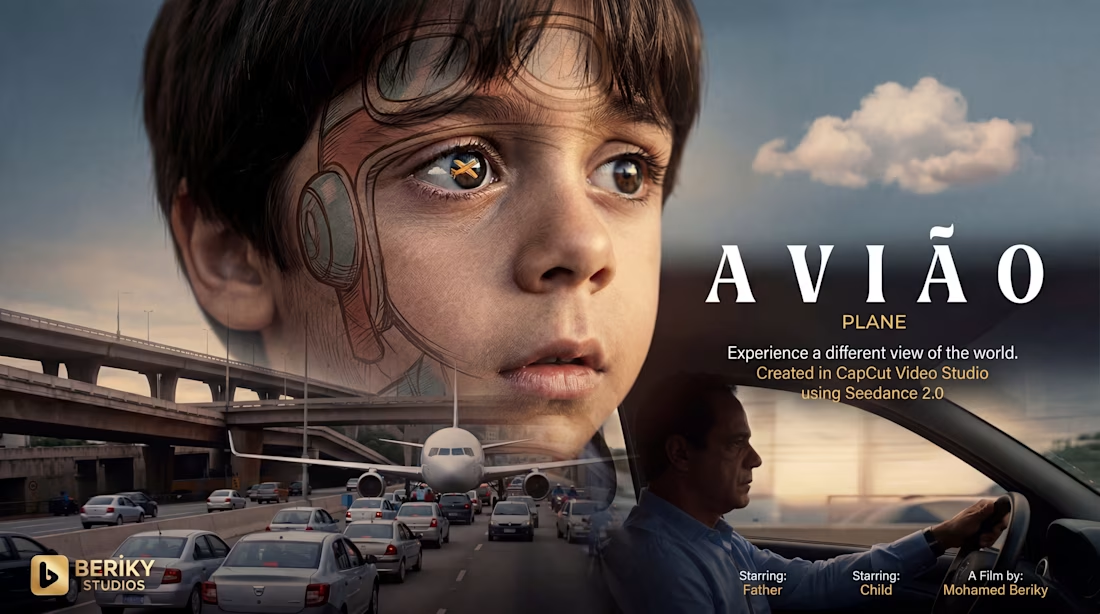
AVIÃO — a cinematic short film about perception, timing, and understanding.
Inspired by real experiences in autism, the film explores how a simple shift in communication can change emotional perspective and human connection.
Some autistic children experience the world differently.
Understanding is part of care.
Created 100% using CapCut Video Studio (Model: Seedance 2.0).
The most important decision in this film was not generating beautiful visuals.
It was generating reailty cinema level visuals that could speak without speaking — with minimal dialogue and maximum emotional clarity.
In “AVIÃO”, I wasn’t trying to test what Seedance 2.0 can generate.
After multiple rounds of director-led testing, Seedance 2.0, for me, the strongest video model current today in terms of understanding cinematic language, directorial intention, and scene logic — responding less like a tool and more like a production engine.
The real question for this film was:
what can CapCut Video Studio add to my approch of using Seedance 2.0?
This became a director-led process inside CapCut Video Studio — using the platform not simply as an AI generation tool, but as a controlled cinematic environment that made it possible to:
• Structure parallel timelines (home / office / road) with precise cut logic
• Build emotional rhythm through silence, pauses, and hard transitions
• Maintain character consistency and performance continuity across shots
• Use minimal dialogue to carry meaning instead of exposition
• Design a visual escalation that moves from realism into perception
The airplane crash was never just an event.
It was a shift in perception.
But the core of the film came from something real:
a simple insight from autism therapy.
For some autistic children, the difference between “no” and “later” is not semantic —
it is emotional regulation.
That insight became the spine of the film.
Not explained.
But experienced.
CapCut Video Studio made it possible to translate that idea into a complete cinematic structure — where timing, cuts, character continuity, and the platform’s smart cinematic workflow helped shape the concept, storyboard, and final scenes while keeping performance, meaning, and emotion at the center.
“AVIÃO” is not about what happens.
It’s about when understanding arrives.
Created using CapCut Video Studio and Seedance 2.0
Director-led cinematic process
Links:
YouTube: https://youtu.be/3dHpacrw3RQ
Linkedin:
#CapCutVideoStudio #Seedance2 #AICinema #Filmmaking #AutismAwareness



So beautiful. Subtle acting, professional, artistic editing.

No camera. No crew. Just AI.
Short tutorial on essential camera angles, stitched and animated entirely with generative tools.
Filmmaking just got easier


amazing job

I so much love this cinematic view ❤️😍 #FreelanceLifestyle #aivideo















Trending


FLORA
Reusable workflows are replacing one-off prompts in creative AI. Share what you're building in FLORA.
portfolioreview
The best portfolios tell a story, not just show a grid. Share yours for feedback.
brandguidelines
Brand guidelines are becoming living systems. What are you building for your clients?
freelancerlife
Freelancer life is wins, pivots, and everything in between. What’s yours right now?
aivideo
AI video tools are moving at warp speed. Which ones are you experimenting with?