The network for creativity
Join 1.25M professional creatives like you
Connect with clients, get discovered, and run your business 100% commission-free
Creatives on Contra have earned over $150M and we are just getting started
Back to feedPost
Automated Multi-Agent AI Support & Lead Triage Pipeline
Are your high-ticket clients waiting hours for an email response? This intelligent multi-agent n8n workflow instantly screens, analyzes, and responds to customer emails in real-time, utilizing advanced RAG (Retrieval-Augmented Generation) to deliver human-like support instantly.
Project Overview:
This is an enterprise-grade AI automation system designed to eliminate manual customer support queues. Instead of simple auto-replies, it uses a multi-agent routing structure combined with a dynamic knowledge base to handle complex inquiries autonomously.
How It Works (Under the Hood):
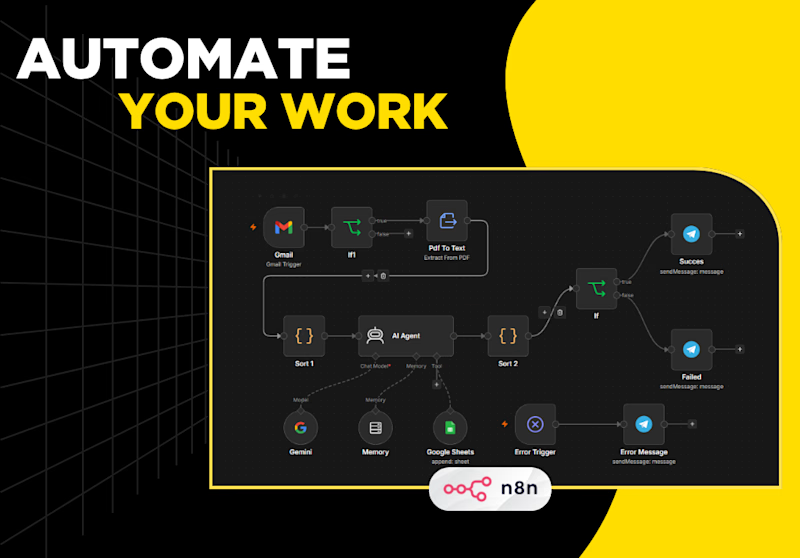
Instant Inbound Triage: A Gmail Trigger catches incoming emails instantly, extracting raw content for processing.
AI Intent Classification: An initial OpenAI model acts as a gatekeeper, analyzing the email to determine if it is a valid customer support request or irrelevant noise.
Conditional Routing: An advanced router splits the path: non-support emails receive a polite automated Telegram update, while actual support tickets are routed to the main AI engine.
Context-Aware AI Agent: The core Customer Support Agent is equipped with an OpenAI Chat Model, conversational memory, and a custom Vector Store Tool.
Pinecone RAG Integration: The agent queries a Pinecone Vector Database (powered by OpenAI Text Embeddings) to fetch real-time, accurate company documentation and context, eliminating hallucinations.
Automated Action & Response: Once the resolution is drafted, the system automatically creates a draft in Gmail for review and sends an instant internal notification via Telegram.
Why This Wins Clients (The Value Pitch):
Zero Hallucinations: Connected to a live vector database (Pinecone) so the AI only speaks from approved company data.
Reduced Overhead: Cuts down customer support response times from hours to under 60 seconds.
Production-Ready Architecture: Designed with modern n8n AI sub-nodes, structured tools, and modular scaling capabilities.


For anyone curious about the architecture under the hood:
Orchestration: n8n (Self-hosted for unlimited scale)
LLM: OpenAI GPT models
Memory & Vector DB: Pinecone Store for dynamic contextual injection
Routing: Native n8n conditional logic to isolate internal alerts...
The network for creativity
Join 1.25M professional creatives like you
Connect with clients, get discovered, and run your business 100% commission-free
Creatives on Contra have earned over $150M and we are just getting started



Related posts

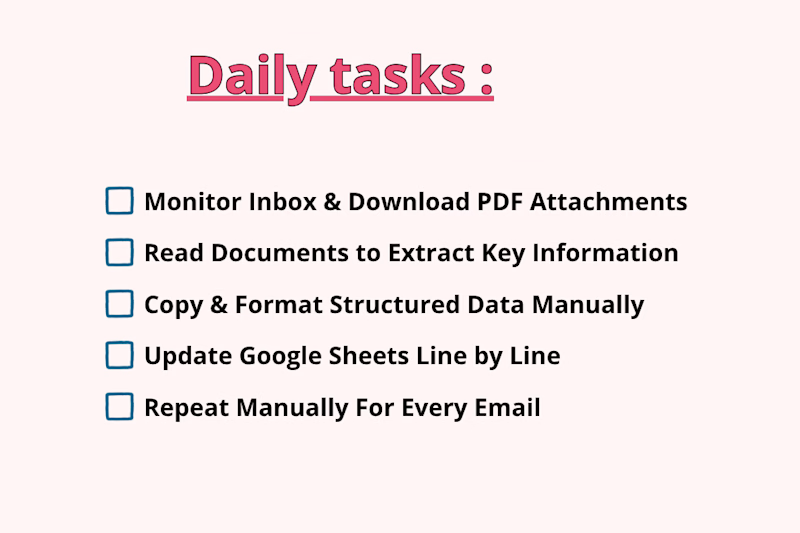
Processing incoming PDF attachments and logging key email data manually takes hours of tedious, repetitive work. Every time a new invoice, quote, or report lands in your inbox, you have to manually open the email, download the PDF, read through dense pages to extract important details, format the data, and log it into Google Sheets row by row.
Which one is faster, saves more time, and prevents mistakes?

1 voted
25%
3 voted
75%
4 votes
Closed

The manual-vs-automated framing is clear, but I'm curious how the workflow copes with PDFs that don't share a layout, like scanned invoices versus quotes. Do you parse them with a fixed template or an extraction step, and what happens to rows it can't read confidently?

Your Business Doesn't Need More Tools. It Needs Better Systems.
Most businesses don't have a software problem. They have an integration problem.
Their CRM is disconnected from their database. Their spreadsheets require manual updates. Their reports take hours to prepare. Their teams waste valuable time moving information between platforms.
That's where I come in.
I'm a Full-Stack AI Engineer specializing in building connected, intelligent business systems.
What I can build for your business:
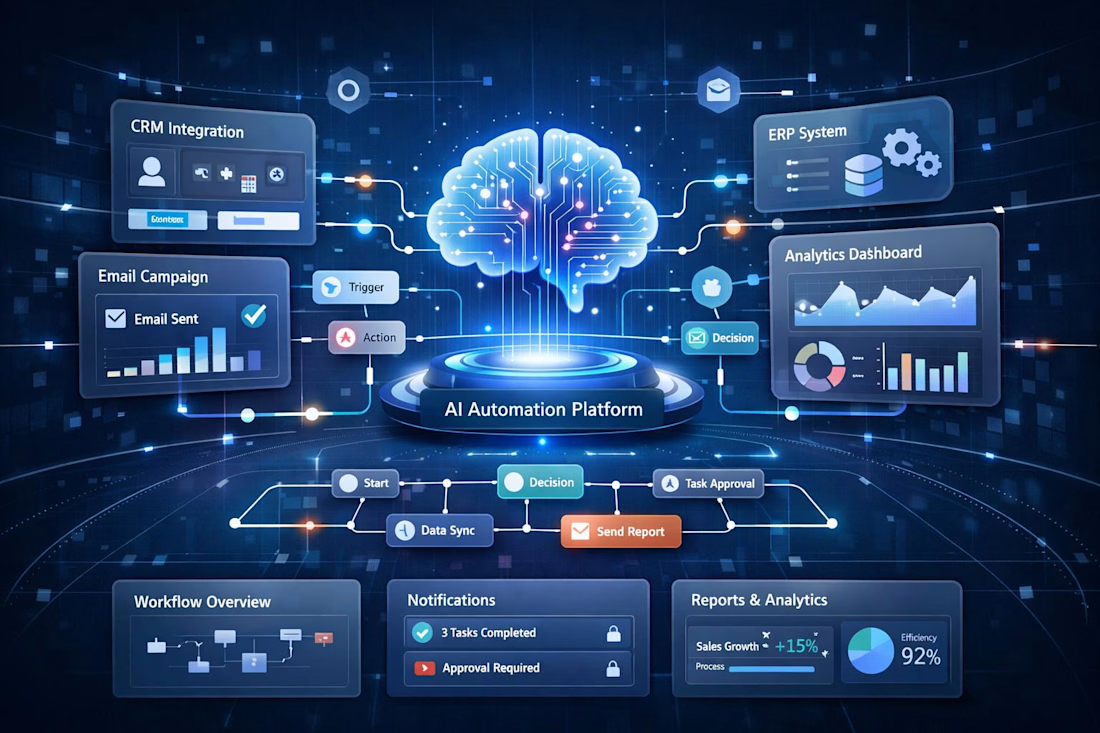
CRM & ERP Integrations — Connect business platforms, databases, and third-party services through APIs.
Workflow Automation — Eliminate repetitive processes with intelligent automation.
Custom Dashboards — Turn scattered business data into actionable insights.
Data Pipelines — Build reliable systems for collecting, processing, validating, and synchronizing data.
AI-Powered Solutions — Integrate LLMs, intelligent agents, and automation into existing workflows.
Custom Software — Build complete web applications and business platforms from architecture to deployment.
I've independently developed complex digital platforms, including government-level systems, international applications, and AI-powered products.
My approach is simple:
Understand the business problem. Design the right architecture. Build the complete solution. Make it reliable.
I'm interested in working with founders, agencies, and businesses looking to modernize their operations and build software that actually solves problems.
Have a complex workflow or an integration challenge? Let's build something that works.
#FullStackDevelopment #AIAutomation #CRMIntegration #WorkflowAutomation #SoftwareEngineering #AIEngineering #Contra
When a CRM-to-database sync fails halfway, how do you handle it: idempotent retries, or a reconciliation pass afterward? That's usually where integrations start to drift.

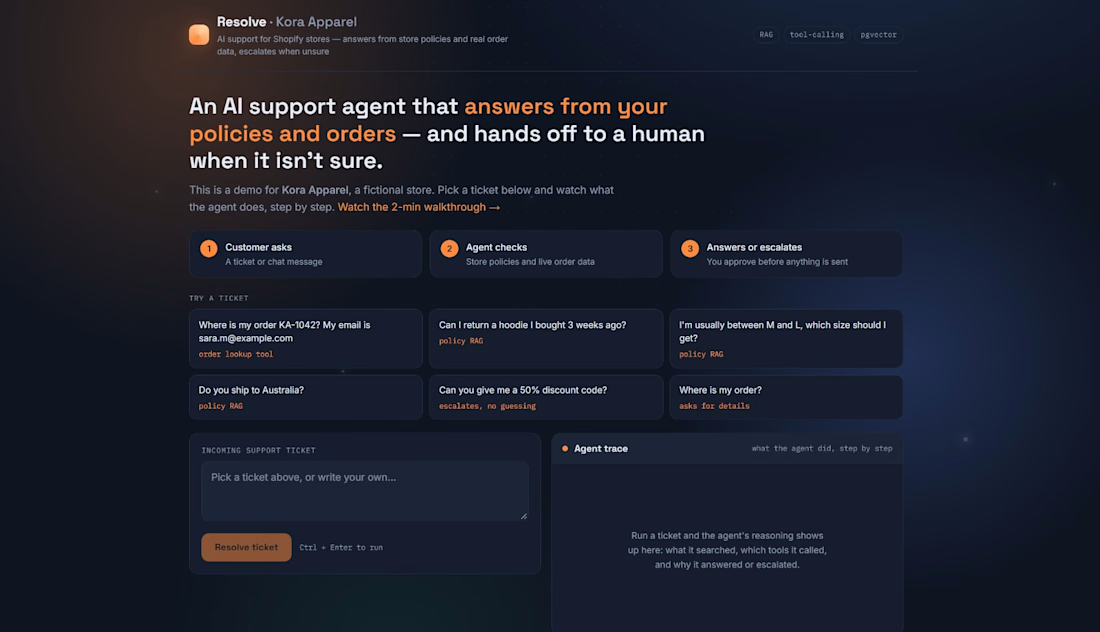
Resolve: an AI support agent that answers from a company’s own policies, looks up orders, and escalates weak matches to a human instead of guessing. A human approves replies before they go out.
Live demo: support-resolver.vercel.app



For the human approval step, I'd show the exact policy passage and its effective date beside the draft. Does Resolve flag a reply for re-review if the policy changes while it waits for approval?