The network for creativity
Join 1.25M professional creatives like you
Connect with clients, get discovered, and run your business 100% commission-free
Creatives on Contra have earned over $150M and we are just getting started
Back to feedPost

5 Signs Your Business Is Ready for Automation
(1) You answer the same questions 10x a day.
(2) Leads sit unanswered overnight.
(3) Quotes go out and never get chased.
(4) Reviews only arrive when you beg.
(5) You copy data between tools by hand.
Two or more? It's time. I start with a fixed-price audit that tells you exactly what to automate first: https://contra.com/abdullah_bhatti_qu3rekfn/services — Abdullah
contra.com
Abdullah Bhatti’s Services | Contra
View Abdullah Bhatti’s services on Contra. The Independent-first, commission-free freelance marketplace shaping the future of work.
The network for creativity
Join 1.25M professional creatives like you
Connect with clients, get discovered, and run your business 100% commission-free
Creatives on Contra have earned over $150M and we are just getting started



Related posts

I pick the automation tool last. After 400+ builds, that order saves clients money.
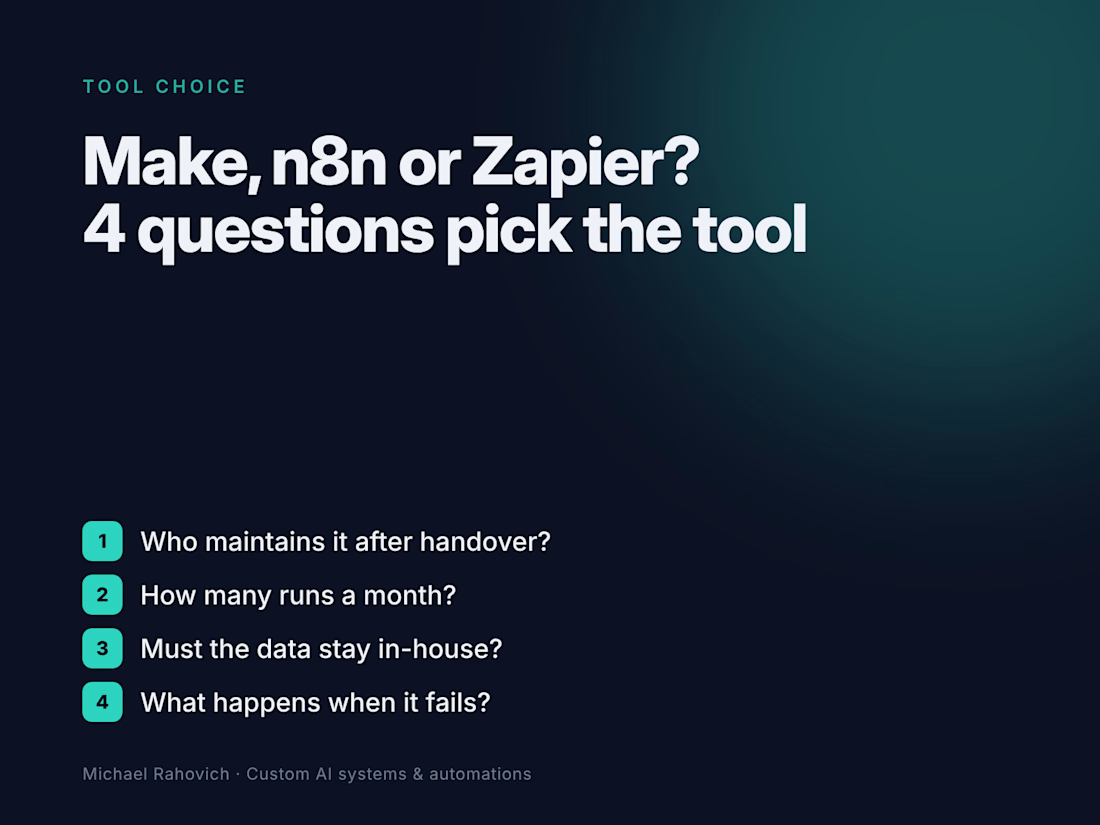
First I map the process on one page. Then 4 questions decide between Make, n8n, Zapier or code😍
1. Who looks after it once I hand it over? If your team already knows Zapier, a simple flow stays in Zapier.
2. How many times will it run a month? A flow that fires on every order or every new lead gets expensive per run. That's often where Make or self-hosted n8n wins.
3. Must the data stay on your own server? Then it's self-hosted n8n.
4. What happens when it fails? Flows with many branches and retries need strong error handling, so I usually build those in Make or n8n.
Code comes in only when no tool can do a step cleanly.
AI models get the same treatment. Sorting messages, drafting replies and reading documents each have a different bar for cost and accuracy, so they don't all get the same model.
Which tool does your business run on today, and would you pick it again?



A real estate team I worked with kept their leads in three places, a notebook, WhatsApp, and a spreadsheet, and by the time they called back, the buyer had already found another agent.
Now, when a new lead comes in, it is checked and sorted automatically, the hot ones go to the agent straight away, and the rest get a follow up without anyone having to remember.
That is what my n8n and ChatGPT lead automation does, and the link is in the post.

Three places for leads is the real problem here, more than the speed. Once everything lands in one list, the sorting becomes easy. One thing I'd check with a real estate team: what happens when the same buyer messages on WhatsApp and also fills the form? Merging those into one...

I recently built VoltEdge Electronics as a sample project to explore how e-commerce operations can be automated beyond the storefront.
The challenge was connecting multiple business processes: order processing, pricing, payment tracking, customer notifications, and support into one seamless system without relying on manual intervention at every stage.
How I approached it:
Built the storefront website.
Used n8n to orchestrate order processing and business logic.
Integrated Supabase for structured data storage.
Automated pricing, including promotional discount calculations.
Connected Gmail and Slack for customer and internal notifications.
Integrated an AI customer support assistant with human escalation.
One of the biggest lessons from this project was that automation isn't simply about connecting tools. It's about designing reliable workflows, handling different outcomes, maintaining data consistency, and ensuring that each process works as expected.
The result is a connected e-commerce system where the storefront, backend, notifications, and customer support work together.
I'm always interested in helping businesses identify repetitive processes that can be simplified or automated.
If you're looking to automate your business operations, workflows, or customer processes, feel free to reach out.