The network for creativity
Join 1.25M professional creatives like you
Connect with clients, get discovered, and run your business 100% commission-free
Creatives on Contra have earned over $150M and we are just getting started
Back to feedPost

The Brutal Truth Cheap Web Agencies Will Never Tell You
"You don't save money with a $500 website. You just pay the difference in lost high-ticket customers."
Most business owners think a $500 website is a bargain. You checked a box and saved capital. But the reality? Your cheap website is actively handing your best-paying clients directly to your competitors.
Here is exactly how a low-cost site leaks your revenue:
The 0.05-Second Credibility Test: Stanford research shows visitors judge your credibility in 0.05 seconds. Clashing colors and generic stock photos subconsciously signal a side hustle. Premium typography and balanced whitespace signal a market leader.
The 90% Bounce Risk: Google data shows that as a page load time goes from 1 to 5 seconds, the bounce probability jumps by over 90%. Cheap hosting and uncompressed code make users close the tab before your page even loads.
The Paradox of Choice: Cheap sites overwhelm users with competing buttons (Call Now, Subscribe, Get Quote). A confused visitor freezes and leaves. Premium design uses a single, primary CTA to guide buyers straight to your calendar.
The Real Business ROI
A $500 website is a liability, a poorly dressed salesperson turning buyers away 24/7. If your average contract is worth $2,000, converting just three extra clients over an entire year pays for a premium digital asset.
🖥️ Watch the live, side-by-side comparison in the video below to see exactly how cheap sites lose tens of thousands in contracts.
Video Link: https://youtu.be/m3MlAqCXv4U?si=hEx16z3A5nNTFf2b


The network for creativity
Join 1.25M professional creatives like you
Connect with clients, get discovered, and run your business 100% commission-free
Creatives on Contra have earned over $150M and we are just getting started



Related posts


What makes a website feel cohesive?
It’s not just the colors.
It’s not just the typography.
And it’s definitely not about making every section look the same.
A cohesive website is built when every visual decision feels like part of the same story, from typography and imagery to spacing, buttons, cards, and even the smallest details.
The goal isn’t repetition.
It’s creating a visual language that people recognize and remember.
That’s when a website starts to feel like a brand, not just a collection of sections.


Well put, Serge. Consistent spacing, buttons and cards do more for that feeling than making sections match, and they are usually the first things to drift as a site grows.

Apex3D Signage — B2B Interactive Intake System
The Problem:
B2B signage companies lose dozens of hours every week answering vague DMs like "How much for a 3D storefront sign?" without knowing dimensions, materials, or lighting requirements.
The Solution:
Instead of a static brochure site, we built an interactive signage specifier for Apex3D:
Custom Configurator: Clients select sign type (Front-Lit, Halo-Lit, Acrylic), materials, environment (Indoor/Outdoor), and dimensions.
Instant Estimator: Calculates a ballpark investment range on the spot.
Automated Lead Handoff: Packages all specs into a structured production brief sent straight to WhatsApp/Email.
The Result:
Zero DM back-and-forth, instant client qualification, and a streamlined sales pipeline.


Turning "how much for a 3D sign?" into a configurator is such a practical fix, and packing the specs into a production brief saves the sales team a whole round of questions. After the estimate, do they still send a PDF proposal, or does the brief do that job now?

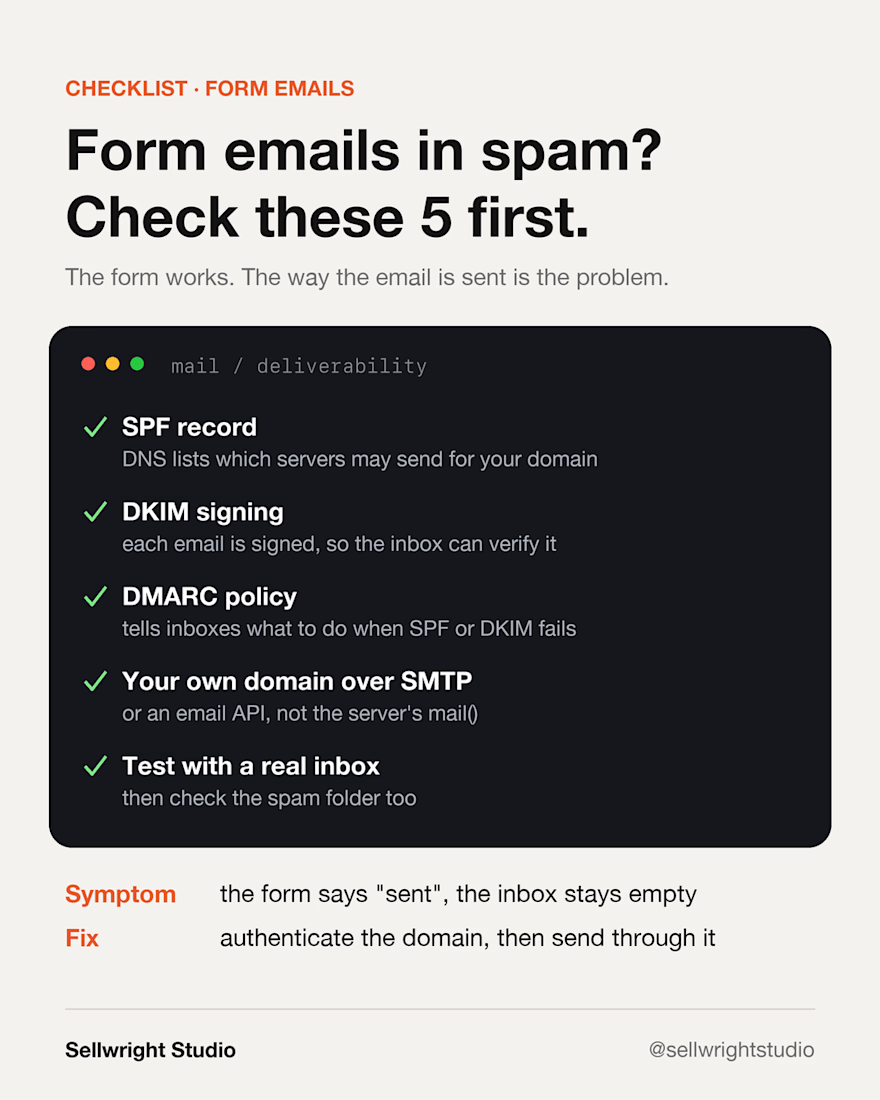
Your contact form works. The emails just never arrive.
This week a booking form on a client site sent its notifications with PHP mail(). The owner's Gmail sent them to spam, or dropped them.
Before you blame the form, check how the email is sent:
• SPF: a DNS record listing which servers may send for your domain
• DKIM: each email is signed, so the inbox can verify it came from you
• DMARC: tells inboxes what to do when SPF or DKIM fails
• Send from your own domain over SMTP or an email API, not the server's mail()
• Test with a real inbox, and check the spam folder too
Where do your site's form emails go: an inbox, a CRM, or both?
One real site, one real tip, every day. Follow for more videos.
More builds: youtube.com/@sellwrightstudio · instagram.com/sellwrightstudio

This one catches so many sites. Moving form notifications off PHP mail() to authenticated SMTP with proper SPF and DKIM fixes most of these cases.