The network for creativity
Join 1.25M professional creatives like you
Connect with clients, get discovered, and run your business 100% commission-free
Creatives on Contra have earned over $150M and we are just getting started
Back to feedPost
Automating Real Estate Transaction Deadline Compliance
An n8n-built system that catches contract deadlines before they cost agents their commission — and their reputation.
The Problem
Everyone building automations for real estate agents goes after the same thing: leads. More leads, faster leads, AI-qualified leads. It's crowded, and it's not where the money is actually leaking.
The real cost sits somewhere nobody's pitching: transaction deadline compliance.
The average agent today is running 25–40 active transactions at once, each with its own set of hard deadlines — inspection contingency, appraisal contingency, financing contingency, earnest money due date, closing date. That's not a handful of dates to track. For an agent juggling ten concurrent files, that's 300+ individual deadlines running in parallel, tracked by memory, sticky notes, or an overloaded spreadsheet.
The research backs up how often this breaks:
Missed or mishandled contingency deadlines occur in roughly 8% of all residential transactions
A single missed deadline costs $1,800–$2,400 in extension fees, renegotiation concessions, or forfeited earnest money
Coordination failures are the #2 cause of deals falling through entirely — right behind financing issues
Failed transactions cost the average agent an estimated $14,200/year in lost commission
Clients who experience a communication gap during closing are 3.2x more likely to leave a negative review, even when the deal still closes
This isn't an agent-competence problem. It's a volume problem: the manual systems agents use were built for six deals a year, and they're now running thirty.
The Business Outcome
Strip away the tech and this system is solving one thing: turning an invisible, memory-dependent risk into a tracked, provable, automatically-managed one.
What that's designed to change for a brokerage or team:
Commission protection — every deadline that would've relied on an agent's memory now has a system watching it instead. At $1,800–$2,400 in cost per missed deadline, catching even a handful of near-misses a year covers the system's cost many times over.
Reduced E&O exposure — brokerages carry real liability when a deadline lapse leads to a dispute. A timestamped, auditable record of every deadline and every reminder sent is evidence the brokerage did its job — something a sticky note can't provide.
Protected client experience — since communication gaps during closing (not lead volume) are what actually drives negative reviews and referral loss, this system is aimed directly at the moment that determines whether a closed client becomes a repeat client.
Scales with the agent, not against them — a top producer running 30+ files doesn't get riskier as volume grows, because the system's capacity to track deadlines doesn't degrade the way human attention does.
In short: this isn't a tool that generates more business. It's a tool that stops the business you already have from quietly leaking money.
How The System Works, Step by Step
Here's what actually happens to a transaction from the moment a contract is signed to the moment nothing is left to chance:
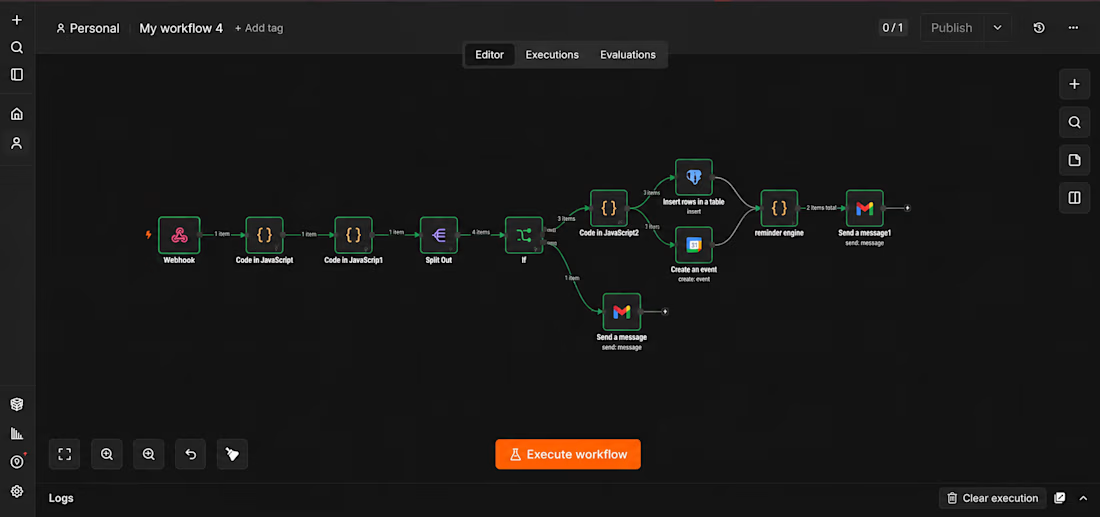
A contract gets signed. An e-signature webhook fires the instant the last signature lands — no one has to remember to "start the file."
The contract is normalized. Real contracts don't arrive as clean text — they're scanned, faxed, or exported as flattened PDFs. An OCR pass converts whatever format it comes in as into readable text before anything tries to interpret it.
An AI reads the contract like a transaction coordinator would. It extracts every hard date that matters: the inspection contingency, the appraisal contingency, the financing contingency, the earnest money due date, and the closing date — structured, not buried in paragraph 14.
Each extracted date is checked for confidence, not trusted blindly. This is the step most automations skip. Every date the AI pulls out gets a confidence score. If the AI is highly confident, the date moves forward automatically. If it's not — say, the contract language was ambiguous or the scan was blurry — that specific date gets routed to a human for a 30-second manual check instead of silently risking a wrong date going live.
Verified dates get tagged by how much they matter. Not every deadline carries the same risk — a missed earnest money deadline can cost a client their deposit; a soft internal milestone doesn't. The system tags each one so the response later matches the actual stakes.
Every deadline lands in two places at once. It's pushed straight into the agent's calendar — no separate app to check — and simultaneously written into a timestamped compliance log, creating a permanent, provable record of exactly when every deadline was known and tracked.
The system watches the clock so no one has to. As each date approaches, escalating reminders fire automatically — three days out, one day out, and the day itself. The final alert reaches both the agent and the client, so a deadline never lapses with only one side aware it was coming.
The result: a transaction coordinator that never forgets, never gets buried under thirty other files, and leaves a paper trail behind everything it does.
Why the Design Choices Matter
Anyone can wire a webhook to a calendar. The parts that separate a working prototype from something a brokerage could actually trust:
Confidence scoring, not blind automation — an LLM misreading a date is worse than the manual process it replaces if nobody catches it. The system flags uncertainty instead of hiding it.
A compliance audit trail — brokerages carry real E&O exposure when deadlines aren't documented. This system produces the paper trail as a byproduct of doing its job, not a bolted-on report.
Retry logic on every external call — a timed-out calendar API shouldn't mean a deadline silently disappears.
Built for messy inputs — contracts arrive scanned, faxed, and re-signed mid-transaction, not as clean text. The pipeline is designed to normalize input before parsing, not assume ideal conditions.
Tech Stack
n8n (workflow orchestration) · Claude API (contract parsing) · Google Calendar API · PostgreSQL (compliance log) · Email/SMTP (alerts)
What This Demonstrates
This wasn't built off a generic tutorial — it started from actual market research into where real estate transactions lose money, then worked backward into a system architecture that addresses the failure mode directly, with the edge cases (low-confidence parsing, API failures, contract amendments) designed in from the start rather than patched on after something broke.
If you're a broker-owner, team lead, or PropTech company dealing with transaction coordination overhead, compliance exposure, or client experience issues during closing — this is the kind of system I build.
Want a version of this built for your brokerage or workflow? Let's talk.


You are right that the leak is on the compliance side and not on leads. The part that broke my version: the dates move. One addendum extending the inspection period shifts the BINSR date, the seller response five days after it, and everything downstream - so a calendar generated...

Honest answer: no, not yet. Right now it parses once at acceptance and generates independent dates — it doesn't know BINSR, seller response, and everything downstream are a dependency chain, so an addendum shifting the inspection period wouldn't ripple through automatically....
The network for creativity
Join 1.25M professional creatives like you
Connect with clients, get discovered, and run your business 100% commission-free
Creatives on Contra have earned over $150M and we are just getting started











Related posts

3 mistakes I see every GoHighLevel user making that creates 100s of duplicate leads:
No deduplication logic between Facebook Lead Ads → GHL
No AI check for same phone/email with different name
No Google Sheets backup before pushing to GHL
I fixed this last week for a client with a simple n8n + AI workflow:
→ Facebook Lead → AI checks duplicate → If clean → GHL + Sheets → Telegram alert
Result: 0 duplicates in 7 days, 6 hours/week saved.
Want the n8n template? Comment "TEMPLATE" and I'll DM you.
#gohighlevel #n8n #leadmanagement #automation

Clean flow. The part I'd watch is the "maybe" pile: couples often share one email or one phone, so a strict duplicate check can silently drop a real second lead. I'd send those to a review tab in the Sheet instead of skipping them. What does yours do with a likely-but-not-certain match?

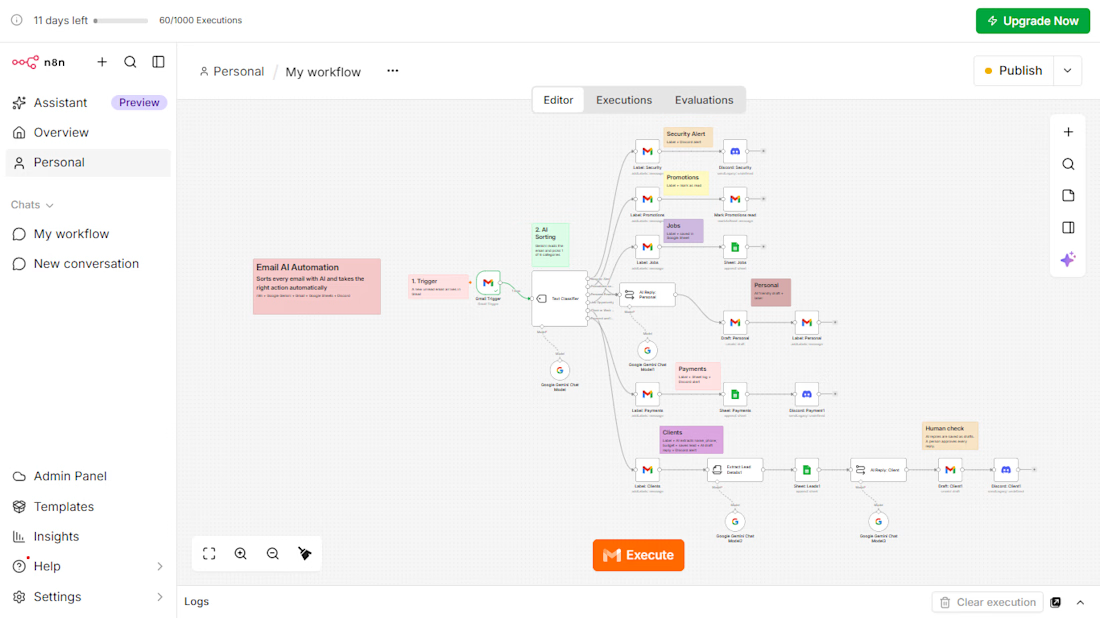
AI Email Automation with n8n and Google Gemini
An AI workflow that reads every incoming email, sorts it into 6 categories, and takes the right action automatically.
The problem: businesses lose time and leads because customer emails are mixed with promotions, job alerts, and security emails.
What I built:
Gmail Trigger that picks up each new email
AI Text Classifier (Google Gemini) with 6 categories: Security Alert, Promotions, Jobs, Personal, Payments, and Client Inquiries
Automatic Gmail labels for every category
Google Sheets log for jobs, leads, and payments
AI information extraction for client emails (name, phone, service, budget)
AI-written reply drafts for client emails, saved as drafts so a person approves every reply
Instant Discord alerts for security, payment, and client emails
Tools: n8n, Google Gemini, Gmail, Google Sheets, Discord
This project is a working demo built on my own inbox. The same system can be adapted to any business email, such as travel agencies, event venues, stores, recruiters, and consultants.

Impressive workflow! I especially like the human approval step for AI-written replies. Automation with the right oversight makes a real difference. 🙌

Managing customer orders, inventory updates, and approval emails manually takes hours of tedious, repetitive work. Every time a customer places an order, you have to manually check stock availability, log sales into spreadsheets line by line, draft custom HTML approval emails, track down confirmation status, and update inventory counts.


What happens when two orders for the last unit come in a few seconds apart? With a sheet as the stock source, both runs can read "1 left" before either one writes. Running the workflow one order at a time, or checking stock again right before the approval email goes out, closes that gap.