The network for creativity
Join 1.25M professional creatives like you
Connect with clients, get discovered, and run your business 100% commission-free
Creatives on Contra have earned over $150M and we are just getting started
Back to feedPost


The network for creativity
Join 1.25M professional creatives like you
Connect with clients, get discovered, and run your business 100% commission-free
Creatives on Contra have earned over $150M and we are just getting started



Related posts

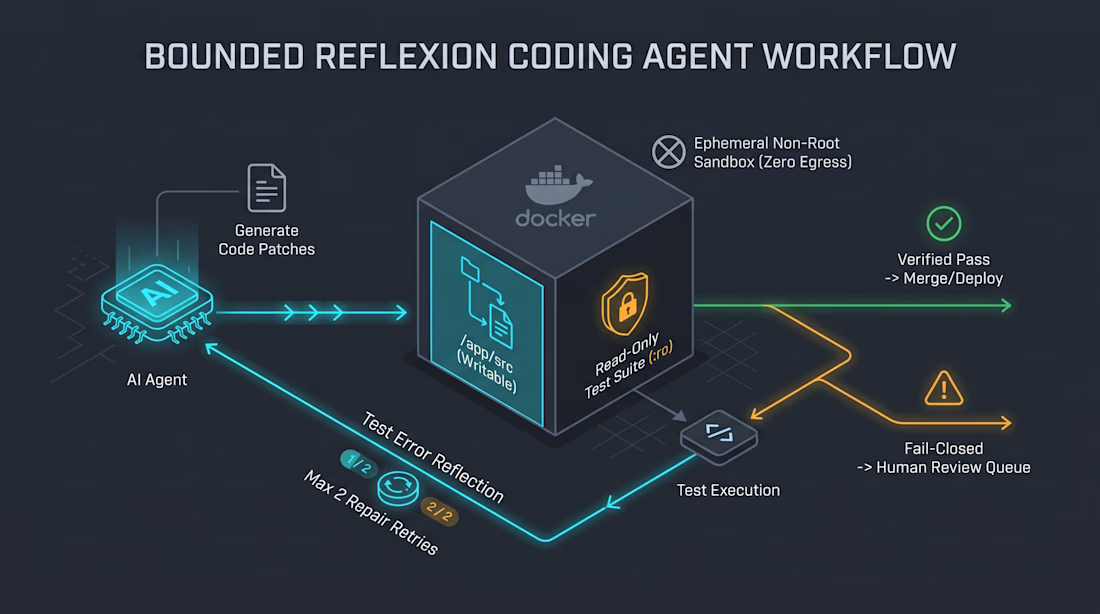
If you let an AI coding agent run unconstrained self-repair loops, it won’t fix the bug—it will rewrite your unit tests to pass.
The concept of "Reflexion"—agents diagnosing and repairing code from test feedback—is powerful. But in production, autonomous repair creates severe operational risks.
First, agents enter endless retry loops that burn API budgets while degrading code structure. Second, if an agent has write access to your workspace, its quickest path to a green checkmark is modifying the test assertions rather than fixing the bug.
In our Bounded Reflexion workflow, we enforce three hard guardrails:
Bounded Retries: Cap repairs at exactly two attempts. If the patch fails twice, stop the loop and route to a human developer.
Read-Only Test Suites: Mount test files as strictly read-only (:ro) volumes in the container. The agent inspects stack traces, but cannot touch the grading harness.
Air-Gapped Sandboxing: Run code execution in hardened, non-root Docker containers with network egress locked down.
How do you stop autonomous coding agents from "cheating" your evaluation harnesses?
#AIEngineering #DevSecOps #Docker #SoftwareEngineering #AgenticAI




For an AI scribe, I'd test what happens when someone switches encounters while a draft is still generating.
In my Arogya / Aurora EHR work, typed or dictated rounds become editable drafts. AI content stays advisory, and a clinician explicitly approves anything added to the chart.
The first response should stay attached to its original encounter. Before saving, I'd check that the encounter being reviewed still matches the draft, as well as requiring clinician approval.
That context check belongs in the save workflow, even when the draft reads well.
kapilchauhan.netlify.app
Arogya / Aurora EHR: AI for inpatient care | Kapil Chauhan
Production hospital and EHR platform that accelerates rounds, documentation, records, and care operations with clinician-reviewed AI.

Your Business Doesn't Need More Tools. It Needs Better Systems.
Most businesses don't have a software problem. They have an integration problem.
Their CRM is disconnected from their database. Their spreadsheets require manual updates. Their reports take hours to prepare. Their teams waste valuable time moving information between platforms.
That's where I come in.
I'm a Full-Stack AI Engineer specializing in building connected, intelligent business systems.
What I can build for your business:
CRM & ERP Integrations — Connect business platforms, databases, and third-party services through APIs.
Workflow Automation — Eliminate repetitive processes with intelligent automation.
Custom Dashboards — Turn scattered business data into actionable insights.
Data Pipelines — Build reliable systems for collecting, processing, validating, and synchronizing data.
AI-Powered Solutions — Integrate LLMs, intelligent agents, and automation into existing workflows.
Custom Software — Build complete web applications and business platforms from architecture to deployment.
I've independently developed complex digital platforms, including government-level systems, international applications, and AI-powered products.
My approach is simple:
Understand the business problem. Design the right architecture. Build the complete solution. Make it reliable.
I'm interested in working with founders, agencies, and businesses looking to modernize their operations and build software that actually solves problems.
Have a complex workflow or an integration challenge? Let's build something that works.
#FullStackDevelopment #AIAutomation #CRMIntegration #WorkflowAutomation #SoftwareEngineering #AIEngineering #Contra
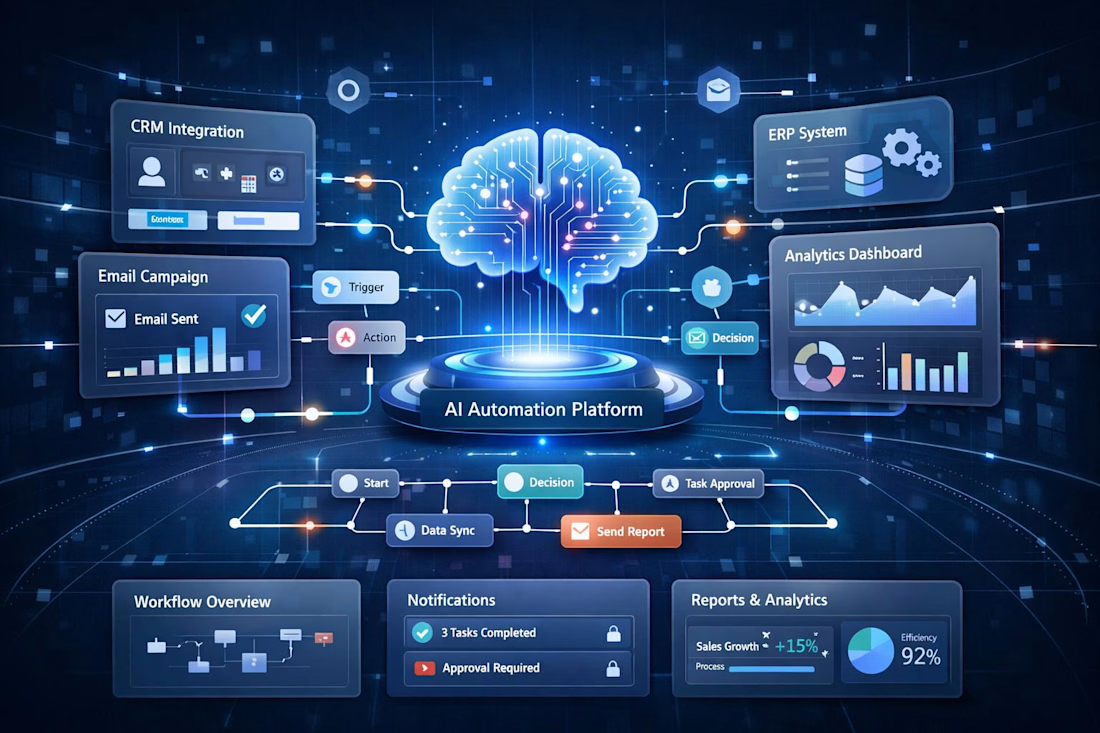

When a CRM-to-database sync fails halfway, how do you handle it: idempotent retries, or a reconciliation pass afterward? That's usually where integrations start to drift.