The network for creativity
Join 1.25M professional creatives like you
Connect with clients, get discovered, and run your business 100% commission-free
Creatives on Contra have earned over $150M and we are just getting started
Back to feedPost

Are you setting a price for your business without knowing what buyers or investors will actually pay?
Your company's value isn't determined by revenue alone. Profitability, cash flow, growth potential, capital requirements, and market conditions all influence what a business is worth.
A professional valuation gives you a stronger financial foundation when preparing for a sale, negotiating with investors, or evaluating an acquisition.
At ValuationLab, I help business owners, founders, and investors with:
- Business and startup valuations
- Discounted Cash Flow (DCF) modeling
- Comparable company and precedent transaction analysis
- Financial forecasting and business modeling
- Scenario and sensitivity analysis
- Valuation support for M&A, fundraising, and exits
With 15+ years of financial analysis experience, I deliver detailed, data-driven valuation work tailored to your objectives.
Need to establish the value of your business before your next deal? Let's get the numbers right. Message me on Contra today with your company details and requirements. I'll help you define the right valuation approach and prepare a tailored proposal for your project.
The network for creativity
Join 1.25M professional creatives like you
Connect with clients, get discovered, and run your business 100% commission-free
Creatives on Contra have earned over $150M and we are just getting started



Related posts

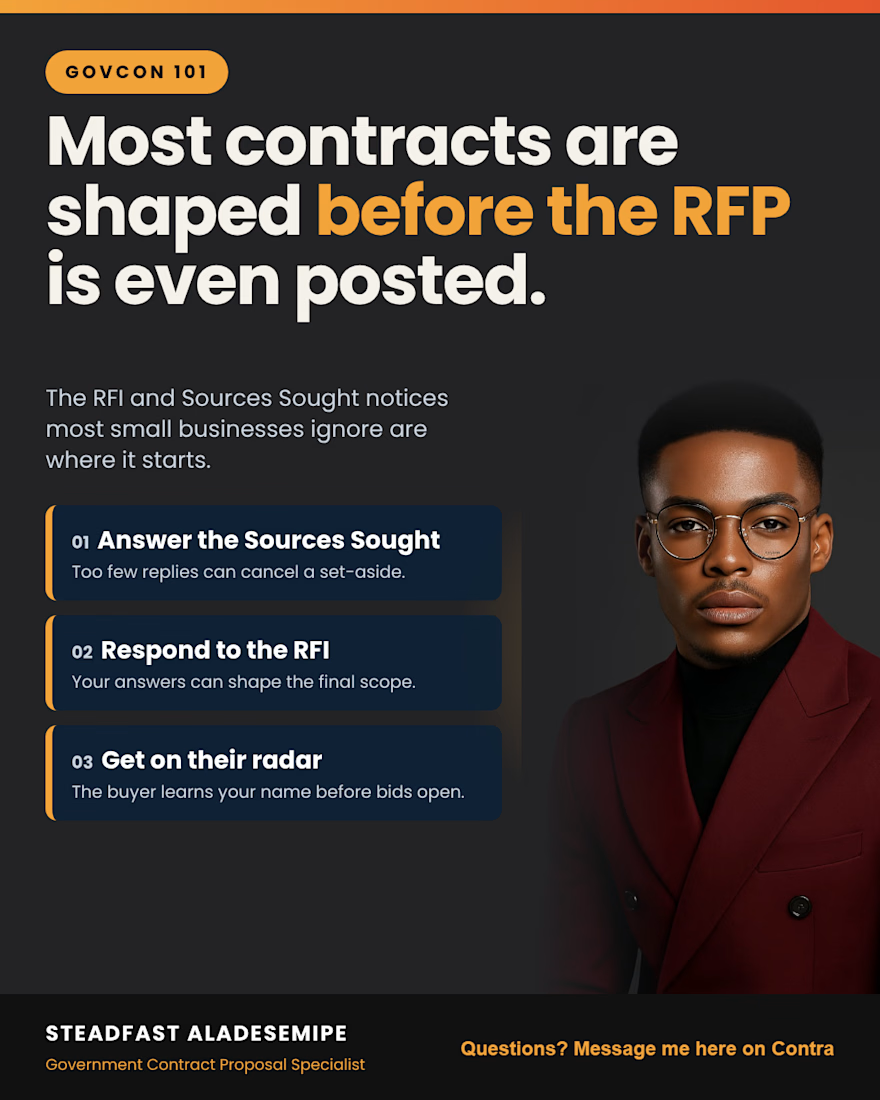
Quick GovCon lesson for small business owners 👇
Government contracts are often shaped months before the RFP is posted. Agencies publish Sources Sought and RFI notices to find out who can do the work and how the scope should look.
If you answer them:
✅ You help keep the contract set aside for small businesses
✅ You can influence the scope and requirements
✅ The contracting officer knows your name before bidding opens
A good response is 2 to 5 pages: who you are, relevant experience, capacity, NAICS codes, set-aside status and a clear answer to every question.
Most small firms skip these notices. That is your advantage.
I help businesses find these notices, write the responses and prepare the full bid when the RFP drops. Message me here if you have one open right now.

A landing page can look finished and still lose the sale.
Read your ad and the first screen of the page back to back. Does the page pick up the same promise? Can someone see the strongest evidence before they have to decide? Does the CTA tell them what happens after the click?
I start a campaign build with those three questions. They shape the copy hierarchy, the form, and the one event worth tracking.


Some of the most useful work I did on a marketplace project happened before we wrote the code: helping the client decide which features could wait.
Every addition meant more budget and a later launch, before we knew how people would respond to the core product.
We defined a first release around the essential marketplace workflows and put additional ideas into a prioritised plan for later. When a request could be solved with a simpler implementation, I brought that option into the conversation too.
Those decisions gave us a clear scope to build and the client a way to make further investments based on actual use.
The web platform is now live, and I’m continuing to work with the client on its development. We’re building on the initial release and working through the next priorities in stages.
For me, taking ownership of delivery includes knowing when to recommend postponing a feature — and being able to explain why.