The network for creativity
Join 1.25M professional creatives like you
Connect with clients, get discovered, and run your business 100% commission-free
Creatives on Contra have earned over $150M and we are just getting started
Back to feedPost
Mounting docker.sock in CI/CD: Why providing build jobs access to the host Docker daemon gives any pull request total root control over your cloud account.
To build container images inside continuous integration pipelines (GitLab CI, GitHub Actions, Forgejo/Gitea Act Runners), developers need a container runtime. The most common shortcut recommended across internet tutorials is simple: mount the host Docker UNIX socket into the runner container: ``volumes: ["/var/run/docker.sock:/var/run/docker.sock"]``.
In any environment where developers, contractors, or public contributors can submit pull requests, **mounting the host Docker socket is equivalent to granting unauthenticated root access to the entire host**:
1. Trivial Container Breakout: Access to ``docker.sock`` allows any process inside the container to communicate with the host Docker daemon. An attacker submitting a malicious pull request or tainted dependency simply executes: ``docker run -v /:/host -it alpine chroot /host`` In under 2 seconds, the attacker escapes the container, obtaining full root access on the host operating system. 2. Cloud IAM Instance Metadata Theft: Once on the host, the attacker queries the cloud instance metadata service (IMDS at ``169.254.169.254``). They extract temporary IAM session tokens associated with the runner's cloud instance role. If the runner instance has permissions to manage S3, push to ECR, or touch Kubernetes clusters, your entire cloud organization is compromised. 3. Persistent Pipeline Backdoors: Attackers can silently install rootkits, modify adjacent container volumes, or poison production build artifacts before they are deployed.
Hardening production CI/CD runner platforms requires eliminating privileged daemon sockets: • Adopt Rootless Podman & Quadlets: Deploy sovereign CI/CD runners (like Forgejo Act Runner) using rootless Podman supervised by systemd Quadlets. Containers run entirely inside user namespaces without root privileges on the underlying host. • Use Daemonless Image Builders: Replace Docker build commands with daemonless build tools like ``kaniko``, ``buildah``, or ``podman build``. These tools assemble OCI images completely in user space without requiring access to a host daemon socket. • Enforce IMDSv2 and Hop Limits: Configure your cloud provider to mandate IMDSv2 (requiring token-based HTTP PUT handshakes) and enforce an HTTP hop limit of 1 (``http-put-response-hop-limit=1``). This prevents containers running inside the VM from reaching the metadata endpoint entirely. • Ephemeral Disposable VMs: For untrusted public pipelines, run jobs inside single-use, ephemeral KVM virtual machines that are destroyed immediately upon job completion.
Stop insecure pipeline breakouts and protect your production cloud credentials.
Deploy a secure, air-gapped developer platform with our 1-to-2 week Sovereign Git Forge & CI/CD Runner Platform Sprint on Contra: https://contra.com/s/7vW66W2v-sovereign-git-forge-and-cicd-runner-platform-deployment
#Security #DevOps #Docker #CyberSecurity #Cloud #Infrastructure #SRE

The network for creativity
Join 1.25M professional creatives like you
Connect with clients, get discovered, and run your business 100% commission-free
Creatives on Contra have earned over $150M and we are just getting started





Related posts

Kerberos ticket failures: Why establishing cross-realm trust between FreeIPA and Active Directory fails when DNS SRV records are omitted.
In hybrid enterprise environments, establishing a bidirectional or one-way cross-realm trust between an enterprise Linux identity domain (FreeIPA/Red Hat IdM) and Microsoft Active Directory (AD) is the industry standard for centralized single sign-on (SSO) and RBAC governance. It allows enterprise Active Directory users to log into Linux compute clusters seamlessly without duplicating user accounts.
Yet initial trust deployments routinely stall on cryptic Kerberos errors: ``KRB5KDC_ERR_S_PRINCIPAL_UNKNOWN`` or ``Cannot find KDC for realm``.
The failure mode almost always traces back to **DNS SRV service discovery omission**:
1. Kerberos Locality via DNS: Unlike legacy LDAP where client configs hardcode server IP addresses, Kerberos authentication is dynamically discovered. When a Linux client attempts to obtain a Ticket Granting Ticket (TGT) for a cross-realm user, the Kerberos library queries DNS for specific SRV records to locate the Key Distribution Center (KDC). 2. The Missing Service Records: If the Windows AD DNS zone or the FreeIPA BIND9 zone fails to publish authoritative SRV records (``_kerberos._udp``, ``_kerberos._tcp``, ``_kpasswd._udp``, and ``_ldap._tcp.dc._msdcs``), domain controllers cannot discover each other during trust establishment. 3. Kerberos Realm Referral Failures: Without explicit realm referrals configured in SSSD and Kerberos (``/etc/krb5.conf``), Linux clients query their local KDC for external AD realms. The local KDC has no routing path to issue referral tickets, and cross-realm authentication fails completely.
Building rock-solid, enterprise cross-realm trust requires synchronized DNS automation: • Automate DNS Zone Forwarding & Delegation: Configure FreeIPA integrated BIND9 DNS with conditional forwarders pointing directly to the Active Directory DNS servers for the corporate AD domain, and configure reciprocal conditional forwarders in Windows DNS. • Validate Authoritative SRV Records: Verify that both realms publish complete SRV record sets with correct priority and weight parameters for UDP and TCP ports 88 (Kerberos) and 464 (kpasswd). • Enforce Cross-Forest Trust Validation via SSSD: Deploy SSSD with ``subdomain_inherit`` and ``krb5_use_enterprise_principal = True``, allowing users to authenticate seamlessly using User Principal Names (UPNs) across both Linux and Windows fleets. • Centralize Host-Based Access Control (HBAC): Use FreeIPA HBAC rules to dictate exactly which Active Directory security groups have permission to access specific Linux hosts, enforcing least-privilege access without touching local host configurations.
Unify your corporate identity, eliminate scattered credentials, and streamline enterprise access.
Deploy enterprise identity infrastructure with our 2-week Enterprise FreeIPA HA & Centralized PKI/CA Sprint on Contra: https://contra.com/s/ALrNLqlg-enterprise-free-ipa-ha-and-centralized-pkica-infrastructure
#IdentityManagement #Security #DNS #Linux #Infrastructure #DevOps #SRE


Orphan cloud infrastructure: How deleted virtual machines leave behind thousands of dollars in unattached persistent disks, idle IPv4 addresses, and orphan load balancers.
When software developers and DevOps engineers terminate a virtual machine, test environment, or Kubernetes cluster, they assume the billing stops. They click "Terminate Instance" or delete an environment branch in CI/CD, and consider the task complete.
In reality, cloud hyperscalers (AWS, GCP, Azure) are designed so that companion resources persist independently after instance deletion—silently accumulating charges month after month:
1. Unattached Persistent SSDs: When an EC2 or Compute Engine instance is deleted without the ``DeleteOnTermination`` flag enabled, its root and data block volumes remain in the cloud account. A single unattached 1TB gp3 volume costs ~$80/month. Across a development organization where hundreds of test VMs are spun up and deleted annually, forgotten unattached disks quietly accumulate $1,000s in waste. 2. Idle Public IPv4 Surcharges: Due to global IPv4 exhaustion, hyperscalers now bill ~$0.005/hour for *every* unattached Elastic IP or idle external address. Organizations that reserve static IP pools for legacy deployments pay hundreds of dollars per year for addresses that route zero bytes of traffic. 3. Abandoned Application Load Balancers: An engineer provisions an ALB or NLB for a pilot customer or staging test. The backend instances are shut down months later, but the load balancer remains active at ~$25–$35/month plus hourly LCU metrics charges. 4. Abandoned Snapshot Trees: Automated backup scripts create daily volume snapshots without lifecycle retention policies, resulting in snapshot chains dating back 3 years that cost more than active production compute.
Stopping the zombie resource bleed requires automated, declarative FinOps hygiene: • Audit Unattached Block Storage: Execute automated CLI and IaC scans to detect volumes in the ``available`` state (unattached to any running instance) and tag them for scheduled deletion after a 7-day grace period. • Automate Elastic IP Release: Identify and release any public IP address not bound to an active network interface, or migrate workloads to private VPC subnets with consolidated NAT. • Delete Classic Load Balancers with Zero Targets: Implement Prometheus and CloudWatch alerts that flag load balancers reporting zero active backend targets for more than 48 hours. • Declarative Infrastructure as Code (IaC) Lifecycle: Manage 100% of cloud resources via OpenTofu or Terraform with strict tagging schemas (``Environment``, ``Owner``, ``ExpiresAt``) so that deleting a workspace cleanly purges all associated disks, IPs, and balancers.
Reclaim trapped capital from zombie infrastructure and direct your budget toward core business development.
Slash wasteful cloud expenditures by 30%–50% with our 2-week Cloud FinOps & Infrastructure Cost Optimization Sprint on Contra: https://contra.com/s/rLYsZ2vY-cloud-fin-ops-and-infrastructure-cost-optimization-sprint
#FinOps #Cloud #AWS #GCP #Infrastructure #DevOps #SRE


Automated Vehicle Manifest & VIN OCR Ingestion Pipeline
Engineered a high-throughput automated ingestion pipeline in n8n processing tens of thousands of documents per month. The system intercepts multi-page shipping manifests and commercial invoices, performs OCR extraction on 17-character VINs with validation, and syncs structured records directly to cloud storage and database endpoints.
Replaced a manual verification process that previously required several days of work across multiple employees, delivering real-time automated ingestion with zero unmanaged failure points.
Tech: n8n • AI/OCR APIs • Azure Blob • Node.js • Webhooks


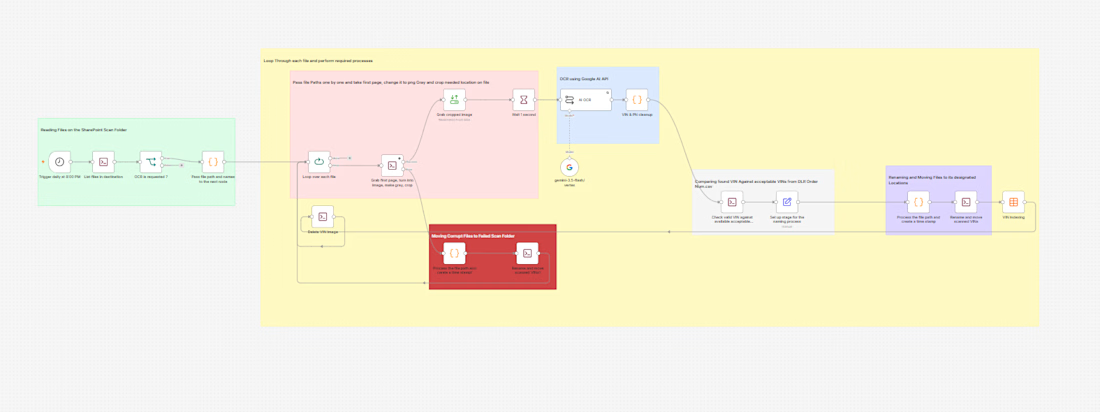

Processing tens of thousands of documents each month with OCR on multi page manifests really cuts the hand entry bottleneck.