The network for creativity
Join 1.25M professional creatives like you
Connect with clients, get discovered, and run your business 100% commission-free
Creatives on Contra have earned over $150M and we are just getting started
Back to feedPost

"Software engineers who don’t know how to use AI coding agents will fall behind."
No.
AI coding agents are not the hard part of building software. They’re a simple tool. You can learn to use them in a few days.
The hard part is knowing what to ask for.
Knowing whether the answer is any good.
Knowing when the code is brittle, overcomplicated, insecure, or just plain wrong.
It’s the judgement required to use them well.
That’s software engineering. And that takes decades to learn properly.
The people at risk aren’t engineers who haven’t mastered using coding agents yet.
It’s people who only know how to prompt one.


The judgment point is what gets missed in every "AI will replace X" take. Tools change the workflow, not the expertise needed to evaluate the output. Same applies in design.
The network for creativity
Join 1.25M professional creatives like you
Connect with clients, get discovered, and run your business 100% commission-free
Creatives on Contra have earned over $150M and we are just getting started
Related posts


Feels like a lot of companies are trying their luck with AI instead of hiring designers right now.
I think it's going to backfire on them in a few months.
Trying to stay optimistic about it.

I can't wait for them to start hiring designers again. No matter how good AIs are, Human Intelligence will always supercede it.

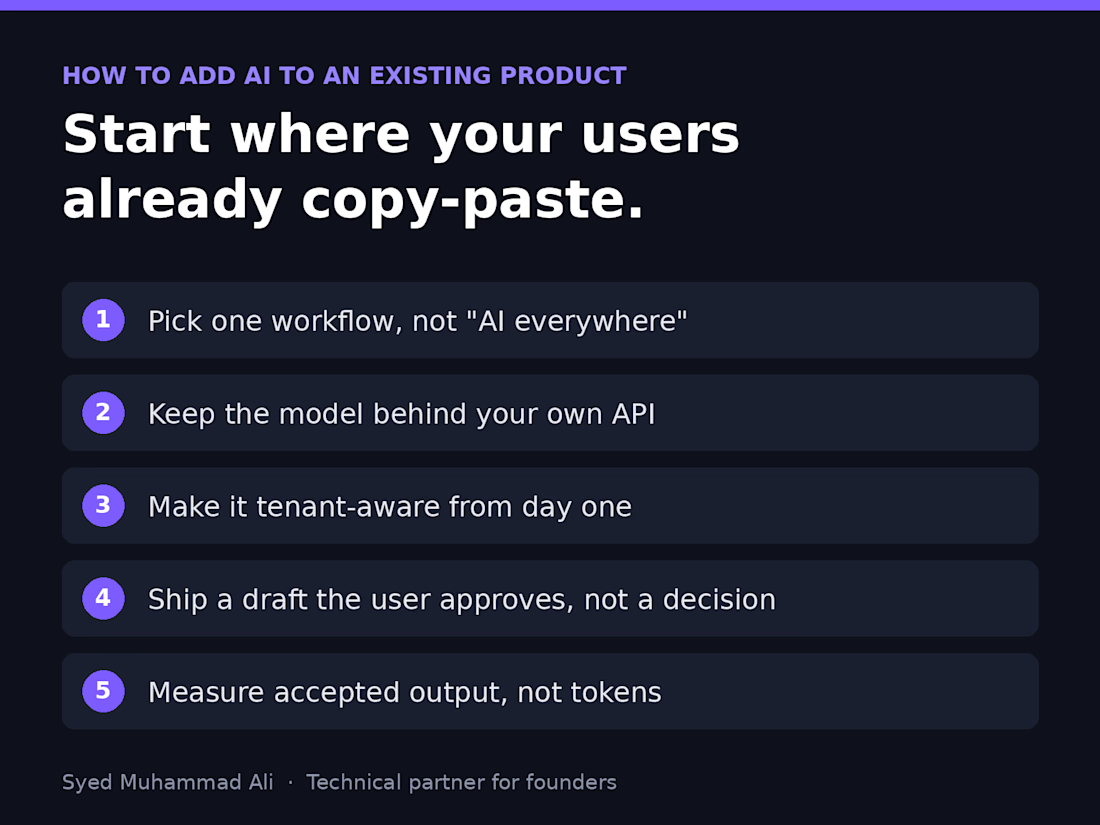
Before you add AI to your product, find the screen where your users already copy and paste.
That's usually where the real AI feature lives. Not a chatbot in the corner, but a step people already do by hand: summarising a ticket, drafting a reply, tagging an upload, pulling fields out of a PDF.
Here's the order I follow when a founder asks me to add AI to an existing SaaS:
1. Pick one workflow, not "AI everywhere." Watch where users leave your app to paste something into ChatGPT and come back. That round trip is your feature.
2. Keep the model behind your own API. One service owns prompts, retries, logging and cost limits, so you can switch providers without touching the frontend.
3. Make it tenant-aware from day one. Each customer's data, prompts and usage stay scoped to their account, or the first enterprise security review will stop you.
4. Ship a draft, not a decision. Let the AI suggest and the user approve. You earn trust and get real feedback before you automate anything.
5. Measure accepted output, not tokens. If users rewrite most of what it produces, the prompt or the context is wrong, and that's your real roadmap.
Most AI features that flop didn't fail because of the model. They were bolted onto the wrong step.
What's the one task your users still copy into ChatGPT?

Watching where users paste into ChatGPT and come back is such a practical way to find the real feature. Most teams start with the chatbot instead.

🚀 Can terminal AI agents replace your IDE?
OpenCode, Codex CLI, Aider, and more — which one fits your workflow?
📖 Find out: https://bit.ly/4iNk9XJ
#AI #Coding #DevTools
bit.ly
Are Terminal AI Coders Finally Ready to Replace IDEs?
Compare the top open source AI coding agents for your terminal in 2026 - OpenCode, Codex CLI, Aider, OpenHands & more. Local models & honest trade-offs.