The network for creativity
Join 1.25M professional creatives like you
Connect with clients, get discovered, and run your business 100% commission-free
Creatives on Contra have earned over $150M and we are just getting started
Back to feedPost

The Quiet Grief of Leaving Your Old Life Behind
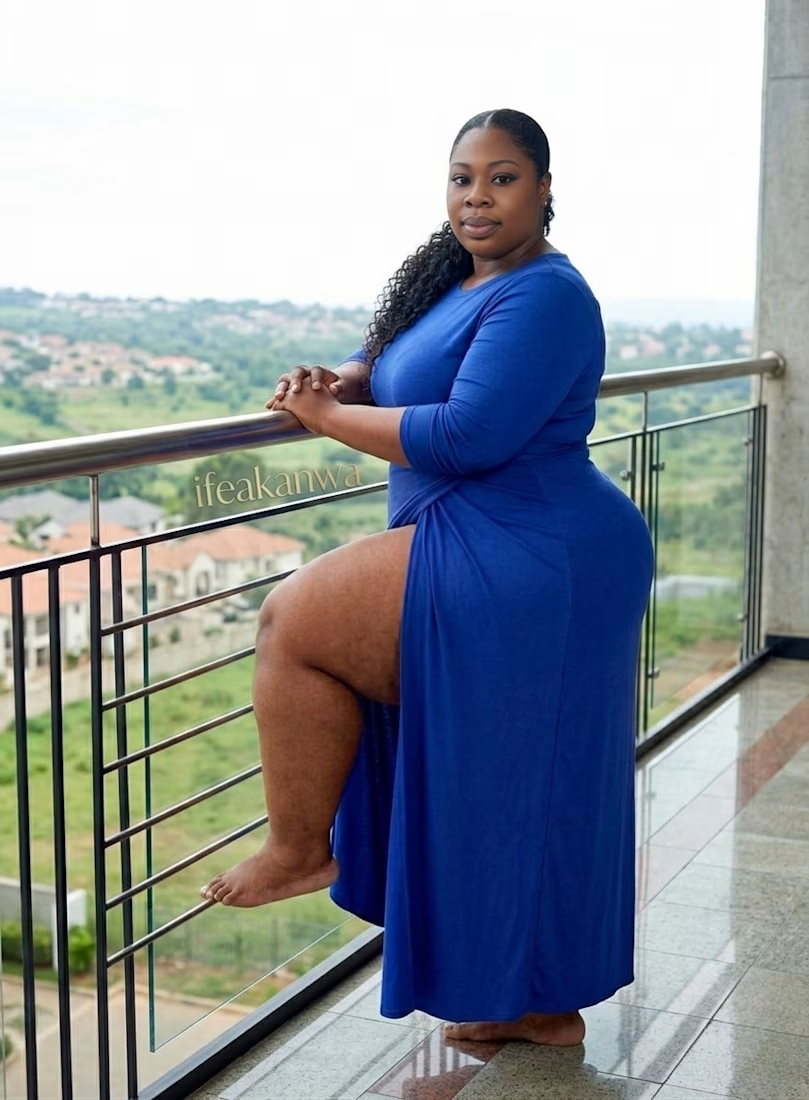
The photograph I am posting today was taken on my forty second birthday. I am wearing a blue dress. Both of my legs are visible. Both are swollen. That is my lipedema. It is a chronic fat disorder that has been with me since I was seventeen years old. I spent decades hiding both legs. On that birthday, I stopped.
But before I stopped hiding, I had to face something else. Something I had been running from for years.
My legs started swelling in 1999. I was seventeen years old. I did not know what was happening to my body. I went from one hospital to another, searching for answers. I tried every remedy that was placed before me. I held onto every promise that something would work. Nothing did. No one could tell me what was wrong.
I went to different hospitals, different doctors. They ran tests. They gave me medications. Nothing stopped the swelling. Nothing even slowed it down. I spent years moving from one consultation to the next, hoping someone would finally have an answer.
Then I walked into the University of Benin Teaching Hospital. A doctor finally gave it a name. Lipedema. Chronic and incurable. He told me gently but plainly that I would have to manage it every single day for the rest of my life.
I remember sitting with those words and feeling something close inside me. Not relief. Not hope. Just a heavy, suffocating certainty that my life would never be what I had imagined.
I fell into a depression. It was as real as the physical pain I carried every day. The future I had imagined for myself felt like it was disappearing quietly, and I had no roadmap for what came next. I was a young woman in pain, without answers, without a cure, and with a body that the world did not know how to see.
And that was when I started hiding.
I hid my legs under long skirts and wide pants. I hid myself in the back of photographs. I hid my story from everyone except the people closest to me. I told myself I was protecting myself from judgment. And maybe I was. But I was also protecting myself from being seen.
But before I stopped hiding my legs, I had to face something else. Something I had been running from for years.
I am the first daughter of four children. Three girls and one boy. My brother was only two years old when our father left Nigeria in 1994. He does not know his father. He has never known him. He is a man now, grown and living his life, and our father has never been part of it.
My father lives in the United States. He left when I was a child. I knew him before he left. He was present in my life until he traveled. For a few years, there were letters through DHL. Money sent every three months. Promises of a future together in America. I held onto those promises like a child holds onto a favorite blanket. They were my proof that he would come back.
In 1998, he went silent. No letters. No money. No explanation. I waited. My mother waited. We all waited. And eventually, we stopped waiting.
Years later, he resurfaced. He built a house. And then he went silent again. But this time, something else happened. He told my mother he wanted a divorce. He claimed he was having problems with the Americans. He said he was struggling, that things were difficult, that he could not manage. He never told us what the problem in America really was. To this day, we do not know. He never explained. He never gave us a real reason.
The only way for things to work out well for him was the divorce. That was his choice. He chose to end his marriage to my mother and start fresh. But he never told us what he was running from or what he was facing. He simply left us in the dark.
My mother, who had waited for him for years, who had raised us alone, who had kept the light on in his absence, believed him. She agreed to the divorce.
It was only years later that the truth came out. There was no problem with the Americans. There was another woman. A Ghanaian woman. He had started a new family with her. He had built a new life. He had given her what he had denied us: his presence, his attention, his daily love.
The divorce was not because of struggles with America. It was because he had already moved on. He had already replaced us.
We tried to be close to him after that. We reached out. We hoped. We thought maybe time had softened him, maybe he would finally see us, maybe he would want to know the children he left behind. He ignored us. Every time. He still ignores us. There is no father-child love between us and our father. There never has been.
My brother does not know him. My sisters and I barely do. We are strangers to the man who gave us life.
That is not just betrayal. That is a different kind of grief. The grief of discovering that your absence was not because of circumstance. It was because of choice. The grief of reaching out and being ignored. The grief of watching your younger siblings grow up without a father and knowing you could not give them one.
All our lives have been with our mother. She raised us alone. She worked as a secondary school teacher with a small salary. She borrowed to feed us and paid back at the end of the month, holding nothing in hand. She started a catering business just to keep us alive. She is my best friend in this world. She has been every single day of my life.
It is still not easy. Some days it is very hard. The weight of his absence does not go away. The sight of my legs does not go away. The memory of what we lost does not go away. But we hold onto God. That is what my mother taught us. That is what keeps us standing.
The inheritance I carry is not money or land. It is the weight of absence. The inheritance of a father who chose to be absent. The inheritance of a body that swelled without explanation. The inheritance of a life that was never going to be what I imagined. The inheritance of watching my mother, who deserved better, hold our family together with her bare hands while my father built a new one overseas.
But here is what I also inherited. I inherited my mother's strength. I inherited the ability to keep going even when everything inside me wanted to stop. I inherited the gift of storytelling, the ability to take pain and turn it into something that makes other people feel less alone.
I inherited the courage to stand on a balcony on my forty second birthday, in a blue dress, with both of my lipedema legs fully visible, and let someone take a photograph.
Here is what I have learned about quiet grief. You cannot rush it. You cannot skip to the part where you feel better. You have to sit in the discomfort. You have to let yourself feel the loss of who you used to be, even if who you used to be was suffering.
But you also cannot stay there forever.
At some point, you have to choose. You have to decide that the old life, with all its familiarity and all its safety, is not where you belong anymore. You have to take a step. A small one. A single photograph. A single post. A single conversation where you tell the truth instead of the polished version.
I took that step on my forty second birthday. I stood on a balcony in a blue dress, with both of my lipedema legs fully visible, and I let someone take a photograph. I did not find a flattering angle. I did not position myself to look smaller. I just stood there. Exactly as I was.
That photograph is now the face of my writing life. Every time I see it, I feel two things at once. Grief for the woman who spent years hiding both legs. And pride for the woman who finally stopped hiding either of them.
I am forty two years old. I am single. I am the first daughter of four children. I live with my mother and my siblings in Nigeria. I have lipedema, a chronic fat disorder that affects both of my legs. It started when I was seventeen in 1999, and it will never go away. I have a father in America who divorced my mother under false pretenses, who never told us what he was facing, who built a new family with a Ghanaian woman, and who wants nothing to do with us. I have a novel called What Dunni Chose that I am publishing chapter by chapter. I have a story to tell, and I am finally telling it.
None of this is what I imagined for myself when I was seventeen. But it is real. And I am learning to love what is real instead of mourning what is not.
If you are in the middle of leaving your old life behind, I want you to know something. The grief you are feeling is real. Do not let anyone tell you to just get over it. Do not rush yourself. Do not skip the sadness. That sadness is not your enemy. It is how you make space for something new.
You cannot build a new life on top of an unburied one. You have to dig. You have to cry. You have to sit in the quiet and let yourself feel the loss of who you used to be.
And then, when you are ready, you stand up. You walk to the balcony. You put on the blue dress. And you let someone take the photograph.
That is what I did. And I am still doing it. Every day. Quietly. Without ceremony.
I write dark romance and paranormal fiction with deep emotion, ancestral mystery, and love that costs everything.
© 2026 Ifeaka Okudinani. All rights reserved.
The network for creativity
Join 1.25M professional creatives like you
Connect with clients, get discovered, and run your business 100% commission-free
Creatives on Contra have earned over $150M and we are just getting started





Related posts

Archive Friday 💿
Such a shame this concept never made it into production—still one of my favorite explorations.
Industry: health/sleep tracking


Nice one

Something quiet, sealed away 🌊🏛️
Spent a few evenings in Blender on this one — ruins caught inside glass, arches worn down by time that never quite finished falling, water moving slow enough to almost not move at all.
No brief, no deadline — just wanted to build something that felt frozen and alive at the same time. 🕊️


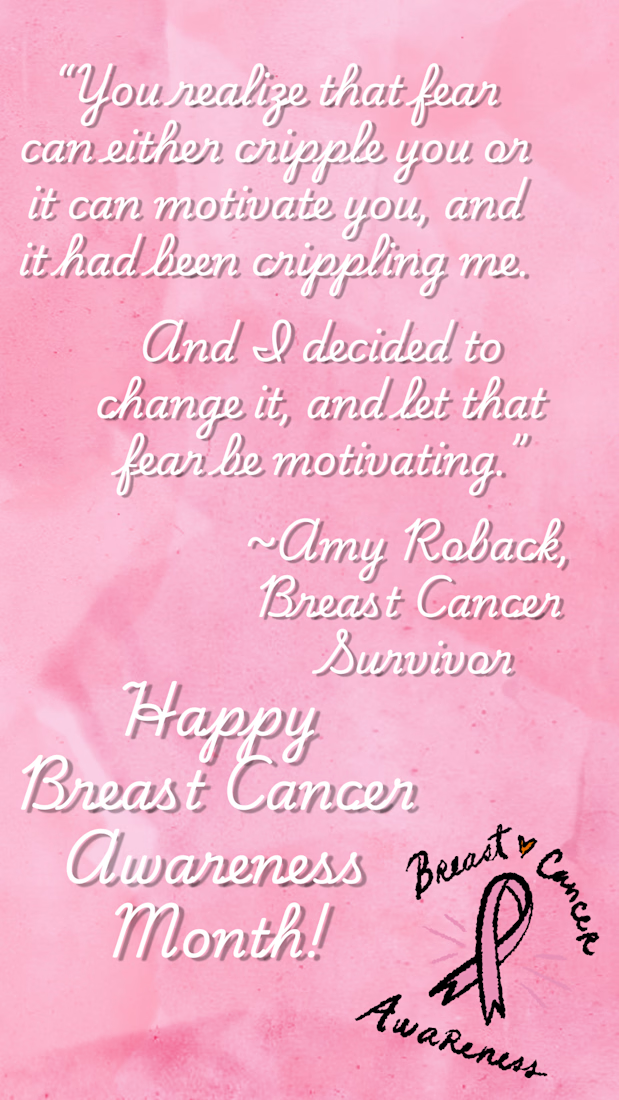
For Breast Cancer Awareness Month, I had created an image for social media to pay tribute to those we've lost, those who have survived, and those still fighting. In this graphic, I chose to find a quote from a Breast Cancer Survivor. This felt like it could relate to audiences before they knew the author of the quote considering the message is something applicable to anyone in everyday struggles. The image also engages with pink, including the ribbon in the bottom corner, since this is the color that represents Breast Cancer.