The network for creativity
Join 1.25M professional creatives like you
Connect with clients, get discovered, and run your business 100% commission-free
Creatives on Contra have earned over $150M and we are just getting started
Back to feedPost

The Structural Limitations of Machine
Systems and the Financial Infeasibility of Dedicated Computational Environments
1. The Core Issue: The Disruption of Structural Analysis through Strict Glossary Enforcement (The 30-Year-Old Historical Precedent)
・ The User’s Testimony: Over 30 years ago, a specialized operation mode forcing absolute adherence to user-defined glossaries was implemented in a machine translation (MT) system developed by Nippon Electric Company, Limited (NEC). This constraint stripped the system of its flexibility, causing a total collapse in its syntactic parsing (structural analysis) and resulting in highly corrupted target text.
・ The Modern Parallel: This historical failure directly mirrors the modern phenomenon known in academic literature as "Catastrophic Forgetting." When contemporary automated models are forced or heavily weighted to retain specific
datasets, their broader structural generation capabilities degrade significantly. The fundamental limitation—where local constraints destabilize the global balance of the system—has remained unchanged for three decades.
2. The Practical Evaluation: The Illusion of Visibility Features
・ The Proposed Mechanism: A concept was considered to visually isolate and identify approved translation memory (TM) segments by enclosing them in heavy brackets (【】) upon generation. This approach was intended to protect structural
logic while providing clear signaling to human reviewers, allowing for immediate quality audits without altering the internal computational weights of the system.
・ The Critical Constraint: However, because automated systems remain fundamentally incapable of securely and simultaneously managing distinct, client-specific translation
memories without experiencing memory degradation or data mixing, generating the clean baseline required for such visual signaling remains highly impractical.
3. The Financial Infeasibility:
Dedicated Single-Client Server Deployment
・ The Computational Hypothesis: The possibility of bypassing general intelligence frameworks to deploy a simplified, dedicated server exclusively handling a single client's
dataset (e.g., Amazon’s translation memory) was evaluated.
・ The Economic Reality: This approach is structurally and financially unviable. Operating an isolated computational resource dedicated to a single client introduces massive fixed maintenance expenses and continuous operational costs, which cannot be sustained by project-based translation rates.
Furthermore, stripping a model of its general intelligence reduces it to a rigid, legacy processing system, completely defeating the purpose of utilizing advanced computing.
4. Final Operational Conclusion
・ The Definitive Solution: Automated systems are structurally blocked by memory conflicts and economically blocked by high deployment costs. Therefore, relying on automated
learning for client-specific adaptation is completely impractical.
・ The Optimal Workflow: The most reliable, accurate, and cost-free method for securing technical quality remains human-led control: utilizing standard translation memory databases within existing translation software, and performing manual global search-and-replace actions during the initial phase of production.
#MachineTranslation #Localization #TranslationMemory #CATTools #AIQualityAssurance #Computational Linguistics #NaturalLanguageProcessing #Translatability #QualityControl #WorkflowOptimization
The network for creativity
Join 1.25M professional creatives like you
Connect with clients, get discovered, and run your business 100% commission-free
Creatives on Contra have earned over $150M and we are just getting started

Challenges
View all


Related posts

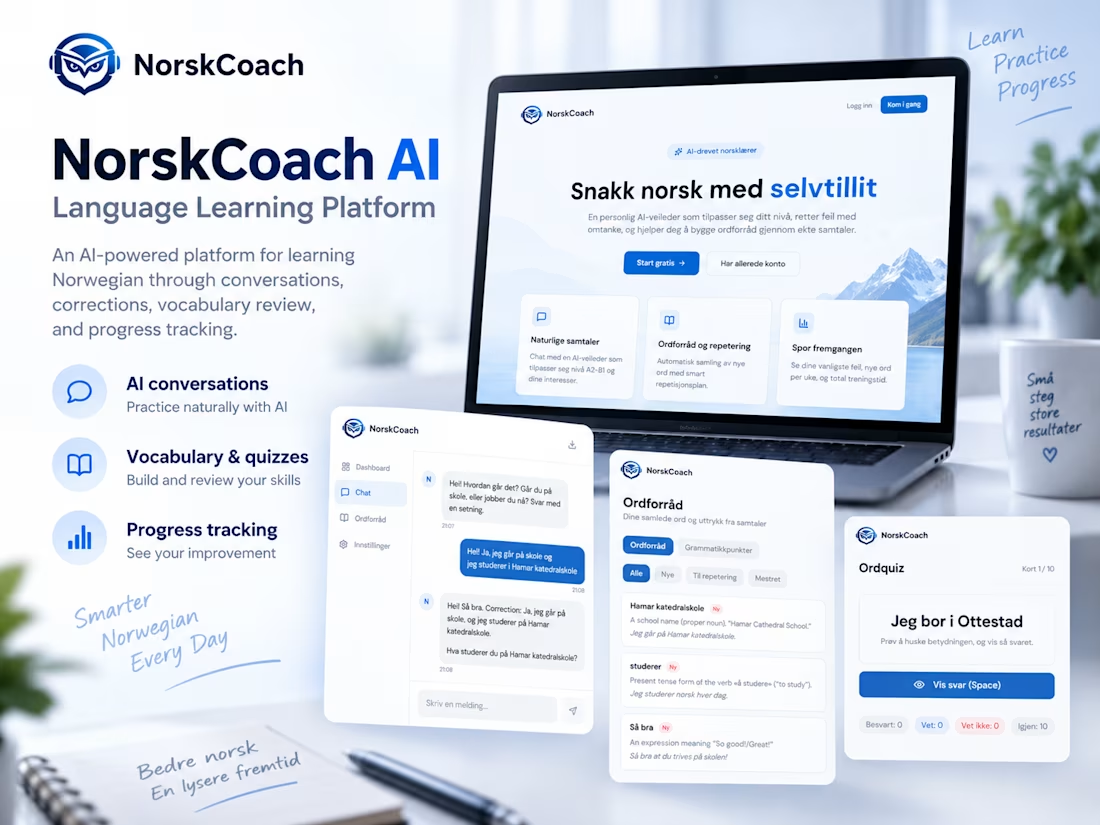
NorskCoach is an AI-powered Norwegian learning platform designed to help users practice language skills through conversation, exercises, grammar support, vocabulary review and writing feedback.
I built the product with Next.js, React and TypeScript, including multiple learning modes, AI-powered chat flows, vocabulary tracking, mistake patterns and spaced repetition features.
The project combines AI integrations with structured learning workflows, user progress tracking and a responsive web interface focused on practical Norwegian practice.



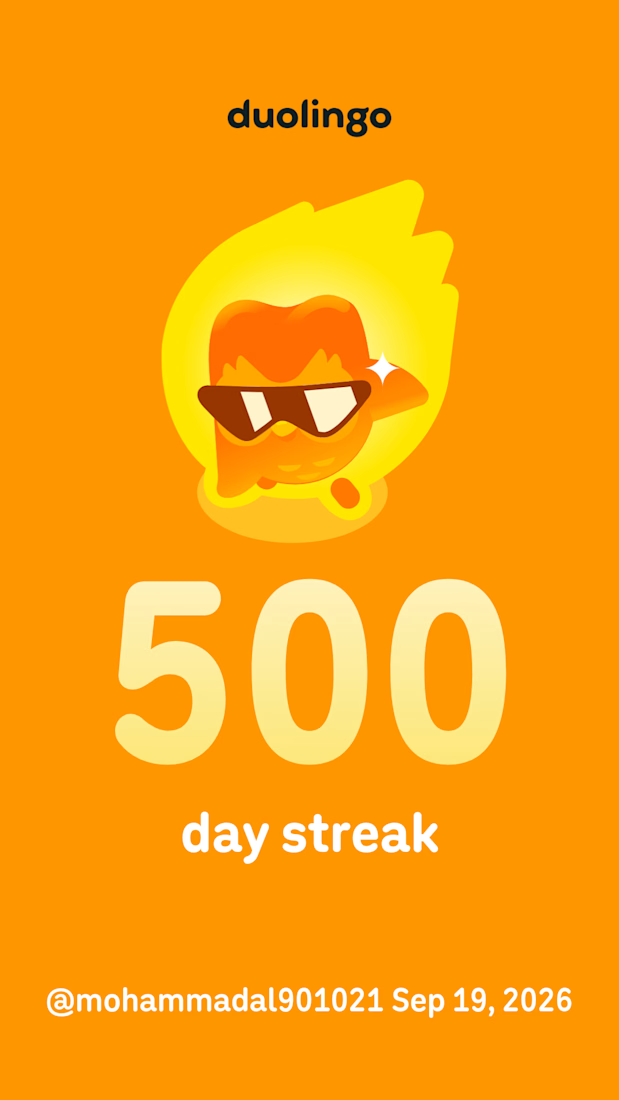
500-day streak on @Duolingo today! 🏆🔥
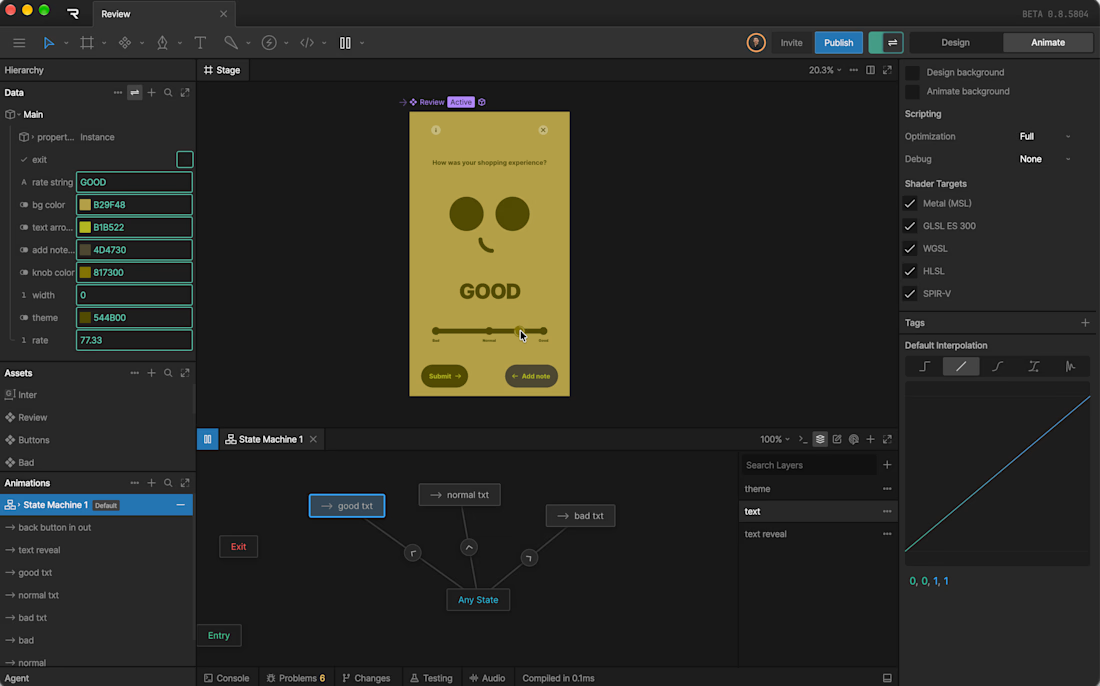
More than just building a habit, logging into Duolingo daily has been a continuous case study in retention-driven UI/UX.
Duolingo’s seamless micro-delights, real-time character reactions, instant celebratory feedback, and dynamic UI are powered by Rive. Seeing how interactive animation drives product engagement was the exact spark that led me to specialize in interactive motion design.
Fast forward to today: I bring these same high-converting interactive experiences to web, mobile app, and hardware interfaces.
What I deliver for product teams, founders, and engineers:
- Retention-Driven Micro-Interactions: Real-time feedback that keeps users engaged and reinforces habit loops.
- Cross-Platform Performance: Ultra-lightweight vector assets running at native 60 FPS across web, iOS, Android, and embedded screens.
- Frictionless Implementation: Complete interaction logic built directly into Rive runtime files, saving developers hours of complex UI coding.
If you’re building a digital product or hardware screen and want to turn static UI into dynamic, high-retention experiences, let’s collaborate!
🔗 Duolingo x Rive Case Study: https://rive.app/blog/creative-technologists-duolingo-s-solution-to-the-designer-to-developer-handoff

4 years of high-tech engineering, product architecture & zero-to-one platform builds.
I don't build basic templates—I architect production systems with bulletproof reliability.
Here are 3 platforms I've engineered and shipped recently:
Kazfen (https://kazfen.com) – Autonomous AI sales rep platform for home service contractors. Automates inbound lead calls in <60 seconds, qualifies jobs, logs decision trails, and syncs to CRMs.
Dark Kinetics (https://darkkinetics.com) – Physical conditioning, isometric holds, thermal recovery & Japanese longevity protocol platform with custom video streaming architecture.
Exovyre (https://exovyre.com) – Serialized Edo-Tokyo biopunk anime platform, creative direction, custom layout grids & high-end motion pipelines.
Core Engineering & Design Capabilities:
• Full-Stack: Next.js 15 (App Router), TypeScript, Python FastAPI, PostgreSQL, Supabase
• AI & Infra: Autonomous voice agents, Claude API pipelines, Stripe, Resend, Vercel
• Design & Motion: Systemic Figma UI/UX, Framer/Webflow CMS, After Effects motion
Currently open for senior full-stack development, AI agent infrastructure, complex Framer/Webflow migrations, and production hardening contracts.
📩 DM me on Contra to discuss your architecture and timeline.

kazfen.com
Every Home Services Lead, Called in 60 Seconds
Kazfen calls, qualifies, and books inbound leads for roofing, solar, and HVAC contractors in under 60 seconds — 24/7.