The network for creativity
Join 1.25M professional creatives like you
Connect with clients, get discovered, and run your business 100% commission-free
Creatives on Contra have earned over $150M and we are just getting started
Back to feedPost

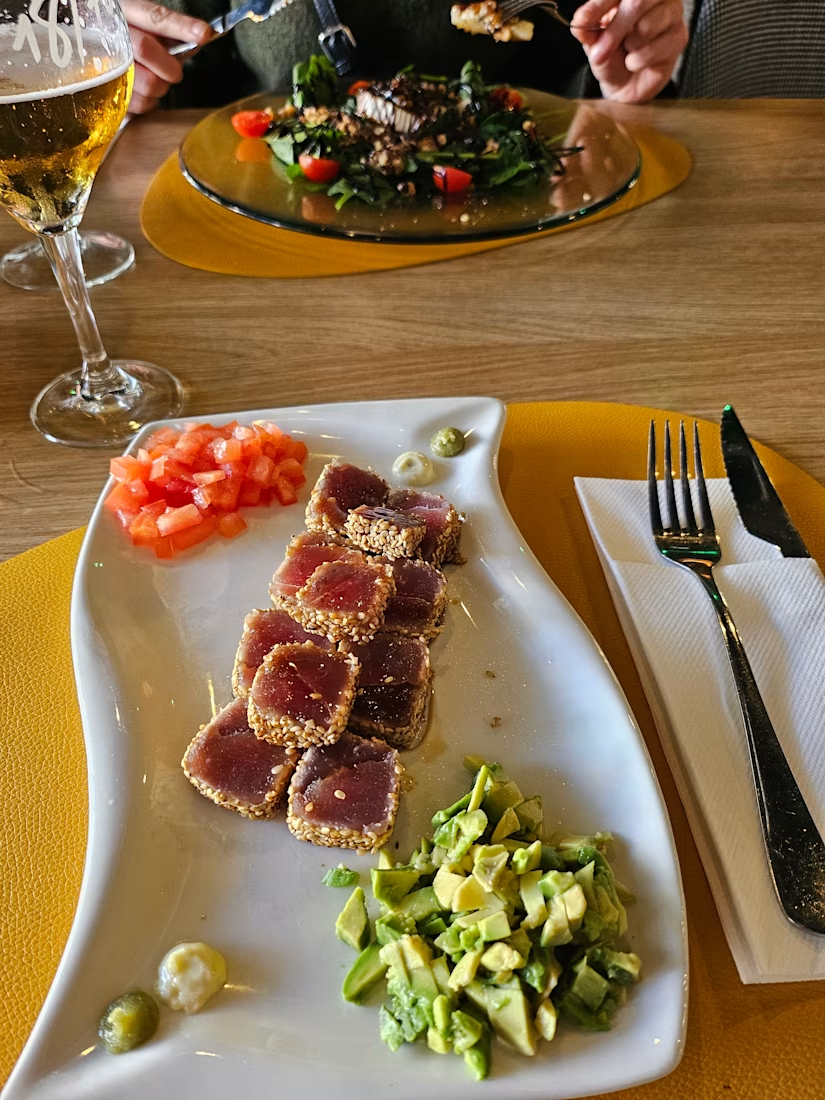
Showing quality of photos of Sashimi with my Samsung Galaxy Flip5.

The network for creativity
Join 1.25M professional creatives like you
Connect with clients, get discovered, and run your business 100% commission-free
Creatives on Contra have earned over $150M and we are just getting started





Related posts

I wanted to make a photography website that felt more like an experience than a portfolio.
So I built CINÉRA — a cinematic photography studio website with a 3D gallery, interactive archive, real availability, and a complete booking flow.
You can explore the work, pick a date and time, add your shoot details, and get booked without the usual back-and-forth.
On the studio side, there’s a dashboard to manage bookings and inquiries, plus automatic booking confirmations to take a bit of the repetitive work off the photographer’s plate.
This was built for an appointment-based business challenge, and honestly, I had way too much fun making it.


Maya Kowalska Photography - Editorial Booking Engine & Studio Desk
Live Product: https://maya-wedding-photographer.lovable.app
Archetype: Solo Luxury & Destination Wedding Photographer (Warsaw & Europe)
Built in Lovable
The Problem
Couples looking for a wedding photographer 12 to 18 months in advance hit a universal wall: the package guessing game.
Every inquiry starts with the same question: "Do you want 8, 10, or 12 hours?" Couples don't know yet. They haven't finalized dinner, speeches, or first dances. What follows is 2 to 3 weeks of back-and-forth emails, questionnaire PDFs, and awkward timeline math. In the meantime, prime weekend dates stay in unpaid limbo.
For a solo photographer like Maya shooting on location 3 days a week, this inquiry friction is crippling. She spends her weekdays playing admin and estimator instead of editing or shooting. When couples under-estimate hours to fit a budget, it creates high-stress overtime negotiations on the wedding night when the timeline inevitably slips.
The Solution: "Tell me the day. I'll figure out the hours."
We replaced the rigid package grid with an intelligent booking canvas and connected it directly to Maya's studio desk.
1. The Front Door (Client Experience)
No package guessing: Couples enter their date, any custom venue, and guest scale, then simply check the moments that matter to them (getting ready, first look, ceremony, portraits, dinner, speeches, party).
Live Run-of-Show Engine: The app dynamically schedules each event chronologically from morning to midnight and calculates the exact continuous elapsed coverage required in real time.
Creative Priorities: Couples define their 3 focal points (The Emotion, The Atmosphere, The Party), which dynamically shape their recommended collection and shot list.
1-Click Reservation: A pre-filled test payment flow settles the 20% deposit instantly, writes to PostgreSQL, and locks the date against double-booking.
2. The Follow-Through (Maya's Studio Desk)
Zero-effort booking intake: Instead of a vague email, Maya's private desk receives a confirmed date, logged deposit, client contacts, and creative brief.
Printable Wedding Day Dossier: The auto-generated run-of-show with visual moment references prints on a single clean sheet with one click, ready to slip into her camera bag on the morning of the wedding.
Configurable Engine: Maya retains full control over base pricing, extra hour rates, and individual moment duration weights in her studio settings.
Scoped for the Challenge vs. What's Next (The Complete Studio Vision)
To keep the challenge submission sharp, fully functional, and testable end-to-end within 90 seconds, I focused on the highest-friction moment: turning an inbound inquiry into a confirmed, paid booking with an auto-generated timeline.
Here is what was intentionally scoped as the next phase of the product:
-Digital Contract Signing & Counter-Signature:
- Post-Booking Client Portal & Timeline Locking
- Full Client Gallery & Asset Delivery
- Automated Milestone Balance Invoicing
& more
Thank you!
#lovable #lovablechallenge
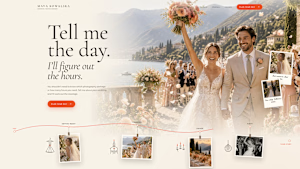
maya-wedding-photographer.lovable.app
Maya Kowalska — Wedding Photographer
Timeless wedding stories captured with feeling across Europe.

Forms are useful.
But when booking means filling out field after field, choosing chip after chip, and searching through different pages just to ask a simple question, the experience starts to feel like work.
Photography clients usually just want to ask:
“How much is it?”
“Are you free this weekend?”
“Can we do something like this photo?”
But pure chat creates another problem.
Someone on the studio side still has to answer the same questions, remember every detail, keep track of every inquiry, and eventually turn those conversations into actual bookings.
And for a solo photographer, that same person is also shooting, editing, preparing gear, and meeting clients.
So for the Lovable challenge, I wanted to find the middle ground.
I built Rona Studio, a fictional solo photography studio in Bandung run by Maya.
For the client, the experience stays natural:
"one conversation, in one place."
They can ask questions, explore Maya’s work, bring a photograph they like into the chat, describe what they want in their own words, check availability, and eventually confirm the booking.
But on the studio side, it doesn’t become an unstructured pile of messages.
Rona, the AI front desk, turns the conversation into structured booking information like client details, visual inspiration, package, preferences, availability, payment, and session details.
For Maya, that means she doesn’t have to constantly check messages while she’s busy shooting or editing.
She can come back when she has time and see what has already been handled.
Normal booking? No action needed.
Something unusual? Surface it with the context she needs to make the decision.
The goal wasn’t to replace forms with chat.
It was to let the client communicate naturally, while still giving the studio the structure it needs to run the business.
One conversation for the client. Structured operations for the studio.
That’s Rona Studio.
Built with @Lovable.
#lovablechallenge #buildinpublic #ProductDesign #AI #Lovable