The network for creativity
Join 1.25M professional creatives like you
Connect with clients, get discovered, and run your business 100% commission-free
Creatives on Contra have earned over $150M and we are just getting started
Back to feedPost

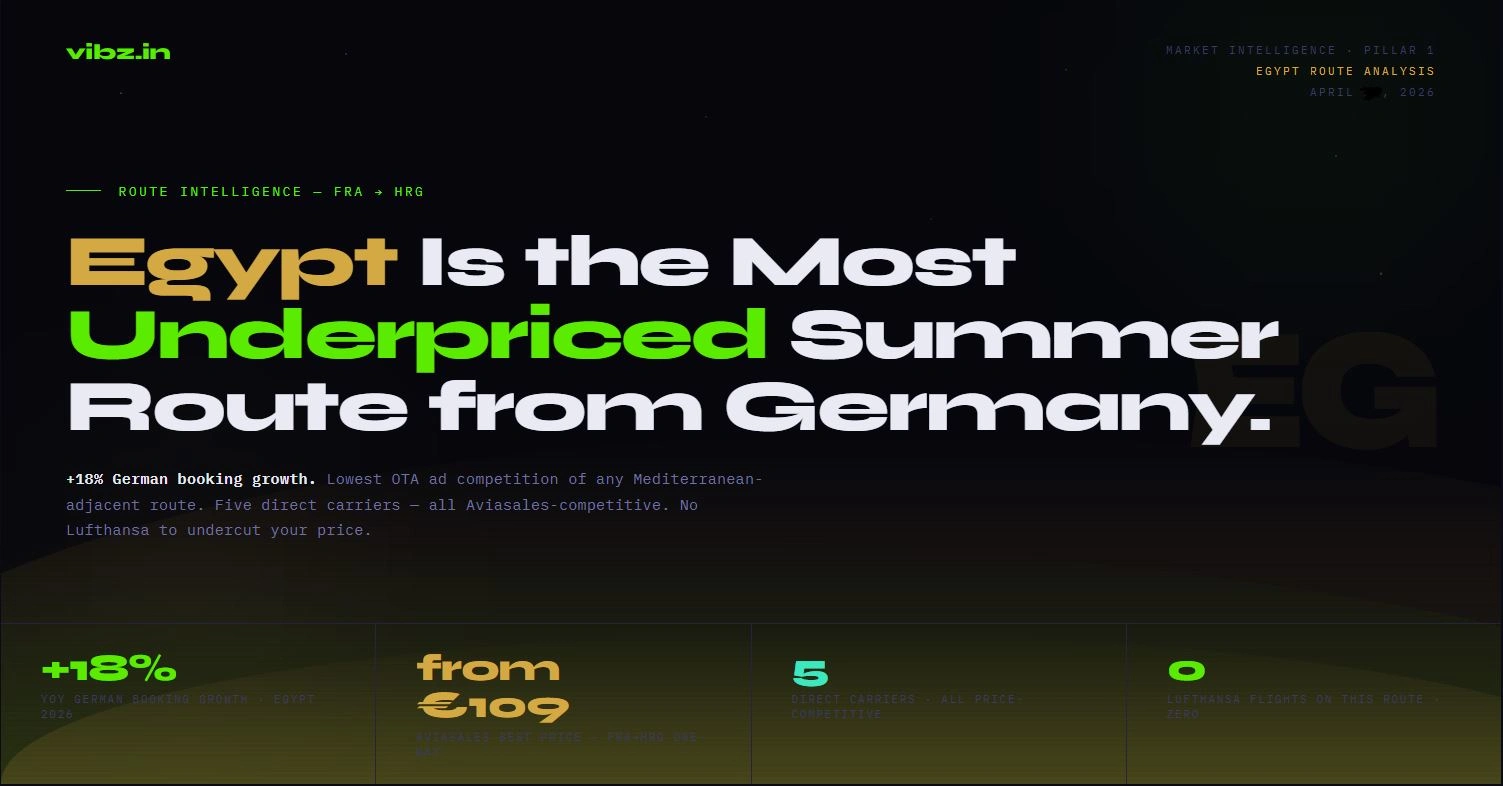
German bookings to Egypt are up 18% year-on-year in 2026.
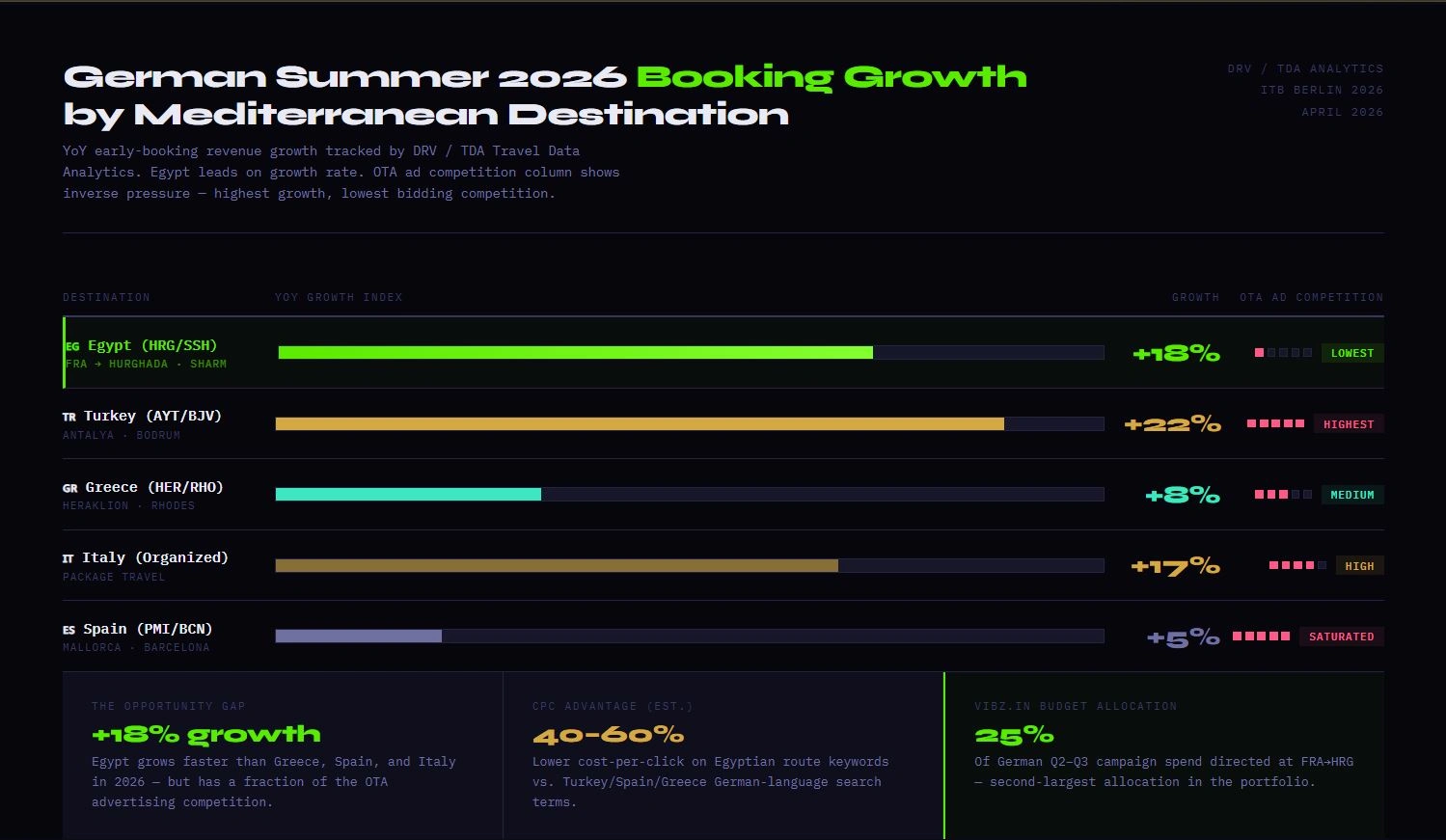
That's the largest growth number of any destination in our active tracking set — ahead of Turkey (+22% in raw bookings but far more crowded on the advertising side), ahead of Greece (+8%), and more than three times the growth rate of Spain (+5%).
And yet: FRA→HRG has the lowest OTA ad competition of any route we monitor from Germany.
That gap — between demand momentum and advertising pressure — is exactly where the margin lives.
This post explains how we found it,what the pricing data shows, and why the absence of Lufthansa on this route creates a clean price field that doesn't exist anywhere else in the German summer portfolio.
▬▬▬▬▬▬▬▬▬▬▬▬▬▬▬▬▬▬▬▬▬▬▬▬▬▬▬▬▬▬▬▬
THE PRICING DATA: FRA → HRG
▬▬▬▬▬▬▬▬▬▬▬▬▬▬▬▬▬▬▬▬▬▬▬▬▬▬▬▬▬▬▬▬
We benchmark every route we advertise against five market sources:
Google Flights, Skyscanner, Kayak, Expedia, and Idealo (the most used German-language price comparison platform).
Here is what the FRA→HRG market looks like right now for summer
2026 departures:
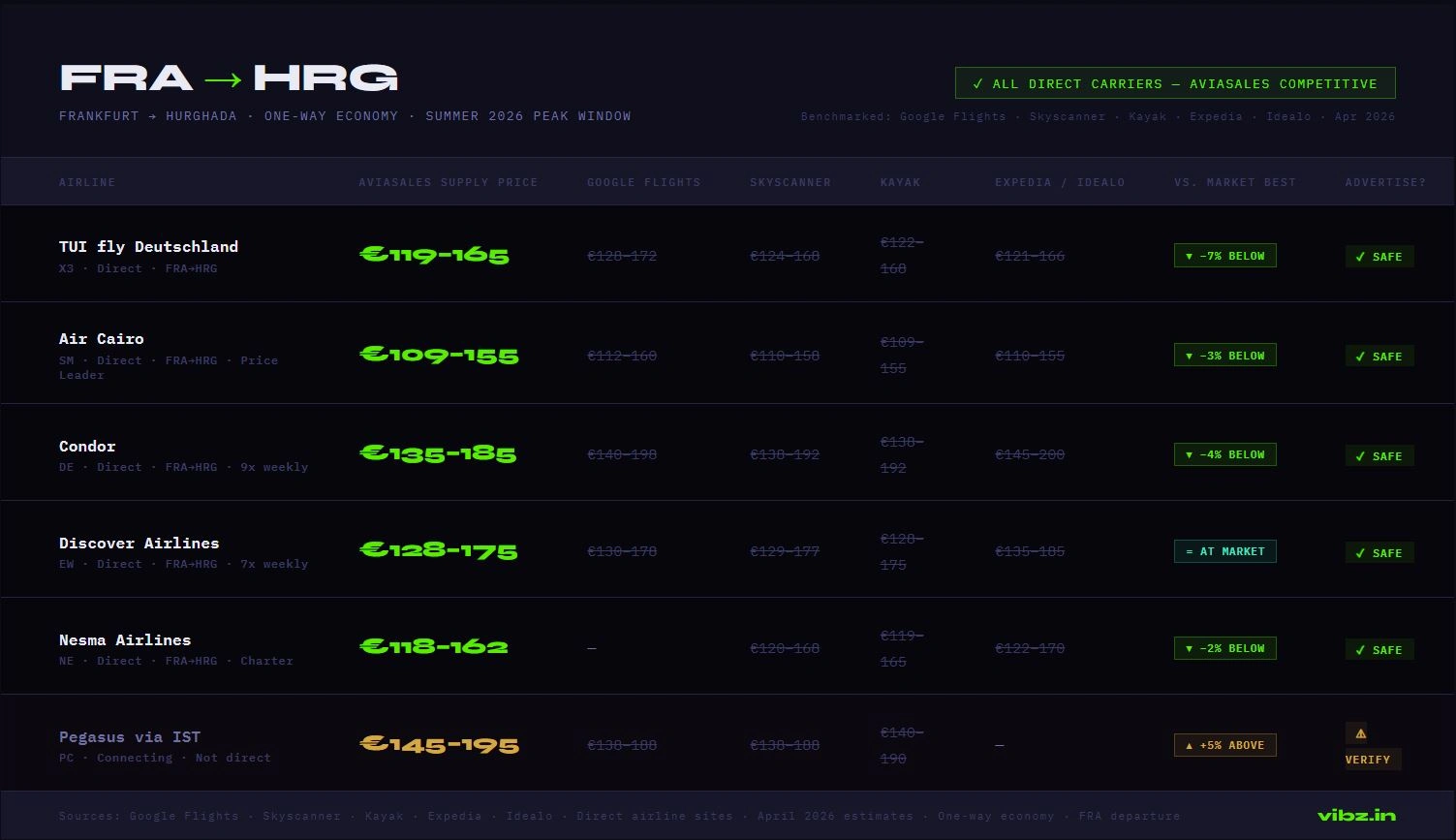
▸ TUI fly: Market average €128–172 OW · Aviasales supply: €119–165
▸ Air Cairo: Market average €112–160 OW · Aviasales supply: €109–155
▸ Condor: Market average €140–198 OW · Aviasales supply: €135–185
▸ Discover Airlines: Market average €130–178 OW · Aviasales supply: €128–175
Every single direct carrier on this route is at or below market through Aviasales aggregation.
That is not the norm.
On FRA→PMI (Mallorca), Condor's Aviasales-supplied price runs 8–20% above Skyscanner on peak summer dates.
On FRA→HER (Heraklion), Lufthansa's direct site undercuts Aviasales by 10–20%, making the airline entirely unadvertisable. On FRA→AYT (Antalya), you get one window of Freebird/Pegasus advantage and then a patchwork of carrier-specific risks to manage.
FRA→HRG has none of those problems.
Five direct carriers.
Clean Aviasales pricing across all five.
No dominant network carrier to undercut you.
No flash-sale chaos from a legacy brand with a German loyalty programme.
This is a structurally simple route to advertise, which is a rarer thing than it sounds.
▬▬▬▬▬▬▬▬▬▬▬▬▬▬▬▬▬▬▬▬▬▬▬▬▬▬▬▬▬▬▬▬
WHY LUFTHANSA'S ABSENCE MATTERS
▬▬▬▬▬▬▬▬▬▬▬▬▬▬▬▬▬▬▬▬▬▬▬▬▬▬▬▬▬▬▬▬
Most high-value routes from Germany have a Lufthansa problem.
German travellers are meaningfully brand-loyal to Lufthansa in a way that doesn't have a clean equivalent in other European markets.
When an ad shows a Lufthansa price, a significant proportion of German users will open lufthansa.com in a second tab to verify it.
If the direct site is cheaper — which it often is, because Lufthansa optimises its direct channel aggressively — the trust relationship with the OTA breaks.
This is why we suppress Lufthansa on FRA→HER (Heraklion), on FRA→TYO (Tokyo), on FRA→NYC, and on FRA→SIN (Singapore).
In each case, the Aviasales-supplied Lufthansa price sits above what lufthansa.com shows for the same route.
On FRA→HRG, Lufthansa doesn't operate direct service.
The route is served exclusively by charter and leisure carriers:
TUI fly, Condor, Discover Airlines, Air Cairo, and Nesma Airlines.
None of these carriers has built the kind of direct-channel loyalty infrastructure that Lufthansa has. None of them is named a German traveller, who reflexively cross-references on a separate tab.
The result is a price field where your advertised fare is accepted at face value.
That acceptance rate translates directly into click quality, conversion rate, and — critically — the trust relationship that drives return bookings.
▬▬▬▬▬▬▬▬▬▬▬▬▬▬▬▬▬▬▬▬▬▬▬▬▬▬▬▬▬▬▬▬
THE RED SEA CHARTER MARKET: WHAT THE DATA SHOWS
▬▬▬▬▬▬▬▬▬▬▬▬▬▬▬▬▬▬▬▬▬▬▬▬▬▬▬▬▬▬▬▬
Hurghada is not a GDS-dominant market.
It never was.
The Red Sea charter economy — Hurghada, Sharm el-Sheikh, and Marsa Alam — developed primarily through direct airline-to-tour-operator contracting rather than through the global distribution system.
TUI fly and Condor operate contracted charter blocks to HRG that predate modern OTA infrastructure.
Air Cairo and Nesma operate as hybrid charters with limited but growing GDS presence.
What this means in practice:
▸ Seat inventory is less exposed to last-minute direct price manipulation than on fully GDS-distributed routes
▸ Published fares from Aviasales track closely with contracted block pricing — less variance between aggregated and actual cost
▸ Price feed staleness risk is materially lower than on Mediterranean peak routes (Mallorca, Ibiza, Santorini)
▸ Overbooking-driven repricing events, which create sudden Skyscanner/Kayak drops that undercut advertised OTA prices, are less frequent on charter-block routes
From an operational standpoint, FRA→HRG is one of the cleanest routes to maintain price parity between ad creative and actual booking price.
Price feed refresh at 8–12 hour intervals is adequate for most of the calendar year, versus the 3–4 hour refresh requirement we maintain on FRA→PMI peak-summer inventory.
This is not a coincidence.
It is a structural feature of how the Red Sea charter market was built, and it favours OTAs who understand the market mechanics over those who don't.
▬▬▬▬▬▬▬▬▬▬▬▬▬▬▬▬▬▬▬▬▬▬▬▬▬▬▬▬▬▬▬▬
THE DEMAND CONTEXT
▬▬▬▬▬▬▬▬▬▬▬▬▬▬▬▬▬▬▬▬▬▬▬▬▬▬▬▬▬▬▬▬
The +18% figure comes from DRV (Deutscher Reiseverband) and TDA Travel Data Analytics early-booking data, cross-referenced with ITB Berlin 2026 market intelligence on German outbound travel.
Egypt's growth is above-average relative to every Mediterranean competitor tracked.
The drivers are familiar:
▸ Egyptian pound weakness relative to the euro makes on-the-ground costs significantly cheaper than equivalent beach-resort alternatives in Turkey or Greece
▸ Hurghada's all-inclusive resort model delivers predictable cost certainty that appeals to German price-sensitive families
▸ Red Sea water temperatures remain viable for diving and water sports later into autumn than most Mediterranean alternatives — extending the viable booking window into September and October
▸ Hamburg Airport is adding Corendon Airlines service to Hurghada from May 2026, increasing capacity and search volume from northern Germany
The Hamburg Corendon addition is particularly notable for OTA campaign planning.
New route launches consistently produce a search volume spike of 4–8 weeks around the first flight — a window where intent is high, and supply advertising has not yet saturated.
This creates a specific opportunity to capture Hamburg-origin traffic on FRA→HRG feeder-and-fly searches.
▬▬▬▬▬▬▬▬▬▬▬▬▬▬▬▬▬▬▬▬▬▬▬▬▬▬▬▬▬▬▬▬
THE ADVERTISING OPPORTUNITY
▬▬▬▬▬▬▬▬▬▬▬▬▬▬▬▬▬▬▬▬▬▬▬▬▬▬▬▬▬▬▬▬
We allocate 25% of our Germany Q2–Q3 long-haul campaign budget to FRA→HRG — the second-largest allocation after FRA→AYT (Turkey).
The reasoning is straightforward:
▸ Demand is growing faster than competing OTAs are entering the space.
This is the definition of an early-mover window.
▸ Aviasales pricing is structurally advantaged on all five direct carriers, eliminating the airline-by-airline suppression analysis required on more complex routes.
▸ The cost-per-click on "Flug Hurghada" and "Ägypten Flug" German-language keywords is materially lower than equivalent intent keywords for Turkey, Greece, or Spain — because fewer OTAs are bidding on them.
▸ Average ticket value is €220–300 OW in summer, yielding meaningful absolute margin even at modest percentage markup.
▸ The route's seasonal demand peak (November–April for beach tourism) means summer campaigns can simultaneously acquire customers for Q4 bookings — a compounding return structure that doesn't exist on pure summer-seasonal routes.
The practical question we ask before allocating to any route is:
Can we advertise these prices confidently, without risk of the user finding cheaper on click-through?
On FRA→HRG, for every direct carrier currently active, the answer is yes.
That is a short list.
▬▬▬▬▬▬▬▬▬▬▬▬▬▬▬▬▬▬▬▬▬▬▬▬▬▬▬▬▬▬▬▬
THE ONE WATCH ITEM
▬▬▬▬▬▬▬▬▬▬▬▬▬▬▬▬▬▬▬▬▬▬▬▬▬▬▬▬▬▬▬▬
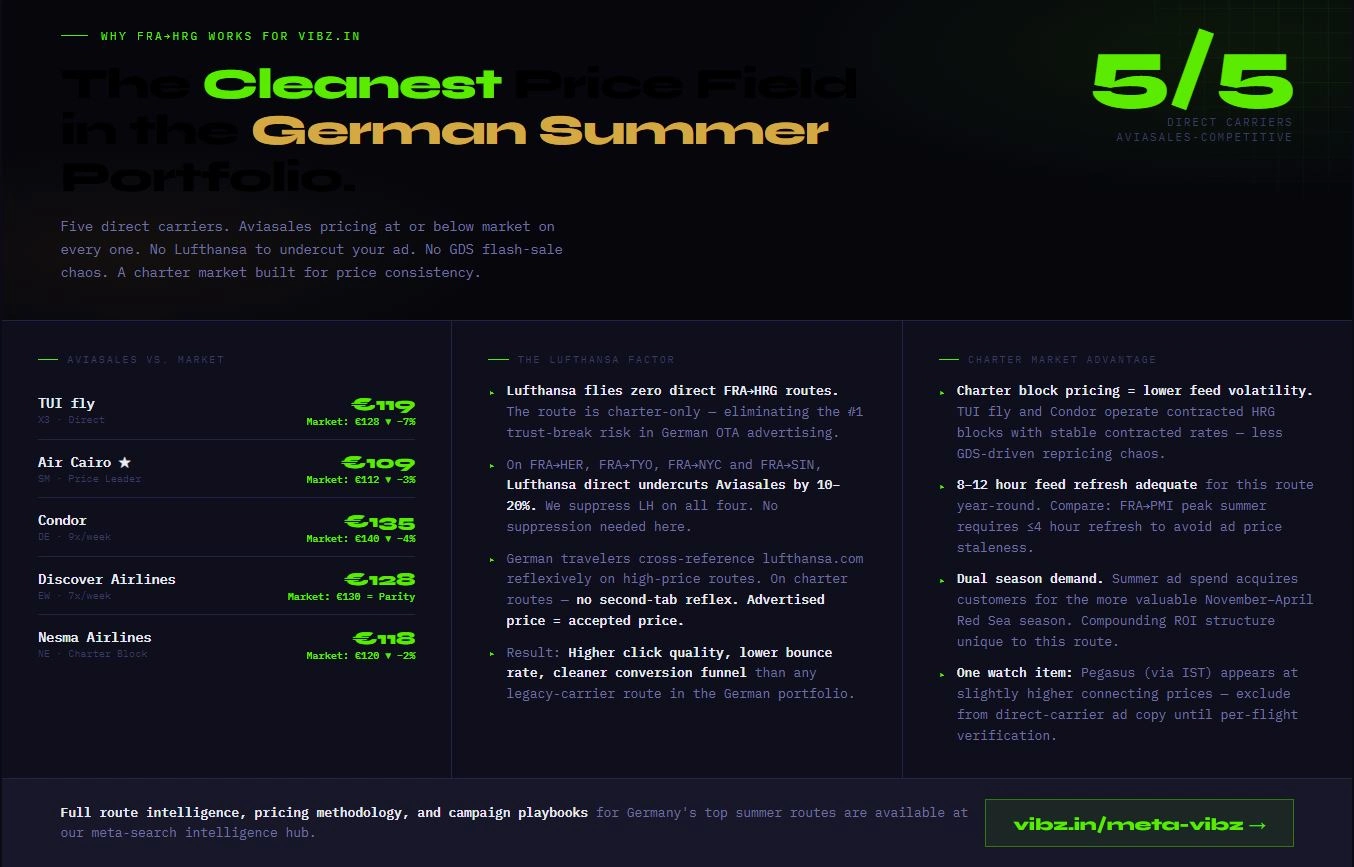
Pegasus Airlines (via Istanbul) occasionally appears in Kayak and Skyscanner results for FRA→HRG at prices slightly below Aviasales supply for direct service.
This is a connecting-flight offering, not a direct route — but German travelers in price-comparison mode may not distinguish between direct and connecting clearly enough.
Our current practice: exclude Pegasus from FRA→HRG ad creative until per-flight price verification confirms parity.
For direct carriers only, the route is clean.
▬▬▬▬▬▬▬▬▬▬▬▬▬▬▬▬▬▬▬▬▬▬▬▬▬▬▬▬▬▬▬▬
IF YOU'RE RUNNING GERMAN TRAVEL CAMPAIGNS
▬▬▬▬▬▬▬▬▬▬▬▬▬▬▬▬▬▬▬▬▬▬▬▬▬▬▬▬▬▬▬▬
The routes with the loudest demand signals in Germany right now —Turkey, Mallorca, Greece — are also the routes with the highest OTA advertising competition, the most complex carrier suppression requirements, and the most volatile peak-summer pricing.
Egypt doesn't have that profile yet.
The demand is real. The pricing is clean. The competition window is open.
That window will close as more OTAs run the same analysis we've run here.
The question is whether your campaigns are in the market before that happens or after.
We're already in.

The network for creativity
Join 1.25M professional creatives like you
Connect with clients, get discovered, and run your business 100% commission-free
Creatives on Contra have earned over $150M and we are just getting started
Trending
retrofuturism
Share your favorite designs from the past exploring the distant future. Or your own take on the aesthetic 🚀
halftone
Dots. Texture. Grain. Let's see your designs using the halftone technique.

Midjourney
Creatives are showing off what they're making with Midjourney.
colorgrade
Video editors sound off: How do you enhance the mood of your video in color grading?





Related posts

Which is more better goes for the D2C - Performance Marketing Campaign ...
Please Vote Yours with A or B.
#shareyourwork #ABtesting #MarketingCampaign #uiux #socialmedia #creativead #figma



It's A. Everything is good about B but the targeted audience just doesn't land very well with that design as the color choices are pretty bold there.

Your Advertising/Marketing agency website doesn’t need more “We help brands grow” copy. It needs proof.
Most advertising, digital and performance marketing agencies make the same mistake:
They lead with a big headline.
Then services.
Then more copy.
Then… eventually, they tell you why they’re worth trusting.
But by then, the potential client may already be gone.
Your prospects want to know one thing: “Can you actually deliver results?”
That’s why I included key metrics / proof section directly after the hero section in "ADVERA" agency template.
Think:
Numbers of campaigns launched, years of experience, ads spend managed, average ROAS etc
Instead of making visitors dig through the website to understand your credibility, you put the proof right where their attention is highest.
The result?
A website that doesn’t just look like an agency website.
It actually works like a sales tool.
It's about putting the right information in the right order to move a prospect from “Who are you?” → “You understand my problem” → “You have the proof” → “Let's talk.”
That’s the thinking behind "ADVERA" agency template.
Design for attention.
Proof for trust.
Structure for conversion.
With this template, You'll get,
Free beginner friendly customization tutorial
Website Launch Checklist
Customization support when needed and more...
If you’re building or redesigning a website for your digital marketing, performance marketing, or advertising agency, this can save you hours of work and costs.
Check out the template — link in the comments.
#DigitalMarketingAgency #MarketingAgency #AdvertisingAgency #PerformanceMarketing #DigitalAgency #AgencyOwner #AgencyWebsite #AgencyWebDesign #LeadGeneration #ConversionRateOptimization #FramerTemplate #WebDesign


CVR rose 8%, but contribution profit per visitor fell 6%. The result is statistically significant. What should the team do?
1 voted
50%

1 voted
50%

2 votes
Closed


I’d reject it. Higher conversion doesn’t mean much if each visitor is generating less profit.