The network for creativity
Join 1.25M professional creatives like you
Connect with clients, get discovered, and run your business 100% commission-free
Creatives on Contra have earned over $150M and we are just getting started
Back to feedPost

Architected RESTful backend with Node.js, deployed on AWS Lambda for scalability.
• Integrated AWS Kinesis for real-time stream processing and updates.
• Implemented GraphQL (Apollo Server) endpoint for reporting dashboard.
• Engineered FastAPI backend with SQLAlchemy ORM supporting 10,000+ concurrent translation jobs.


The network for creativity
Join 1.25M professional creatives like you
Connect with clients, get discovered, and run your business 100% commission-free
Creatives on Contra have earned over $150M and we are just getting started





Related posts

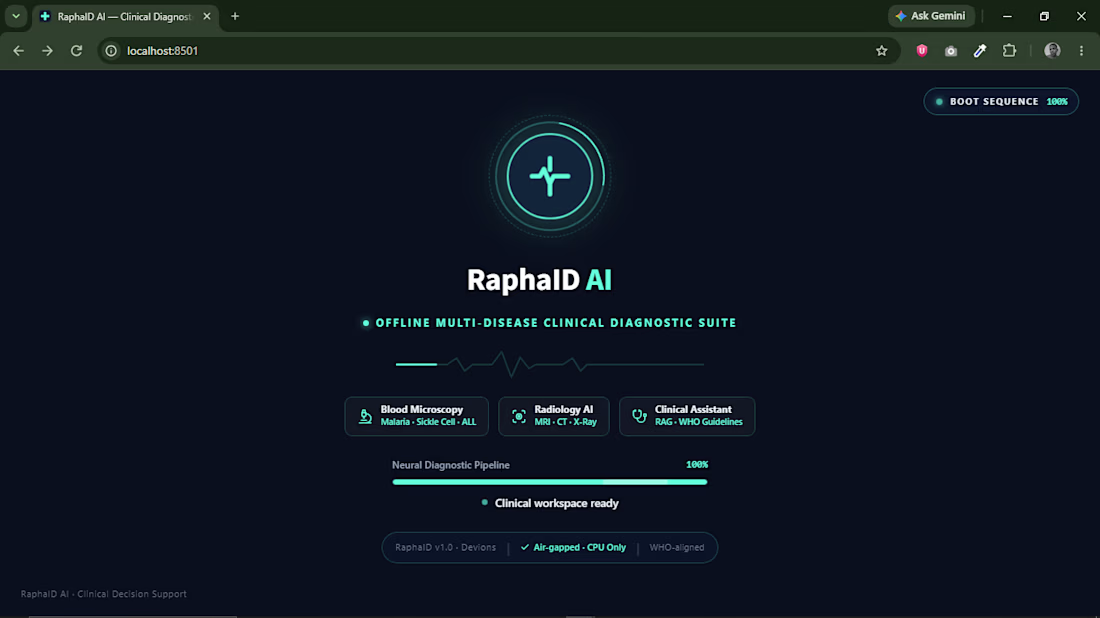
Building AI for healthcare leaves zero room for error.
I’m currently collaborating with an incredible team on Raphald AI, a medical detection application. Building the systems for a project with stakes this high is a massive reminder that the underlying backend architecture matters just as much as the machine learning model itself.
When integrating diagnostic AI, your API endpoints cannot drop requests, and your database workflows demand absolute integrity. You aren't just passing JSON payloads; you are handling critical, real-time workflows where stability is non-negotiable.
Engineering these systems continues to shape my approach to building robust Python backends. If you are developing a product that requires reliable AI integration or rock-solid FastAPI infrastructure, check out the newly updated services on my profile. Let's build something that works when it counts.



A tutoring site where owner can add as many tutors and tutors can personalize their dashboard adding Timings , pricing and Subjects they can teach along with details of skills and experiences. The clients can visit the site and Book with any teacher by selecting the plan and reaching them out in a Site that will also support payments with time.


📦 One thing that makes React Native apps easier to scale: build features as modules, not as one giant app.
For example, instead of spreading payment logic across 8 screens, keep it grouped:
• UI
• state
• API calls
• validation
• analytics
• errors
• tests
The same goes for:
• auth
• onboarding
• profile
• chat
• subscriptions
• notifications
This makes it much easier to:
✅ change one feature without breaking another
✅ onboard new developers
✅ test functionality in isolation
✅ replace APIs later
✅ remove features cleanly
✅ scale the codebase without chaos
You don’t need enterprise architecture for a small app.
But you do need boundaries.
Good structure gives you speed later, not just cleanliness today. 🚀