The network for creativity
Join 1.25M professional creatives like you
Connect with clients, get discovered, and run your business 100% commission-free
Creatives on Contra have earned over $150M and we are just getting started
Back to feedPost

The Blind Spot in AI Localization: Why
RAG Isn’t the Ultimate Solution
There is a widespread misconception among
mainstream AI developers: the belief that connecting Retrieval-Augmented Generation (RAG) to client glossaries and translation memories (TM) completely solves the localization quality problem.
While RAG excels at retrieving pre-existing, static context, it leaves a massive operational blind spot.
In the global technology landscape, true mastery of this issue is restricted to a very small circle—primarily chief architects at leading CAT platform vendors (e.g., Phrase, RWS, memoQ, XTM) and Globalization Product Managers at major enterprise tech firms who have witnessed UI/UX degradation firsthand.
Why do general AI developers miss this nuance?
1. Static Database Alignment vs. In-Document Dynamic Logic
RAG ensures fidelity to past databases. However, when localizing unreleased software specs, novel UI frameworks, or new product lines, dynamic naming conventions and context-bound terminology emerge organically. RAG architecture is simply not designed to establish and govern new, internal consistency across a 100-page document in real time.
2. The Absence of Real-Time Control UI
In traditional CAT environments, linguists have a "cockpit"—an interactive interface allowing instant term propagation, segment comparison, and immediate rule enforcement. AI developers, focused on raw LLM intelligence and autonomous generation, have largely ignored the need for human-in-the-loop steering controls, leading to high latency and unmanageable terminology drift.
3. The Illusion of Full Autonomy
Many AI engineers treat translation as a simple string-swapping exercise, aiming for full automation. In reality,
enterprise localization is a high-context engineering task where a single inconsistent UI label damages the entire user experience.
The Path Forward
Understanding this technical landscape is what separates basic machine translation from Enterprise AI Quality
Assurance (CQA).
Until AI platforms evolve beyond simple RAG integrations to offer real-time, interactive governance UI, the professional
linguist’s ability to orchestrate dynamic, in-document logic remains an indispensable asset for global software quality.
#Localization #AITranslation #RAG #L10n
#SoftwareLocalization #AIArchitecture #LocalizationStrategy #UXLocalization
#TranslationQuality
The network for creativity
Join 1.25M professional creatives like you
Connect with clients, get discovered, and run your business 100% commission-free
Creatives on Contra have earned over $150M and we are just getting started

Challenges
View all


Related posts

Giving the code editor a much-needed AI upgrade. 🔥

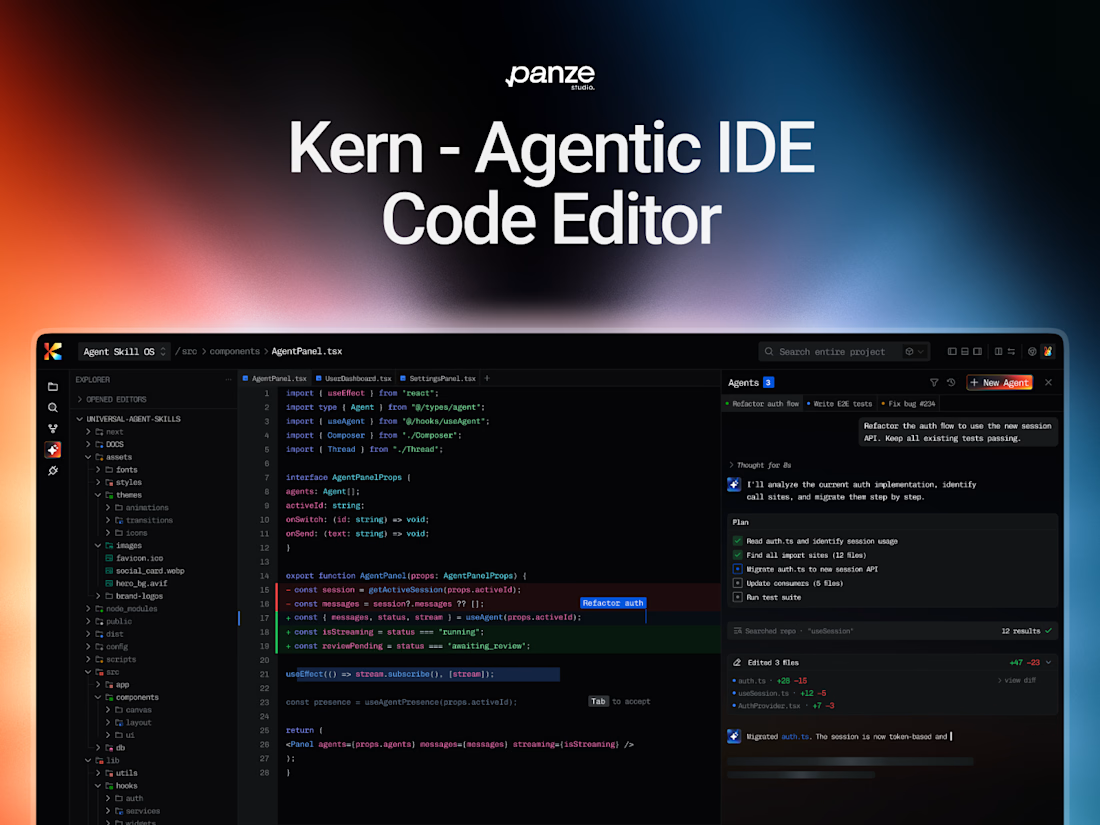

This is such an amazing design! Wow!

What does luxury look like?
A cinematic AI product of a modern apartment designed to make you stop, look, and imagine yourself there. ✨
Would you live here?


AI Lead Qualification & Appointment Automation System
AI Lead Conversion Platform — Telegram, CRM & Automated Scheduling
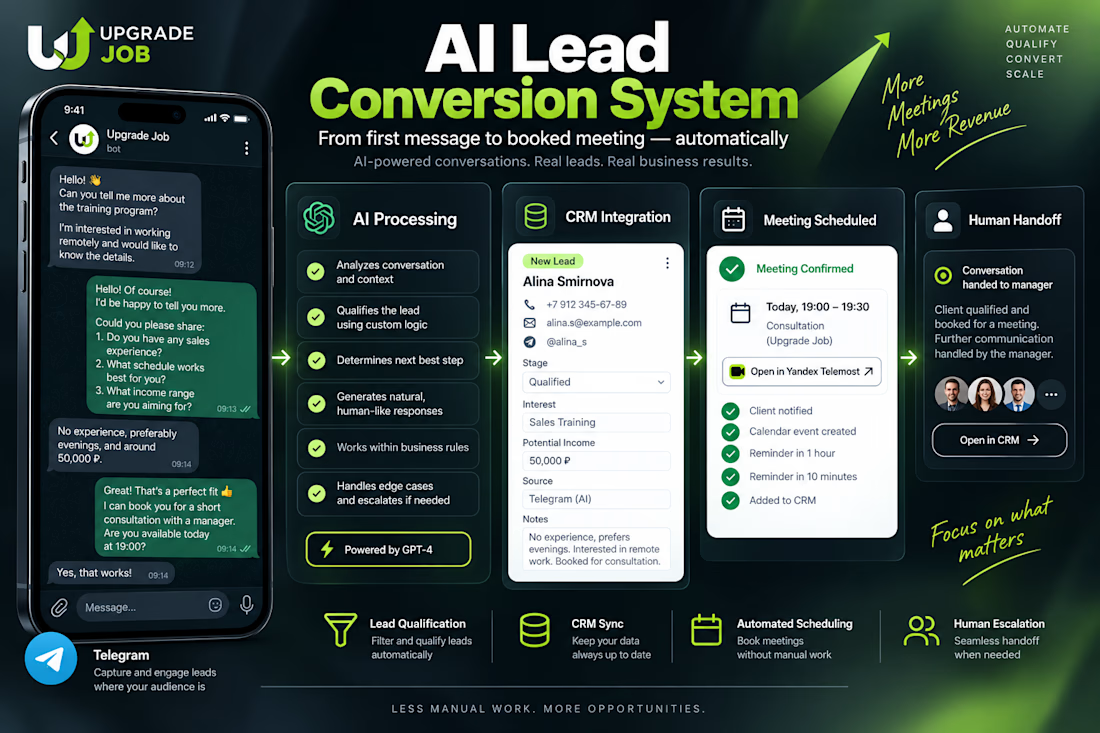
Designed and developed an AI-powered lead conversion system that handles incoming Telegram conversations from first contact to qualification, CRM synchronization, and appointment booking.
The AI works with conversation history, lead profile data, unanswered questions, current funnel stage, available actions, and verified CRM data to determine the next appropriate step and generate structured responses.
The system automatically creates and updates leads in the CRM, manages qualification stages, books meetings, generates Yandex Telemost links, sends reminders, handles rescheduling, and escalates exceptional cases to a human manager.
The architecture includes dialogue state management, message deduplication and batching, PostgreSQL persistence, concurrency protection, validation before actions are executed, and safeguards against sending unverified or prohibited information.
This is not just an AI chatbot — it is an automated sales workflow that connects Telegram, AI, CRM, scheduling, and human escalation into one controlled process.
AI makes decisions within controlled business rules instead of operating as an unrestricted chatbot.



The concurrency safeguards and validation-before-actions detail is a strong distinction here—booking systems usually fail at the edges, not in the happy path. I’d expose a compact lead state to the operator (stage, next action, last unanswered question) so a human can resume...