The network for creativity
Join 1.25M professional creatives like you
Connect with clients, get discovered, and run your business 100% commission-free
Creatives on Contra have earned over $150M and we are just getting started
Back to feedPost

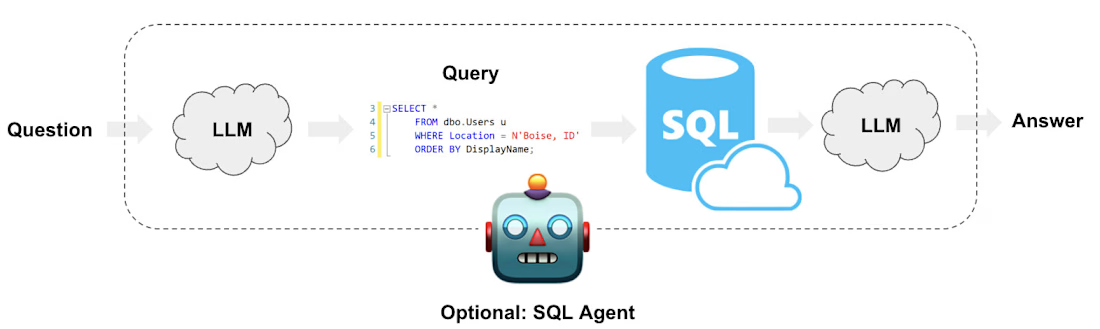
Interact with databases using natural language with this NL2SQL system built using LangChain. Users can ask questions in plain English, and it generates and executes SQL queries, returning clear answers.


The network for creativity
Join 1.25M professional creatives like you
Connect with clients, get discovered, and run your business 100% commission-free
Creatives on Contra have earned over $150M and we are just getting started





Related posts

Then: 1 month, 1 template.
Now: 1 week, 15 templates.
Same designer, different workflow.
I wrote up how I built no-code.supply: fifteen website templates, each with its own brand, in HTML and React, and some in Framer too. Claude Code did most of the typing. I did the directing.

no-code.supply
How I built 15 website templates with an AI coding agent in a week
How I built 15 AI-ready website templates with Claude Code in a week: the workflow, the quality bar, and why a template is only the starting point.

Going from one template a month to fifteen a week is wild. How much of the design direction did you still do by hand?


An AI-built app can work perfectly while any stranger can read its customers' data. Nothing on screen shows it.
Ask whoever built it: which tables hold user data, and what stops a logged-out stranger from reading each one? A good answer is a list. "It should be fine" means nobody has checked.

Andrés, this is the check most founders never run, because nothing breaks until someone looks. Asking for the list of tables and who can read each one is a test any owner can do without writing code. Row level access belongs on the launch checklist, not the cleanup list.

I just finished building my own open-source farm bot called Farmbt 🌱
It's a team of 13 AI agents. I asked them one question, and they came back with a ranked list of opportunities nobody has fully cracked yet.
You describe a problem area in plain words, and the agents take it from there:
🔎 Researchers search the web in parallel and pull out findings, each with its source
✅ A verifier re-opens the pages and checks every claim against the real text
🗳️ A gap hunter runs three independent passes, and only gaps that show up repeatedly survive
🥊 A critic tries to prove each gap is already solved
🛠️ Solver agents design fixes, check them against existing products and papers, and write an experiment plan
The hard part wasn't getting AI to produce answers. It was making it not make things up. So every claim is graded by evidence, confidence ratings are capped by what the source actually supports, and everything is saved, so a run that hits a rate limit picks up where it stopped.
It runs on free-tier models today and gets better with every model upgrade, with no code changes.
First test: crop-disease detection apps for smallholder farmers. 39 sources, 16 findings and 5 opportunities, ending in a concrete first experiment to run.
Open source: github.com/Samthnalyst1234/Farmbt
If you need an AI pipeline that's reliable enough to trust, for research, automation or anything in between, let's talk 👋


The step where a verifier re opens every page is a solid guard against hallucinations, and persisting state lets the run survive rate limits without missing a beat