The network for creativity
Join 1.25M professional creatives like you
Connect with clients, get discovered, and run your business 100% commission-free
Creatives on Contra have earned over $150M and we are just getting started
Back to feedPost

The study of signs and symbols and their use or interpretation is not only essential for developing brands but also important to craft authentic storytelling.
Semiotics is one of the most complex and misunderstood subjects in communication degrees. But its value for understanding how to properly convey a message is as much important and subjective as its own meaning.
Every [ꜰᴏʀᴍ/ꜱʜᴀᴘᴇ] has a [ᴄᴏɴᴛᴇɴᴛ/ᴍᴇᴀɴɪɴɢ] attached to it. In the same way, every symbol represents a set of interpretations known as [ꜱɪɢɴs]
To think "semiotically" is to understand how to separate the form from its content so that both can be used separately and through new combinations.
Example
If we observe a flower in its prime of health and colors, we can notice that the petals are vibrant, the texture is smooth and the stalk is firm. But as a physical form, it is subject to the decay of time, this means that while healthy, it can represent different [ꜱɪɢɴs], like nature; youth, and beauty, but once the decomposition stage starts and it loses these properties and these [ꜱɪɢɴs] are replaced by different and negative ones like dryness; decay and desaturation.
If we subtract the form from this context, we can identify new possibilities of meanings, because we can still observe the flower without being limited by its physical form.
So if we are to observe a flower until a bee lands on it and pollinates its stigma, we are able to capture a whole new set of meanings behind this behavior from nature, because, behind this regenerative, recurring, and holistic cycle, we can capture much stronger and universal [ꜱɪɢɴs] that are not limited to the shape of a flower, like life; cooperation and growth.


The network for creativity
Join 1.25M professional creatives like you
Connect with clients, get discovered, and run your business 100% commission-free
Creatives on Contra have earned over $150M and we are just getting started
Related posts

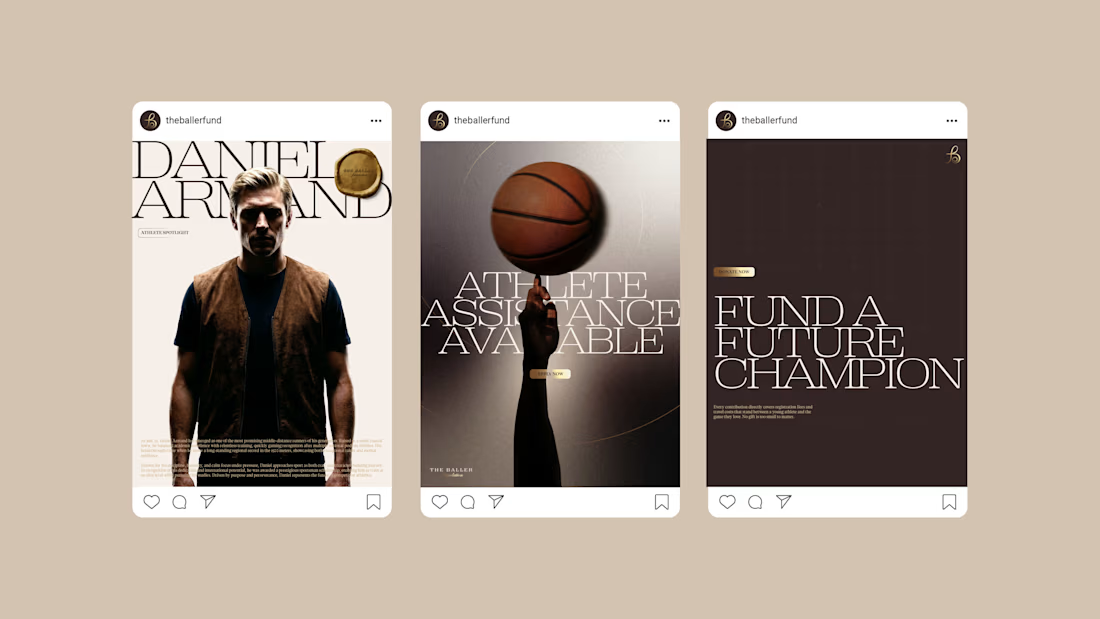
The Baller Fund | Brand Identity
The Baller Foundation is in the youth sports philanthropy sector. They provide scholarships, grants, and training resources to young athletes who demonstrate talent, drive, and commitment, but lack the financial means to participate in competitive club sports programs.
I helped them develop an inspiring & empowered identity which reflects their brand personality and values. As an outcome, I'm creating their path to establishing trust, building confidence be percieved prestigous.






Really sick identity. Crushed that, man!


Awesome! Congrats!

Just found out that I'm in the top 1% of creatives on Contra! 🎉
Thank you all for being so supportive of my work and my freelancer journey!
















Trending


Notion
Notion isn’t just where you work, it’s starting to work for you. What agents are you building?
portfolioreview
The best portfolios tell a story, not just show a grid. Share yours for feedback.
brandguidelines
Brand guidelines are becoming living systems, not static documents. What are you building for your clients?
aivideo
AI video tools are moving at warp speed. Which ones are you experimenting with?
freelancerlife
Freelancer life is wins, pivots, and everything in between. What’s yours right now?