The network for creativity
Join 1.25M professional creatives like you
Connect with clients, get discovered, and run your business 100% commission-free
Creatives on Contra have earned over $150M and we are just getting started
Back to feedPost

This project is an agentic lesson-generation system that creates a beginner lesson, evaluates it against hard pass/fail quality checkpoints, and regenerates it when the lesson fails. The workflow terminates when the lesson passes or the retry budget is exhausted.
The lesson is designed for a 12th-grade graduate from India with limited English vocabulary, a non-English-medium background, and no prior AI knowledge.
😊


regenerate until it passes with a retry cap is such a smart loop ngl
The network for creativity
Join 1.25M professional creatives like you
Connect with clients, get discovered, and run your business 100% commission-free
Creatives on Contra have earned over $150M and we are just getting started





Related posts

Framer skills are fun and useful.
Check out how I create a new page + CMS for this website.
You'll get 5 skills with the template from @Framer Marketplace https://www.framer.com/marketplace/templates/oda/


Bundling the skills with the template is a smart move, feels like you're selling the workflow and not just the layout. Does the agent keep the page consistent with the existing CMS styles on its own, or do you still end up nudging spacing by hand?


I've built a new mobile AI assistant that brings chat, text and image generation, voice input and document analysis into one app.
It have Smart Chat, Text Creator, Image Create, Voice Input, plus PDF Scanner, Photo Analyze, Social Content and Prompt Ideas, filtered by category.
Almost everything AI can do, just in one place.


Such an amazing tool! Keep going!

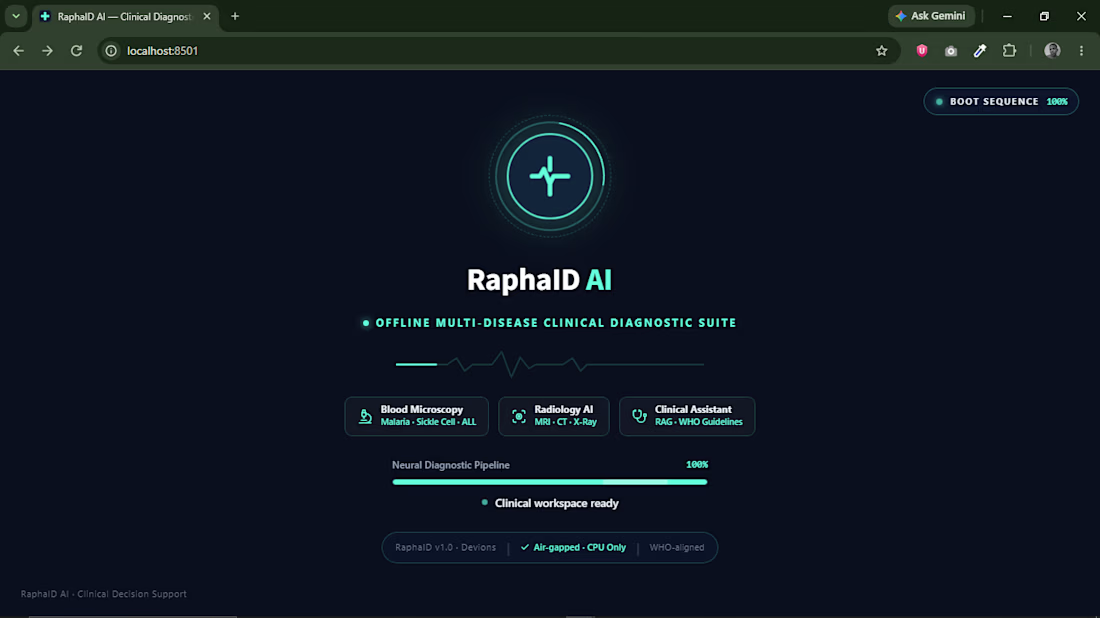
Building AI for healthcare leaves zero room for error.
I’m currently collaborating with an incredible team on Raphald AI, a medical detection application. Building the systems for a project with stakes this high is a massive reminder that the underlying backend architecture matters just as much as the machine learning model itself.
When integrating diagnostic AI, your API endpoints cannot drop requests, and your database workflows demand absolute integrity. You aren't just passing JSON payloads; you are handling critical, real-time workflows where stability is non-negotiable.
Engineering these systems continues to shape my approach to building robust Python backends. If you are developing a product that requires reliable AI integration or rock-solid FastAPI infrastructure, check out the newly updated services on my profile. Let's build something that works when it counts.