The network for creativity
Join 1.25M professional creatives like you
Connect with clients, get discovered, and run your business 100% commission-free
Creatives on Contra have earned over $150M and we are just getting started
Back to feedPost

The walls of a home do not move. The person does. A hall that was wide enough at sixty stops being wide enough the year a walker appears; a bathroom that worked for decades fails the day a wheelchair has to turn in it. Clearance shows where a home and its person will stop fitting each other, with measurements, before it happens.
For most people this question does not arrive as their own. It arrives through a parent: a fall, a hospital discharge, a family that has days to answer "can she come back to this flat?" with nothing on the table but opinions. For others it comes quietly in their fifties, while choosing the home they intend to grow old in, when there is no way to ask the showroom whether the bathroom will still work in twenty years. Either way, the numbers that decide already exist, published in accessibility standards. Nobody reads them next to their own hallway. I wanted the tool that does.
How it works: you pick a home layout, correct four measurements (bathroom door, hall width, bathroom size, entrance threshold), and set a mobility trajectory: cane, then walker, then wheelchair. Clearance draws the space that person needs directly over the floor plan until it collides with the walls. The collision is the finding. Every deficit is a measured figure against a required figure with the clause cited next to it: UK Approved Document M for the verdicts, US ADA figures shown separately, never blended. No scores, no advice tone. A room passes or it fails.
The worked example is Flat 12, Maren House: a 1968 walk-up, 46 m², second floor, six steps at the entrance, no lift. Its resident is 62 and lives alone. Inside the flat, every failure has an intervention. The staircase has none, and from the walker stage on the building decides, not the flat. That is the finding the product exists to surface: a flat can pass while its building fails.
There is also a carer toggle. Care is getting scarcer, and where a carer does come, the home has to give a second working body its own clear floor space. Switch the toggle on and rooms that passed a second ago start failing. No published standard defines a carer's working zone, so that overlay is labeled on screen as modeled, not a code figure. If the data has a hole, the screen says so.
The test ends in a dwelling passport: a verdict-by-decade document with every clause cited, made to be sent to the family. Often the person who sees the problem first is an adult child living in another city, who can persuade but not decide. The passport lets the conversation argue with measurements instead of arguing with them.
How I used Flowstep
Guidelines before generation. I wrote a design system doc for an architect's drawing-set register (paper, ink, hairlines, monospace figures, one alarm red reserved for collisions, plus a ban list of genre defaults: no pastels, no gradients, no smiling stock seniors) and pushed it to Flowstep over MCP before generating anything.
The hero sheet, the floor plan with clearances, was drawn by hand in Figma and imported through the MCP connection. Re-importing the same frame updates the screen in place, so I could iterate in Figma and refresh. The other sheets were generated one at a time in chat, then each render was audited against the approved copy deck and patched by hand through the JSX surface: get-screen, fix, add-screen. Those calls don't consume generation quota, which turned the whole build into a workable loop of generate, audit, patch. The trajectory slider and the carer toggle are staged as navigation between screen variants, wired manually and locked. Ten screens, clickable end to end.
After the prototype I rebuilt Clearance as a live coded version from the same Figma tokens. The deployed app recomputes every verdict from the four inputs, with no backend and no LLM at runtime.
What I liked the most
The JSX import/export surface. Generation gets a screen most of the way there; get-screen and add-screen let me fix the rest precisely and for free instead of rolling the dice again. Also the in-place Figma re-import, and the element-level Navigation panel that lets imported screens join the clickable flow like native ones.
Live version: clearance-app-blue.vercel.app

This is cool!
The network for creativity
Join 1.25M professional creatives like you
Connect with clients, get discovered, and run your business 100% commission-free
Creatives on Contra have earned over $150M and we are just getting started







Related posts

Rebuilding the moment an inbound inquiry turns into a confirmed booking for MEND Appliance Care, a local repair shop in Spalding, Lincolnshire.
The Problem Solved: Replaced 2.5 hours of daily owner phone-tag, vague fault descriptions, wrong van parts, and customer no-shows with an instant AI-powered diagnostic intake, fixed upfront pricing, deposit collection, and auto-generated dispatch scheduling.
Key Features Built in Lovable:
• Multi-Modal Intake: Customers describe the issue using text, photos, model numbers, or video.
• Instant AI Diagnosis & Transparent Pricing: Autodetects fault & exact part (e.g., Bosch Serie 6 drum shock absorbers) with clear labor/part cost breakdowns.
• Flexible Resolution Paths: Home Repair, Workshop Drop-Off, DIY Part Purchase, or local stockist routing (Toolstation/Screwfix).
• Owner Safety Net & Dispatch Dashboard: Real-time job calendar, "Ask Maya" human-in-the-loop review queue, and 1-click customer comms.
Built entirely with @Lovable for the #lovablechallenge.
Shop owner dashboard : Email: maya@mend-demo.co.uk
Password: MendDemo2026

Swapping that phone tag for an automated booking flow must be saving the owner hours and cutting the no show rate

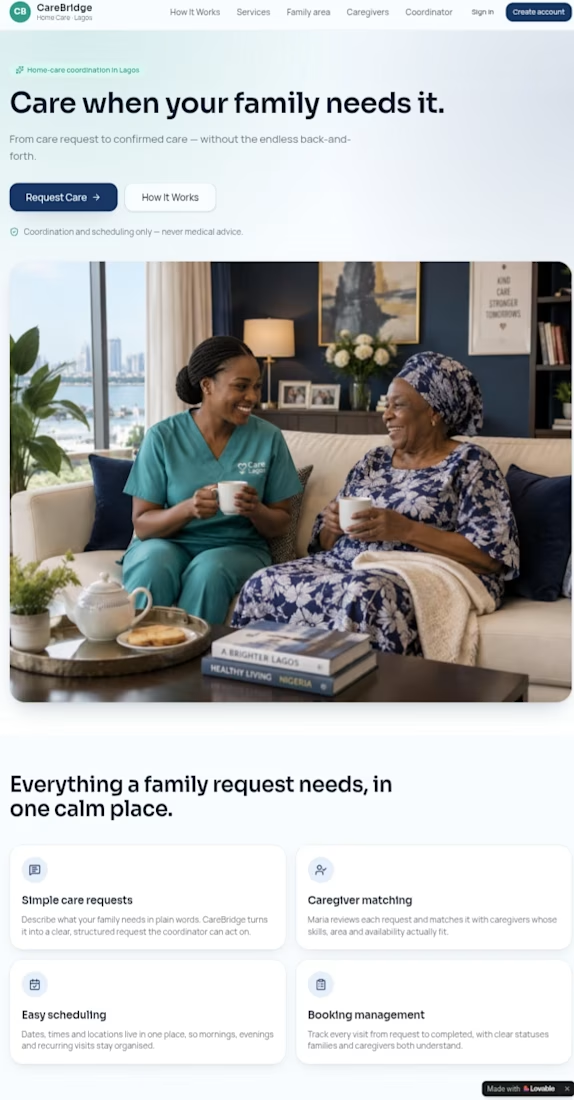
CareBridge Home Care is a care coordination platform designed for a small home-care business in Lagos. It connects families, care coordinators, and caregivers in one workflow.
The core problem is the manual back-and-forth involved in understanding a family's care request, checking caregiver availability, finding a suitable match, and confirming the booking.
CareBridge turns a family's request into structured information, gives the coordinator a clear review and matching workflow, checks configured caregiver services and availability, and keeps the family and caregiver updated through their respective workspaces.
The result is a connected workflow from the initial care request to caregiver matching and confirmed booking, reducing unnecessary coordination effort while keeping the coordinator in control.


This summer my dad wanted a new fence and deck. The quotes took over a week. Looking at it from the carpenter's side, the hard part isn't the calendar, it's driving out to measure before you can even write a quote.
So I built Karlsson Staket & Altan, a made-up solo carpenter in Kristianstad, Sweden, where the customer does the measuring by drawing.
For the customer:
Search the address and draw the fence or deck on a satellite map – length and area are measured automatically
Shape it in 3D: height, material, railings, stairs
Instant price with the Swedish ROT tax deduction
Pick a build week with live availability and get a booking reference and a calendar file
For the owner
A 12-week season board with drag-and-drop and capacity per week – full weeks disappear for customers
Material lists calculated from the drawing, merged into one order with stock deducted and rounded to full packs, plus a shopping list
One page per project: quote, booking confirmation, work order and draft invoice
Adjust the customer's 3D model and send it back with a comment to their personal project page
How I built it
I planned first: chat mode in Lovable, a starter prompt written with Claude Opus 5.5, a hand-drawn design sketch, and a plan I approved before any code. Version 1 stopped at a price, nobody actually got booked, so I kept iterating in small steps. The hardest part was the 3D model. It was bout 10–15 hours in Lovable, using Lovable Cloud and Google Maps, with prices recalculated on the server.
Try the guided tour: https://karlsson.lovable.app/demo (demo mode, nothing is saved)
Note: the project photos are AI-genera::ted, and the before/after numbers on the site are estimates, not measured data.

love the 3D part - something I rely heavily on in this commercial app/system I built https://fairdinkummechdecks.com.au
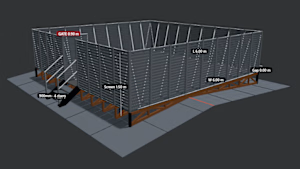
fairdinkummechdecks.com.au
Fair Dinkum Mechdecks — Design to Delivery
Draw standard or custom HVAC platforms, place equipment, check loads and clash zones, price the job and share an interactive 3D client review from one Australian-built estimator.